admin
admin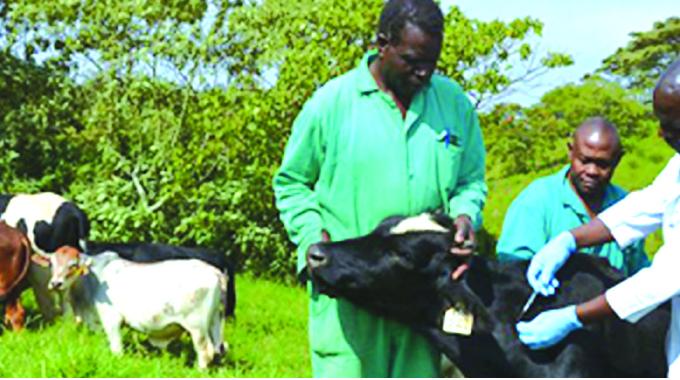
Precious Manomano-Herald Reporter
The Veterinary Services Department has urged farmers to vaccinate their livestock against vector-borne, soil borne and tick borne diseases to prevent major outbreaks during the forthcoming rainy season as efforts to grow the livestock sector continue to gather traction.
Government has implemented several measures aimed at boosting livestock production to satisfy national demand for both human consumption and industrial use.
Under the livestock recovery and growth plan the Government was concerned with the level of performance of the livestock sector and it set out a blueprint to address all areas that were limiting growth.
The main objectives are to improve or address challenges in the key areas of animal health, animal genetics, animal nutrition and other related parameters.
Vector-borne diseases include diseases like lumpy skin disease and three-day stiff-sickness which are prevalent in the rainy season due to abundance of the biting flies or insects.
The soil-borne diseases such as anthrax and blackleg are also prevalent this time of the year.
Acting Deputy Director of Veterinary Field Services Dr Reverend Spargo said vaccination of cattle was the most effective option for controlling the spread of these diseases and it was mainly done before the rainy season.
He said diseases usually affect cattle during the onset of the rainy season where people are starting up their summer cropping.
“The bacterial spores that cause these diseases stay in the soil and when agricultural activities are starting such as tilling the land this exposes the spores,” said Dr Spargo. “Also after the first rain and the grass is shooting, cattle tend to graze too close to the ground and hence more are likely to pick up the spores while grazing.”
Dr Spargo emphasised that this was the time to vaccinate for tick borne diseases but farmers had to continue intensifying dipping.
He encouraged farmers to avoid buying vaccines from unrecognised shops adding that fake vaccines may drive antimicrobial resistance.
Farmers should approach the Veterinary Department for clinical and diagnosing of their livestock.
Recently, the department’s chief director, Dr Josphat Nyika, said vaccination of livestock was crucial since rains could cause disease outbreaks in livestock.
Diseases such as anthrax, lumpy skin and black leg usually manifest during this period.
“Farmers can still vaccinate their cattle to save them from these diseases although the best time is to vaccinate in a warm period. When we dip the cattle the chemicals are quickly washed away by the rains before they can have an effect on the animal,” he said.
Lumpy skin disease is a specified viral disease of cattle transmitted by biting insects and characterised by nodular swellings on the skin and other parts of the body.
Symptoms include fever, discharge from the eyes and nose, skin lesions, edema of the limbs, and swollen lymph nodes.
Lumpy skin disease vaccine is recommended by the livestock authorities to control the disease.
The disease occurs in Zimbabwe and other southern and eastern African countries. The nodules may develop into abscesses which can break to form open wounds.
Widespread cases of the lumpy skin disease have been reported in Matabeleland South and Matabeleland North which has resulted in the death of livestock, especially cattle.
Anthrax is a life-threatening infectious disease caused by bacteria that normally affects animals, especially ruminants such as cattle. But being a bacterium, it is easily treatable with antibiotics if detected in time.
Zimbabwe usually experiences anthrax outbreaks during the rainfall season because rains wash away the top soil and expose spores that can remain dormant in the soil for over 40 years
Signs of anthrax include sudden death of livestock, rapid decomposition of the bloated carcasses and tarry blood coming out of all natural openings. Blood from a contaminated carcass is brownish and does not clot.
Livestock farmer, Mr Chamunorwa Masangwi, of Zvimba said farmers should always dip, dose and vaccinate their livestock even when there was no disease outbreak.
“We should get a vaccination calendar or get education on vaccinations so that we do not continue losing our cattle,” he said.
Ms Margaret Munemo of Banket said farmers believe in keeping large numbers of cattle but cannot afford to buy chemicals for dosing.
“Another challenge is that we are attached to our livestock and we do not want to sell.
“Instead of selling part of the herd to get money to buy feed and vaccines, we maintain the large herd which may later be affected by diseases,” she said.



 Online Reporter