Tendai Gukutikwa
Health Reporter
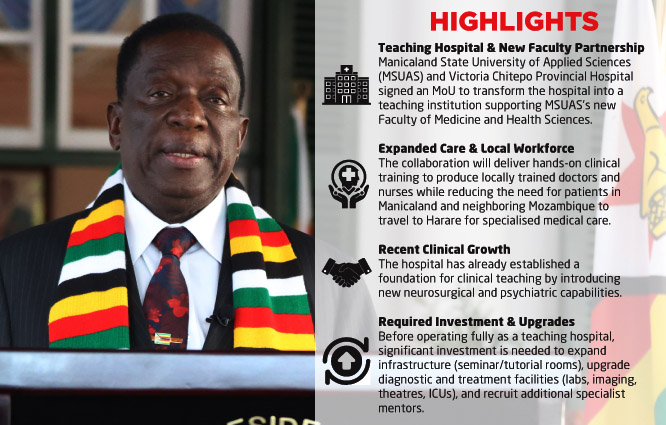
VICTORIA Chitepo Provincial Hospital is on course to becoming a teaching hospital under a landmark partnership with Manicaland State University of Applied Sciences (MSUAS), a development expected to enhance specialist healthcare services and train future health professionals in the province.
The move is set to give Manicaland a dual advantage, creating a practical training ground for aspiring doctors, nurses and other health professionals, while strengthening the capacity of the province’s major referral institution.
This is also in line with President Mnangagwa’s mantra of leaving no one and no place behind in the development agenda.
MSUAS Vice-Chancellor, Professor Albert Chawanda, announced the development last Friday, revealing that the university signed a Memorandum of Understanding (MoU) with Victoria Chitepo Provincial Hospital as part of plans to establish a Faculty of Medicine and Health Sciences.
He described the partnership as a significant milestone in expanding the university’s contribution to Zimbabwe’s healthcare sector.
“The university has entered into a Memorandum of Understanding with Victoria Chitepo Provincial Hospital towards the establishment of a teaching hospital to support our envisioned Faculty of Medicine and Health Sciences.
“This represents an important step in strengthening our contribution to Zimbabwe’s health human capital and service delivery,” said Professor Chawanda.
He said the initiative reflects the institution’s commitment to ensuring that its academic programmes address real national and community needs.
“This shows that we are becoming a university without walls, whose classroom extends into industry, whose laboratory extends into the community, and whose partnerships cross national borders,” he said.
Victoria Chitepo Provincial Hospital medical superintendent, Dr Hilary Makiwa, said although the MoU was signed in February, it provides the framework for the development of the envisaged medical and nursing programmes under the new faculty.
He said the hospital will offer the critical clinical environment needed for students to complement classroom learning with hands-on experience.
“The intention is to bridge the gap between theoretical instruction and practical healthcare delivery.
“Students need to train in an environment where they encounter real patients, real diseases and the actual challenges facing our health system,” said Dr Makiwa.
Under the arrangement, Victoria Chitepo Provincial Hospital will provide clinical training platforms, specialist departments and healthcare services for supervised learning. Its healthcare professionals will also participate in clinical teaching, mentorship and practical skills development.
The partnership is further expected to unlock opportunities for collaborative research and community health projects, enabling students to gain deeper insights into health challenges affecting Manicaland.
However, Dr Makiwa said the hospital will need significant investment before it can fully operate as a teaching institution.
He identified infrastructure, equipment and human resources as the key areas requiring attention.
“Teaching hospital status comes with additional demands. We need adequate teaching spaces, tutorial and seminar rooms, student work areas and appropriate clinical teaching facilities, while ensuring that existing clinical infrastructure can accommodate increased activity brought by students,” he said.
The transformation will also require enhanced diagnostic and treatment capacity, particularly in laboratories, imaging services, operating theatres and intensive care units.
Despite the challenges, Dr Makiwa noted that the hospital has already made considerable progress in expanding specialist services.
“Victoria Chitepo Provincial Hospital has expanded its specialist services considerably, and we have recently added neurosurgical and psychiatric capabilities. That growth in specialist services creates a stronger foundation for clinical teaching,” he said.
He added that the expansion would have to be matched by an increase in specialists and other healthcare professionals capable of mentoring students without compromising patient care.
“Medical specialists, medical officers, nurses and other health professionals are key to the success of a teaching hospital. Clinical teachers need sufficient time and appropriate responsibilities for teaching, while ensuring that patient care remains the priority,” said Dr Makiwa.
The medical superintendent said the benefits of the partnership will extend well beyond the hospital.
As Manicaland’s principal referral institution, Victoria Chitepo Provincial Hospital serves patients from across the province and neighbouring Mozambique.
The establishment of a teaching hospital is expected to strengthen specialist healthcare services, promote research and drive innovation in healthcare delivery.
“For patients, the potential benefits include improved specialist services, stronger diagnostic capacity and better access to advanced treatment within Manicaland.
“This can reduce the need for patients to travel to Harare or other provinces for specialised care,” he said.
The initiative is also expected to create opportunities for continuous professional development among healthcare workers through teaching, research and exposure to emerging technologies.
Dr Makiwa said one of the most significant long-term benefits would be the production of locally trained health professionals who understand the unique healthcare challenges facing the province.
“The greatest long-term benefit is the potential to produce doctors, nurses and other health professionals who are trained locally, understand the health challenges of the province and may be more inclined to remain and serve in the communities where they trained,” he said.
The development comes at a time when Zimbabwe is intensifying efforts to strengthen its healthcare workforce and improve access to specialised medical services, particularly in provinces outside the country’s major urban centres.
Victoria Chitepo to become medical training hub