Chronicle Editor
Sukulwenkosi Dube-Matutu, [email protected]
VILLAGERS in Garanyemba, Gwanda, have been instrumental in the success of Government and partner-led drought mitigation projects. Their active participation, particularly in providing labour, has contributed to the establishment of a livestock drought mitigation centre and village business unit. This centre boasts solar-powered boreholes, a one-hectare nutrition garden, and essential livestock feeding and watering facilities, enhancing the community’s resilience against drought.
At the garden, farmers have planted cabbage, rape, and spinach. Livestock can now drink water at the drought mitigation centre. A villager, who is also the vice-chairperson of the garden project, Freeman Hlazo, said they assumed ownership of the programme as it was mainly aimed at developing their community.
“We had sent a plea several times requesting a solution to ease our water challenges. When we were informed that a project was coming to benefit us with a reliable water source to benefit us and our livestock, we were happy because that is the development we had long been waiting for.
“We organised ourselves as villagers and every day we worked on the site, and even up to today, we are still carrying out works which haven’t been completed. As villagers, we don’t have the resources, but some have building expertise and we can also provide labour. Both women and men were actively involved in this project,” he said.
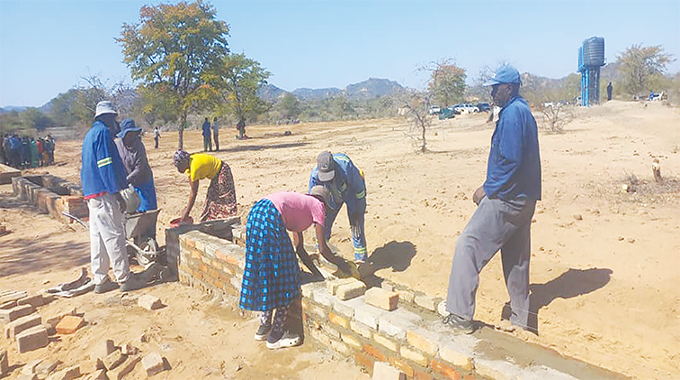
Hlazo said the involvement and cooperation from villagers saw the project being launched on time.
Sibusisiwe Nyathi said their involvement continues as they are working diligently to ensure maximum production at their garden. She said they will also set aside funds to maintain their project.
“This project was implemented by the Government, but as community members, we have a huge role to play to ensure that this it is successful. We will ensure that these resources are put to good use. Our target is to push back poverty and minimise deaths of our livestock in our community,” she said.
Another area which has embraced development initiatives is the community in Mtshabezi Village, Gwanda District, which was recently certified as open defecation-free after the successful implementation of a Water and Sanitation Hygiene (WASH) programme, which has seen community members construct latrines. The villagers have also set up hand-washing points outside their ablution facilities. The programme was implemented by Welt Hunger Hilfe (WHH) under the Enhanced Resilience for Vulnerable Households in Zimbabwe (ERVHIZ).
The project was spearheaded by Sanitation Action Groups (SAGs). Charles Nyoni, chairperson of the Zenzele Sanitation Action Group (SAG), said the first phase of the project targeted 78 homesteads.
He said 30 homesteads did not have ablution facilities, while most did not have hand-washing points.
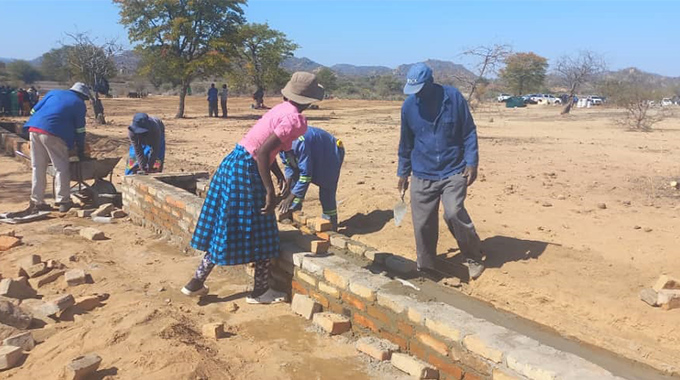
Nyoni said the SAG was instrumental in cascading knowledge on sanitation and hygiene within the community. He said villagers assisted in constructing ablution facilities for the vulnerable.
“This programme sought to improve sanitation and hygiene standards within our community, and one of the targeted outcomes was to see villagers construct ablution facilities and practise hygiene within their homes. We had several homesteads that didn’t have ablution facilities, and one of our tasks as the SAG was to identify them.
“We were trained to educate villagers on sanitation and hygiene. Our target was to ensure that all villagers construct ablution facilities, but we noticed that there were some who couldn’t afford it. WHH assisted the vulnerable with resources to build latrines, while community members provided labour. Through collaborative effort and unity, our sanitation and hygiene standards have improved,” he said.
Mtshabezi senior village head, Sindiso Nyathi, said the project has also seen the community benefiting from improved water supply.
He said the Government was walking the talk of ensuring that no community is left behind in its development agenda, and communities have responded well to the development initiatives.
Nyathi said the involvement of all stakeholders is key in development. – @DubeMatutu


 Online Reporter