Chronicle Editor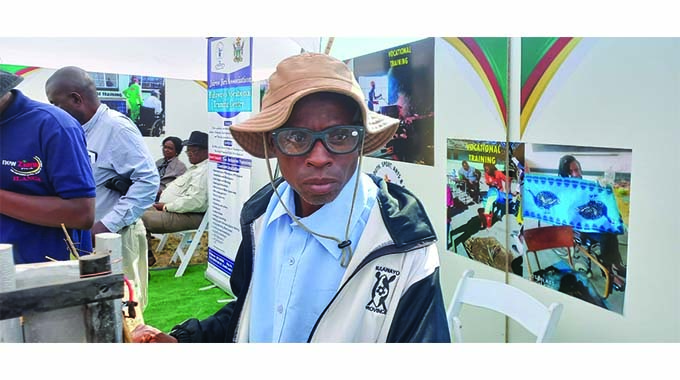
Sukulwenkosi Dube-Matutu – [email protected]
MR Raymond Magudhugudhu, a visually impaired skills trainer in electrical engineering has defied the odds after designing a model circuit electricity substation which has become a key learning tool for students at Sizinda Vocational Training Centre.
Mr Magudhugudhu (48) took advantage of the 11th Edition of the National Disability Expo which was held in Gwanda, Matabeleland South last week to showcase his invention. It shows how electricity is distributed from the point of generation up to the final consumer.
He has 22 years’ experience as an electrical engineering skills trainer.
His model circuit focuses on the distribution of electricity from the main substation level. It shows electricity being transmitted from a main substation through distribution lines up to substations. The electricity is further passed through distribution lines to a local transformer and then it is distributed to various consumers.
Mr Magudhugudhu said at each stage the electricity voltage is stepped down so that it is reduced to the appropriate voltage for industrial and domestic use.
“In this model we are saying that the electricity is generated either from Kariba Hydro Power Station or Hwange Thermal Power Station. Firstly, the electricity should be synchronised to the national grid where it will be stepped up and mixed and from there it will be transmitted into what are known as main substations,” he said.
“Main substations are found in any provinces or towns. If power at a main substation is switched off, then the entire town or province will not have electricity. At the main substation our output voltage is reduced to 33 kilo volts. There are step-down transformers in the main substation which step down electric power from the national grid. The national grid can have a super high grid voltage of 400 kilo volts and it can be stepped down to 33 kilo volts in a main substation.”
Mr Magudhugudhu said the output of a main substation is further transmitted to substations which are several in a single town or city.
He said at the substations there are step-down transformers where electricity is stepped down further to 11 kv. Mr Magudhugudhu said at this output the electricity voltage will still be high for household appliances and gadgets. He said the electricity is further transmitted to a local transformer where electricity voltage is stepped down further to either to a single phase of 220 to 250 volts or a three phase ranging from 380 to 450 volts.
“The single phase is normally used for domestic purposes while the three phase which has a higher magnitude is used for industrial purposes. From the transformer the electric power is distributed to various consumers which include residential areas, industrial areas among others. In this model circuit we also have a tower light which is operated using a daylight switch.
“This switch senses darkness and light. During the night the tower light will be on because it will be dark. The light dependent resistance will decrease at night while it increases during the day which stops electricity from being passed into the tower light flood light,” he said.
Mr Magudhugudhu said the model circuit provides a practical learning process for students to understand the distribution of electricity. He said he was glad to have been given an opportunity to exhibit his invention at the National Disability Expo. Mr Magudhugudhu said he is visually impaired but he uses a creative mind to come up with models. He said he was able to do all the wiring alone.
Mr Magudhugudhu is working with the help of an assistant. He said he became visually impaired in 2019 as a result of sugar diabetes. This setback did not however, deter him from continuing his work as a skills trainer.
“I first noticed that my eyesight had developed a problem in 1995. I went through gradual deterioration of eyesight up until 2019 when I became totally blind due to sugar diabetes. At first it was difficult to accept that I had gone blind and I even thought of giving up on life. I went through counselling which helped me to recover. I was determined to continue empowering students with skills in electrical engineering and that has helped me to keep going and coming up with these inventions to make learning easier. These practical sessions are very critical in helping students to grasp concepts. In vocational training 80 percent of learning should be practical and 20 percent theory,” he said.
Mr Magudhugudhu said he was grateful for the opportunity which he had been giving to continue working despite his disability. He said Government’s stance of promoting inclusion of people with disability has helped to bring meaning to the lives of PWDs and to empower them.
In 1998, Mr Magudhugudhu obtained a National Certificate in Electrical Power Engineering from Masvingo Polytechnic. He later obtained a Diploma in Electrical Power Engineering from Bulawayo Polytechnic. Mr Magudhugudhu also obtained a Further Educators Trainer Certificate from the Bulawayo Polytechnic.
He has worked as a skills trainer at Jairos Jiri Vocational Training Centre and Lobengula Vocational Training Centre. He joined Sizinda Vocation Training Centre in 2010.
The 11th Edition of the National Disability Expo was held from Wednesday to Friday last week at Phelandaba Stadium in Gwanda.
More than 100 participants participated. They included organisations of people with disabilities (PWDs), affiliates and associates of organisations of PWDs, Government ministries and other stakeholders.
The expo’s key focus was to enable those living with disabilities to be aware of existing technologies, equipment, aids, services and products that can allow them to live a fuller life.
This year’s edition of the National Disability Expo was held under the theme “Holistic Empowerment of Youth and Children with Disabilities towards the attainment of Vision 2030. A better and brighter future for everyone.”–@DubeMatutu


 Online Reporter