admin
admin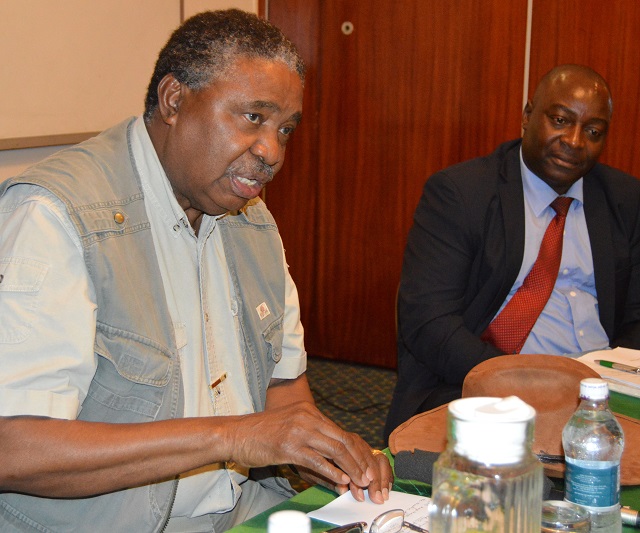

Mashudu Netsianda, Senior Reporter
VICE-President Phelekezela Mphoko has urged milling companies to think outside the box by venturing into contract farming to sustain their operations and help alleviate food shortages in the country.
Speaking during a meeting with members of Grain Millers Association of Zimbabwe (GMAZ) for the southern region in Bulawayo yesterday, VP Mphoko said millers should come up with new strategies to boost their business rather being cry babies.
“We are saying there is need for you (millers) to think outside the box and come up with new strategies to survive in business. We have abundant water resources in this region and it is therefore prudent for you to consider initiating irrigation farming as an alternative to fund your projects.
What is important in any crop is water and the only way to succeed is to find your own new methods,” he said.
Millers in the southern part of the country had asked to meet the VP to air their grievances and challenges in terms of procuring grain from Grain Marketing Board (GMB).
The chairperson of GMAZ (southern region), Mr Thembinkosi Ndlovu expressed concern over price distortions in the market. He accused GMB of competing with private millers and pushing them out of business by selling grain at prices which are not commercially viable.
“Our capacity utilisation is below 30 percent because GMB is pushing us out of business taking advantage of its position as a State enterprise with monopoly over the country’s grain reserves,” said Mr Ndlovu.
GMB buys grain from farmers at $390 per tonne and sells it for $445 to millers. However, maize imported from Mexico lands in the country at $350 per tonne.
With complications emanating from the imports from Zambia, where millers were landing the grain at between $190 and $240 per tonne, the Mexico imports are expected to increase the price of mealie meal on the market.
Meanwhile, speaking on the sidelines of the meeting, VP Mphoko said the Government is seized with the ongoing water crisis in Bulawayo and modalities were being worked out to address the challenge.
He said the Government remains committed to ensuring that water becomes available in the long term in the city.
“The problem of water in Bulawayo is a serious issue which dates back to 1912. The most important thing is that we want water to be availed to the people of Bulawayo and as Government we are working flat out to address the challenge and very soon there will be a solution,” he said.
VP Mphoko said the Minister of Environment, Water and Climate, Cde Oppah Muchinguri-Kashiri is working towards resolving the problem. Cde Muchinguri-Kashiri, last month told The Chronicle that her ministry was also embarking on some stop-gap measures to ensure that the city never runs dry.
The Government allocated $3,7 million in the 2017 budget allocations for the construction of the Gwayi-Shangani Dam, which is one of the city’s long-term water solutions.
Bulawayo’s water woes have seen a 72-hour weekly water shedding schedule being introduced by the city council to avert a potential crisis due to dwindling water levels at the city’s six supply dams.
The water crisis in the city has reached alarming levels with some residents in western suburbs going for a week without receiving a drop of the precious liquid amid fears of a serious health hazard.
For years, the city has been under a strict water rationing regime and residents are penalised if they exceed a fixed daily consumption rate.
Households in high density suburbs are expected to use 450 litres per day while those in low density suburbs are limited to 550 litres per day.
In July 2011, the city introduced stringent fines for people who waste water. Fines for residents found using a hosepipe were hiked to $1 500 from $200.
The previous year, council announced that people caught using domestic water for construction would be fined $1 000 up from $30 and those who use water for brick moulding would also pay $1 000.
— @mashnets


 Online Reporter