Online Reporter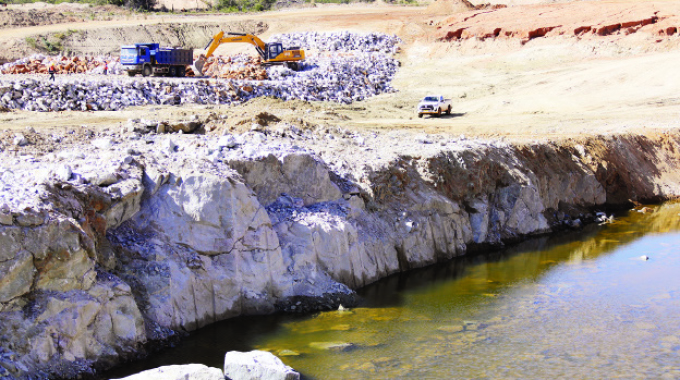
Patrick Chitumba, [email protected]
THE arid lands of Silobela in the Midlands Province are on the brink of a major transformation with the completion of the US$87 million Vungu Dam, expected by the end of 2026.
Once complete, the massive project is set to revolutionise local livelihoods, bringing water security, agricultural growth and new economic opportunities to the community. The dam will supply water to four irrigation schemes, enabling year-round farming and boosting food production.
Clean drinking water will also be made available, improving community health and well-being. A special Presidential fish-farming project is expected to thrive, resulting in fresh income streams for locals.
A water treatment plant will be built on-site while boreholes drilled for the project are already providing villagers with water for domestic use and livestock watering.
Additionally, a 13km electricity grid extension to power construction is also benefitting surrounding communities.
Construction has generated jobs for local villagers, with the Zimbabwe National Water Authority (Zinwa) leading the project.
Two local contractors are on site, one handling irrigation and water treatment works and the other responsible for building the dam wall.
While the project will benefit thousands, some villagers will need to be relocated to make way for construction. Valuations for affected homesteads and properties are underway and once compensation is finalised, relocation to nearby suitable land will begin.
Midlands Provincial Irrigation Engineer, Shingirai Zano, said the project will have long-term benefits for the community.
Speaking at a Midlands Provincial dialogue workshop on development-induced displacements (DIDs) organised by the
Centre for Conflict Management and Transformation (CCMT), he emphasised that few homesteads will be affected.
“The dam will have the capacity to irrigate 1 200 hectares. We have identified three main irrigation schemes — Ntobe Block (788ha), Sikhunyana (367ha) and Nyakwati (345ha). Construction began in 2021 and is progressing well,” said Eng Zano.

“It is a work in progress and construction commenced in 2021. The contract period was for three years at a cost of US$87 million and it is expected to be completed by the end of 2026,” he said.
Eng Zano said while some villagers will lose grazing land and a few miners may have to vacate their claims, the Government is committed to ensuring affected families benefit directly from the dam.
“The development-induced displacement will see some villagers moving from homesteads while others will lose some grazing land. Some miners will also be affected by this development,” he said.
CCMT director, Mr Xavier Mudangwe, stressed the importance of balancing development with the rights and dignity of affected communities.
“The progress of any place should not come at the expense of its people. Development should uplift, not impoverish. We commend the Second Republic for these projects, but we also recommend obtaining prior community consent before commencement,” he said.
Mr Mudangwe added that relocation plans should go beyond just providing alternative land.
“Let’s not just provide alternative land. We need to look at cultural, social networks, and sources of livelihood.
It should be comprehensive and we hope that this workshop provides that platform to share experiences and develop best practices to do with DIDs started in 2017.”
Once complete, Vungu Dam is expected to benefit not just Silobela but also Crossroads Business Centre and downstream communities in Nkayi, Matabeleland North province.