admin
admin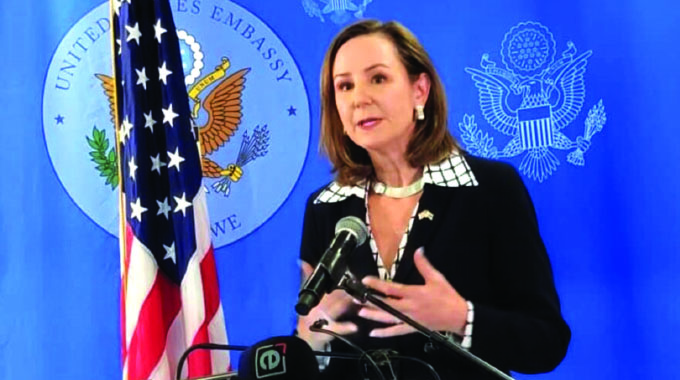
Gibson Nyikadzino
Zimpapers Politics Hub
Have you ever tried to make an online purchase and receive a message that “your country is an inappropriate destination for this company to conduct business with?”
Or have you ever tried to receive money from a bank in the West, and later get a message that “this bank cannot process transactions destined for Zimbabwe?”
Are you aware there are people in the civil society who are receiving their grants after opening bank accounts in neighbouring Botswana, Mozambique, South Africa or Zambia?
That alone, is enough evidence that Zimbabwe is a sanctioned country.
The country is grappling with a heavy economic yoke that the US has placed on the necks of all citizens.
Despite all this, US Ambassador to Zimbabwe Pamela Tremont appears to be a good human being, like everyone else. This writer recently watched an interview she had, where she both dispelled talk of, and denied, the existence of sanctions against Zimbabwe imposed by the US.
The centrality of the argument this week, is contrary to Amb Tremont’s position that Zimbabwe is under sanctions.
This position is being advanced to logically counter disinformation and information through the use facts, about sanctions against Zimbabwe.
There has been a constant media diet of non-stop propaganda that has been fed to Zimbabweans and non-Zimbabweans, and they continue being injected with dosages of falsehoods that the country is not under sanctions.
Likewise, in the interview, AmbTremont noted that “Zimbabwe is not under sanctions. In March, we ended the Zimbabwe specific sanctions programme that targeted only Zimbabwean individuals”.
There are changes that happen with terminology. In the first days, the US denied that Zimbabwe was under sanctions, preferring to use the term “restrictive measures”.
While, politically, Amb Tremont says “Zimbabwe is not under sanctions”, a qualitative analysis of some legislative provisions in the US law arsenal proves otherwise.
The sanctions programme that the US representative made reference to are the executive orders that successive US administrations have used since 2003 to enable economic warfare with Zimbabwe, without repealing the 2001 Zimbabwe Democracy and Economic Recovery Act (ZIDERA).
So, without its repeal, a bipartisan act whose Bill’s proponents were current US President Joe Biden and former Secretary of State Hillary Clinton, it is difficult to convince progressives that Zimbabwe is not under sanctions.
People must not be fooled, ZIDERA’s contents are malicious, anti-development and anti-democratic. The act represents the “might is right” attitude where the US directs multilateral institutions to stop lending money to Zimbabwe. This is so because the US has shares and directors with voting power in all multilateral institutions, who either block or reject any form of financial aid to Zimbabwe.
Section 4(c)(1) and (2) of the ACt states that “the Secretary of the Treasury shall instruct the United States executive director to each international financial institution to oppose and vote against any extension by the respective institution of any loan, credit, or guarantee to the Government of Zimbabwe; or any cancellation or reduction of indebtedness owed by the Government of Zimbabwe to the United States or any international financial institution”.
Though there are many interpretations to the above ZIDERA clause, what cannot be substituted or discounted is that the US through its access to multilateral financial institutions wants an advantage that resembles Zimbabwe as a pariah state, restrict it from accessing financial packages that propagate her journey towards economic transformation.
What this also entails is that the US is not only keen on barring Zimbabwe from accessing financial capital, but over the years internationalised a bilateral dispute between Zimbabwe and Britain, and made it its own.
Besides ZIDERA, the other format of sanctions that Zimbabwe that have been imposed by the US are expressed through the Africa Growth and Opportunity Act (AGOA) of 2000.
Both ZIDERA and AGOA have economic implications, which is to choke the Zimbabwean economy.
AGOA which was enacted a year before ZIDERA, has some economic disadvantages for Zimbabwe. Looking at its contents, it is not even short of being a sanctions regime.
Of Africa’s Sub-Saharan countries, AGOA makes Zimbabwe and Sudan the only ineligible countries to have access to American markets.
Though Amb Tremont in her interview said: “Since March, we have been talking to US banks and financial institutions about why they are not returning to Zimbabwe and what’s keeping them away. Almost none of them never bring up sanctions. They understand that (sanctions) is not what is preventing them from coming to this market.”
What puts her argument off-tangent is that the legislative provisions in ZIDERA and AGOA, while they are not explicit on mentioning their goals as sanctions, they subtly tell that the country is no longer an investment destination for the majority of the Western business community.
Lastly, progressives must be mindful about the other format of economic sanctions that the US imposed on Zimbabwe through the Treasury’s Office of Foreign Assets Control (OFAC).
In 2016 and 2019, two Zimbabwean banks were fined by the OFAC, in what America said was the “facilitation of banned transactions”.
Then Barclays Bank was fined US$2,48 million in 2016, while in 2019 Standard Chartered Bank was fined US$18 million “for violations of sanctions regulations”.
In August of 2022, a local mining firm had a US$10 million payment blocked by OFAC because Zimbabwe is designated a “hostile destination”.
If the triad of ZIDERA, AGOA and OFAC are confirming through their details which, when read qualitatively, that Zimbabwe is targeted as a country for sanctions, it is imprudent to buy the misinforming narrative that the country is not under sanctions.
These sanctions are an economic warfare; hence all wars end on the negotiating table.
It is illogical for people to dither and ponder on whether or not Zimbabwe is under sanctions when they have not read the acts mentioned.
ZIDERA exists to punish Zimbabwe.
If the sanctions are targeted on “certain individuals”, why would the US direct is executives at multilateral financial institutions to deny Zimbabwe access to finance and debt relief?
If these laws are repealed, when Zimbabwe banks are not punished for facilitating certain transactions and when individuals are able to buy some of their wares online without getting notifications that “your country is an inappropriate destination” that will be a first step to understand that Zimbabwe is not under sanctions.
As it stands, Amb Tremont, it is undisputed that Zimbabwe is struggling under the heavy yoke of illegal sanctions!



 Online Reporter