admin
admin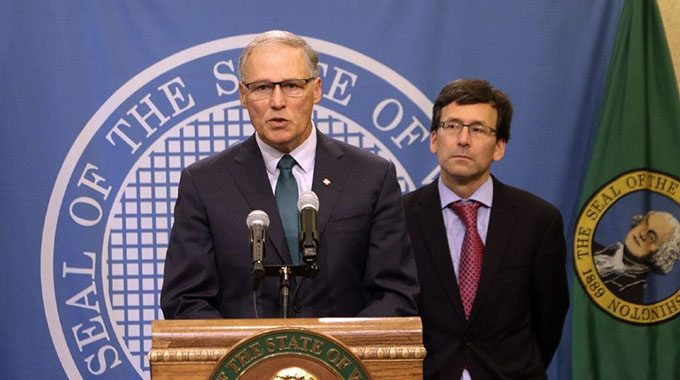
OLYMPIA. – Washington’s Supreme Court unanimously struck down the state’s death penalty on Thursday as arbitrary and racially biased, making it the 20th state to do away with capital punishment.
Execution was already extremely rare in Washington, with five prisoners put to death in recent decades and a governor-imposed moratorium blocking its use since 2014.
But the court’s opinion eliminated it entirely, converted the sentences for the state’s eight death row inmates to life in prison without release, and furthered a trend away from capital punishment in the US.
“The death penalty is becoming increasingly geographically isolated,” said Robert Dunham, executive director of the Washington, DC-based Death Penalty Information Center. “It’s still on the books in 30 states, but it’s not being used in 30 states. It’s becoming a creature of the Deep South and the Southwest.”
Texas continues to execute more prisoners than any other state – 108 since 2010. Florida has executed 28, Georgia 26 and Oklahoma 21 in that timeframe. But nationally, death sentences are down 85% since the 1990s, Dunham said.
In the past 15 years, seven states – Connecticut, Delaware, Illinois, Maryland, New Jersey, New Mexico and New York – have abandoned capital punishment through court order or legislative act, and three – Colorado, Oregon and Pennsylvania – have adopted moratoriums.
In New Hampshire and Nebraska, lawmakers banned the death penalty but saw those decisions overturned by veto or referendum.
The concerns cited in those states have ranged from procedural matters, such as the information provided to sentencing jurors in New York, to worries about executing an innocent person or racial and other disparities in who is sentenced to death, as was the case in Washington.
“The death penalty is unequally applied – sometimes by where the crime took place, or the county of residence, or the available budgetary resources at any given point in time, or the race of the defendant,” Chief Justice Mary Fairhurst wrote in the lead opinion.
She added: “Our capital punishment law lacks ‘fundamental fairness’.”
Defence lawyers had long challenged the death penalty on those grounds, noting the state’s worst mass murderers and serial killers, Green River killer Gary Ridgway among them, had received life terms, not death. In a 5-4 ruling in 2006, the justices rejected an argument from a death row inmate that he shouldn’t be executed because Ridgway hadn’t been executed.
This time, death penalty critics were armed with more data about how capital punishment works, including a statistical analysis by University of Washington sociologists.
Their report showed that although prosecutors were not more likely to seek the execution of black defendants, juries were about four times more likely to sentence black defendants to death.
“Now the information is plainly before us,” Fairhurst wrote. “To the extent that race distinguishes the cases, it is clearly impermissible and unconstitutional.”
Gov. Jay Inslee, a one-time supporter of capital punishment, imposed the 2014 moratorium.
“Washington state is now among a growing number of states that has eliminated this costly and capricious sentencing program of capital punishment,” Inslee told a news conference. “The certainty of death in prison remains the same. Today’s decision does not let anyone out of prison.”
The ruling came in the case of Allen Eugene Gregory, a black man who was convicted of raping, robbing and killing Geneine Harshfield, a 43-year-old woman, in 1996.
“However one feels about the propriety of capital punishment in theory, in practice the death penalty is imposed in an unfair, arbitrary, and racially biased manner,” one of his attorneys, Lila Silverstein, said in a written statement. – AP


 Online Reporter