Chronicle Editor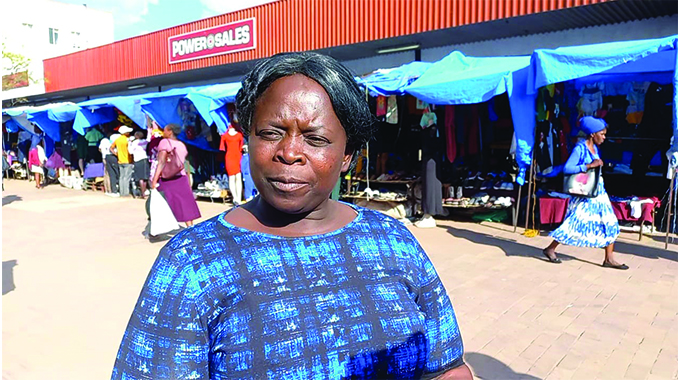
Nqobile Tshili – [email protected]
MANY times reality strikes in a negative way for some women, especially when they lose their husbands as they would have not just lost a companion but a partner who also helps put food on the table.
This was the situation faced by Ms Portia Jamu (46) from Cowdray Park who had to resort to street vending in 1996 following the death of her husband, who left him with two minor children.
Ms Jamu who was in her early 20s then says instead of continuously mourning, she resorted to street vending, which on many occasions would land her in trouble with law enforcement agents.
Hers is not a story of despair but that of fortitude, resilience and the advantage of being a registered member of the informal sector.
She is part of informal traders operating from Lobengula Street and has even rented a shop to expand her business enterprise and believes there is room for growth.
She sells clothing, blankets in the outdoor vending space.
Ms Jamu said while in the streets she observed that she was not the only widow and they decided to form an association focusing on their issues.
“My husband died in 1996 leaving me with two minor children and it was not easy. So, I started street vending just to make ends meet. I was always having running battles with the local authority,” she said.
“We, then, were encouraged to apply for vending stalls as a group of widows as the council has made a special first preference for us.
“So, we managed to get vending stalls and that is where we started operating formally under Bulawayo Upcoming Traders Association (BUTA).”
Ms Jamu said when they became registered all their fears became a thing of the past as they even started getting training on how to improve their businesses.
She said it did not take long, as widows started to grow their business through partaking in stokvels, which saw them even buying housing stands for members.
“As our businesses grew, we increased the money and we even moved towards buying each other housing stands, and paying fees for our children. I have managed to build a house in Cowdray Park. We had more than 40 people who managed to buy the stands but when we were now buying the stands, we were now including women and youths,” she said.
“Formalisation, of the informal sector changed us a lot, Government departments were even advising us to ensure we were registered and got loans. Some women were afraid to engage banks for loans but through capacitation, all these things have changed.”

Ms Jamu said it was important for vendors to formalise as the benefits of doing so outweighs the troubles of running battles with the cops.
BUTA spokesperson Ms Nonhlanhla Hlabangana said women have been the backbone of the informal sector and in turn bread-winners in many families.
“Women in the informal sector look after families, some of them are widows while others are single mothers. In a nutshell, the informal sector has been dominated by women and they have shown a lot of resilience and sometimes innovation,” she said.
“Some of them have even built homes through their involvement in the informal sector. But now I think it’s time for the informal sector to grow and also contribute towards attainment of Vision 2030,” said Ms Hlabangana.
“Those who are micro need to be elevated to small and those who are small need to grow to become medium. We have been involved in the informal sector for a very long time, some of us started in the 90s and there is a need to transform. We can’t stay small forever.”
She said she believes Government is ready to engage informal players at a greater scale following the appointment of Micro Small and Medium Enterprises (MSME) to represent Matabeleland region.
MSME chairperson for Bulawayo, Matabeleland North and Matabeleland South advisory council chairperson Mr Dumisani Ncube said registration of players in the sector is important if members are to benefit from opportunities in Government.
He said most of the informal sector players who have seen their business growing, are those who took a step towards formalising their operations.
“I’m a good example of those who formalised. I formalised and I encouraged them to formalise. I know the advantages. There is a law about allocation of tenders that 25 percent belongs to the SMEs and they should claim it. But without being registered they cannot claim their rightful portion because they are not registered. By registering, it will enable them to fight for those tenders,” said Mr Ncube.
He said it is also difficult to access loans if players in the informal sector are not registered. Mr Ncube said his appointment to the advisory council speaks to efforts that they have been making to gain Government recognition.
He said the informal sector absorbs the majority of the workforce and should professionalise its operations.
“Now that we are advocating that they register, that will mean they will get financial support and get operating spaces and they will be protected as they would be an entity on their own,” said Mr Ncube.
“They have employed more than five million people in the country through the small and medium enterprises. They are contributing up to US$8 million in the gross domestic product. We are the highest employer,” he said. -@nqotshili


 Online Reporter