Chronicle Editor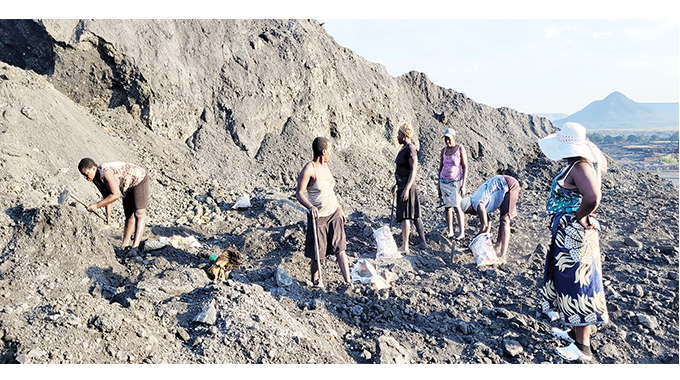
Mashudu Netsianda – [email protected]
JUST before sunset or early in the morning, an ensemble of women carrying hoes and shovels has become a common sight as they make their way to an old Hwange Colliery Company Limited (HCCL) dumpsite to reclaim coke.
Trapped between sinking land and pollution, the women, most of whom are widows and single mothers, said they have no option but to sift through the risky heaps of coal dumps in search of coke, a by-product of coal.
It’s a risky place to operate in, with underground and splitting or sinking land.
Recently, a 16-year-old teenager was killed while searching for coke at an old HCCL mine dumpsite.
The deceased, Shallom Lunga was buried alive when a tunnel he was working in collapsed. In November 2021 another young girl Alisha Sekina Mazwiti (8) succumbed to burns from underground fires, days after doctors had amputated her legs to minimise the effects of the injuries.
She suffered third-degree burns when she was literally swallowed waist-deep by a fire hole at an old dump site in Makwika Village.
Alisha had gone to relieve herself and was in the company of her aunt when the incident occurred around 4pm.
While in the bush, Alisha reportedly climbed a small hill made of rubble from the old mine dump and suddenly she was literally swallowed by the ground to waist level after she stepped on an underground fire spot.
During the same year, HCCL had to procure a drone as part of its efforts to assist in the security of its concessions following growing reports of illegal coke harvesting activities taking place at its old coal mine dumpsites.
However, despite the risks associated with ‘coal harvesting’ the poor local residents have vowed to continue participating in the mining economy to meet their basic needs.
Chronicle news crew recently visited the area known as Madumabisa in Hwange and spoke to some of the women involved in digging for coke.
Ms Elizabeth Mpofu said she has resorted to invading the HCCL dumpsite in search of coke, which she sells to feed her family.
“I have no option but to dig for coke for a few dollars as it is my only source of income to survive. Every day, in the mornings and evenings, I go to the dumpsite to dig for coal, which I then sell for US$2,50 per bag,” she said.
“I am a single mother and have been reclaiming coke for the past three years. This is the only way I raise rent and school fees for my daughter who is in Grade Three.”
Ms Lindiwe Ncube said she started digging for coke when her son was three months old.
“My husband ditched me and went to South Africa. I had to venture into this risky business to feed my son who is now three years old.

“This is a strenuous and risky piece of work, but I have no option since I have to prioritise the welfare of my child,” she said.
Ms Lucia Ncube, a mother of four, said she earns up to US$50 per week by selling the coal by-product she and her children dig.
“I pay school fees and buy food from this coke. I sell a 50kg bag of coke for US$2,50 and per day I make US$5,” she said.
“We are aware of underground fires but we have no option but to take the risk.”
Ms Nambula Mwandamena weighed in: “Coke helps us and we sell it to people who visit our compound. Being a single mother, I pay rent by selling coke, producing an average of 10 bags per month and when I sell the product, I use that money to buy wares for resale.”
Ms Jester Dube, a window said she has been into the business for the past five years.
“I wake up early in the morning, take my hoe, and head to the dumpsite where I spend half of the day there, and this has become my normal routine. I have three children, two of whom are twins, and through digging for coke, I am able to feed them, pay their school fees and rent,” she said.
Ms Dube said coke is in high demand in major cities and towns.
“We have buyers hiring haulage trucks to do door-to-door collections every week. There is good business because customers come to us, which therefore eliminates the issue of transport,” she said.
“Once I fill my baskets or sacks at the pits, I then sell the coke in the compound where I stay. We lead harsh lives that are full of risks, but we have no option.”
Ms Sikhangele Mathe of Madumabisa Village said underground fires are also affecting livestock from neighbouring villages.
“I came here in 2014 and this place has a lot of underground fires and at night we see the flames.
“The problem with these fires is that you can’t see the fire and our children play in these hotspots,” she said.
“Recently, there is a child who was severely burnt while chasing cows from straying into our garden. Although he has fully recovered, he is now nursing permanent scars.”
HCCL the corporate affairs manager, Dr Beauty Mutombe said they are employing a raft of measures to curb unnecessary loss of life from underground fires.
“HCCL is doing a lot to guard against the incidents of people getting burnt at old dumpsites. There are hazard (fire) warning signs in all these areas.
“HCCL recently procured and licensed a drone to assist in the security of the concessions,” she said.
Dr Mutombe said the company is also carrying out campaigns to raise awareness on the dangers of hazards found in certain mined-out areas.
“Unfortunately, all these incidences happen through trespassing. Some would be looking for coal and some for clay.
However, we do not tire, we will continue to do the right thing to save lives,” she said.


 Online Reporter