Chronicle Editor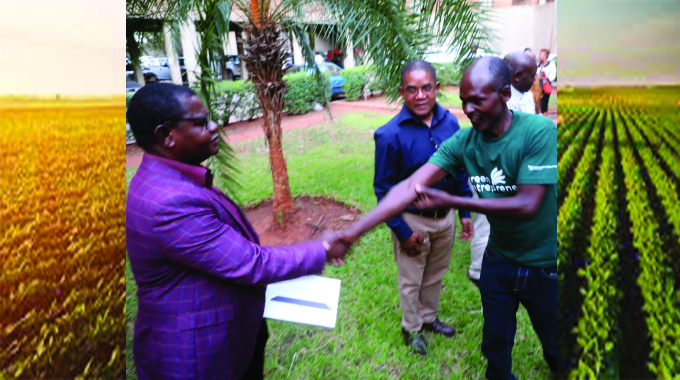
Sukulwenkosi Dube-Matutu and Angela Sibanda, [email protected]/angelasibandat@gmail
THE Ministry of Lands, Agriculture, Fisheries, Water and Rural Development has handed over about 800 Samsung tablets to agricultural extension officers in Matabeleland North and Matabeleland South Provinces as part of a capacity-building programme aimed at enhancing agricultural production and achieving food security.
The capacitation of extension workers is crucial in ensuring the success of the Pfumvudza/Intwasa conservation farming model.
A total of 384 extension officers from Matabeleland North received the tablets during a brief handover ceremony in Bulawayo on Thursday while over 400 officers from Matabeleland South got theirs in Gwanda last week Wednesday.
Permanent Secretary in the Ministry of Lands, Agriculture Fisheries, Water and Rural Development, Professor Obert Jiri, presided over the handover ceremonies at both events where he stressed the need for extension to prepare households within their areas of jurisdiction for the El Nino phenomenon where rains will be erratic and short.
Prof Jiri said the ministry was targeting 6 000 agriculture extension officers including the Veterinary Services Department.
He said come October 31 extension workers should ensure that each farmer in their area has prepared their three plots and come up with strategies to help motivate farmers to prepare.
“As extension officers you are the key persons in driving food security. We started on this journey of capacitating our extension officers so that you are fully equipped as you roll out Government’s agriculture development plan,” said Prof Jiri.
“I’m glad that as extension workers you have adopted the plan that farming has to be taken as a business and you have cascaded it down to farmers and a lot of farmers have adopted this concept.
“A lot of farmers now understand that farming is a business even at the communal level. In the past, we used to have reports of communities that will be suffering from hunger but now when you go to those communities all you hear is Pfumvudza/Intwasa and see open granaries full of maize and traditional grains.”
Prof Jiri said the capacitation of extension workers is anchored on the need to equip personnel that is responsible for transforming the agricultural sector.
He said a similar programme has been extended to veterinary officers, meat graders, and dip tank attendants.
Prof Jiri said it is important that a farmer is capacitated in all areas of production, which covers the mobility of extension workers for enhanced coverage of communities.
“We want the mobility programme to be effective hence we started with the distribution of motorbikes. We are working on ensuring that each and every one of our extension workers has a motorbike in order to be mobile,” he said.
“We want every worker to be out there on the ground driving the Pfumvudza/Intwasa programme as that’s what is topical at the moment,” said Prof Jiri.
“We need the extension workers and even directors in the ministry to be present on the ground so as to monitor and motivate people to prepare their plots and to do it in a proper manner. You can only be effective when you get to the farm. We must see you with the farmers.”
Prof Jiri said each extension officer will now be measured on how many households in their ward would have been lifted out of poverty into food security. He urged extension workers to visit each and every household, assess their progress, and offer them business advice on how to attain food security.
“We are coming up with all these capacitation strategies so that we can help each farmer and household to move into an upper middle-income status. Visit every household and ensure that each farmer has prepared their three plots. Where they need assistance help them,” said Prof Jiri.
He noted that the success of the Pfumvudza/ Intwasa programme was premised on the heavy presence of extension officers educating and assisting the farmers.

“People need to know that this year the country will receive low rains and they must know that they have to adopt the climate-proofed Pfumvudza/Intwasa, which can assist farmers to produce even with low rains,” said Prof Jiri.
“As an extension worker, you must account for each and every household within your area of jurisdiction. Engage village heads and ensure that they have led by example by preparing three plots.
“Some parts of the country received rains and the next few days will be critical as we need to prepare our plots while there is still moisture. Come the first rains we have to ensure that all farmers are ready for planting. This will help to guarantee a good crop,” he said.


 Online Reporter