Chronicle Editor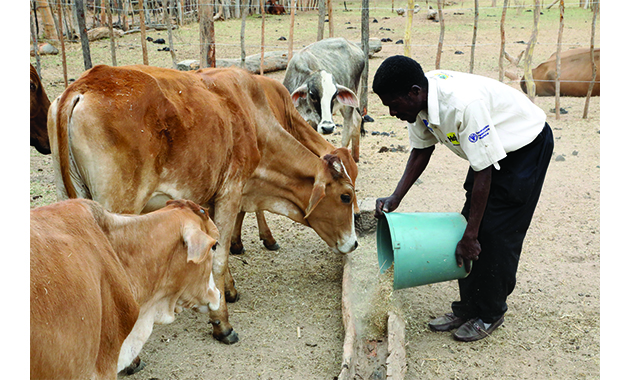
Mkhululi Ncube, [email protected]
TWO eggs and half a teaspoon of cooking oil make a good breakfast for many people but not so for Mr Ntonkozo Ncube of Mzaca village in Nkayi District, Matabeleland North Province.
Popularly known as Magwenjengwenje in Ward 16 under Chief Dakamela, Mr Ncube uses this to nurse calves and has a vision that, if adopted and supported by his community, could prove a powerful model of solving problems faced by rural livestock farmers.
He takes two eggs and cracks them before pouring the contents into a cup and adding the cooking oil before mixing the contents with a teaspoon. A week-old black calf suddenly springs to life when he approaches it with the bottle. He puts the young animal between his legs while his wife Mrs Virginia Ncube holds it at the back. The calf munches on the contents while tapping its tail repeatedly –a sign it is enjoying and once finished it trails Mr Ncube as if telling him it needs some more. His innovative farming methods could help drive rural development by boosting livestock production in particular.
“I nurse calves from the community that would have lost their mothers or whose mothers cannot feed them after they are attacked by ticks,” said Mr Ncube in a recent interview.
“I assist anyone no matter where they come from and that one there (pointing to a calf) is from Ngomambi area in Ward 5. At the moment I have 10 calves that I am nursing and they are at various stages of growth.
“Some calves were brought here in sick condition and I nurse them back to life. The cows, which are unable to feed I take them and in turn give the owners young heifers.
“When they give birth, I nurse the calves since they cannot feed them. To me it’s an advantage having this because it will calve yearly and by the time the heifer, I gave out starts giving birth I would be having more cows in my kraal.”
Mr Ncube said he takes the position of a foster mother for the calves as he bonds with them like mothers bonding with their babies.
“I give it this three times a day because this mixture is like a cow`s milk during the first two weeks (umthubi). After feeding this mixture, I give it milk either bought from shops or milked from other cows,” said Mr Ncube.
“When milking I make sure I use a ‘closed’ container to prevent germs from infecting the milk. I give the calf the egg mixture for two weeks then after that I give it exclusive milk for six months because from there it is able to survive on grass,” he said.
The father of eight pointed to several cattle in the kraal, which were raised through the same method and some have calves now. Once the calf has survived, which most do, Mr Ncube said he charges two goats or US$60 for his services.
Mr Ncube is a neighbour to the Mpofu family, which lost 21 cattle last year following a deadly dose of a grain protectant.
“Those two calves are from the Mpofu family because some of the cattle that died had young calves. So, I took the calves and nursed them and here they are alive and well,” he said.
“If I had not taken them there is no way these would have survived. This is why I am saying I donated two cattle to them because I am not going to charge them for my services as it was my way of assisting them.”
Besides taking care of the calves, Mr Ncube grows various crops for stock feed to supplement grass feeding for his cattle and also assists neighbours.
He also grows various fruit trees with over 300 mango trees dotted in his garden.
“I grow a number of stock feed and use some of the natural feed, which is readily available in the bush. I have bana grass, lablab, sunhemp, cow peas, forage sorghum and leucaena tree for goats,” said Mr Ncube.
“I invested in a grinding mill to process my feed here at my homestead. I also use things like iziqu, ihabahaba, and maize stalks among others, which I crush to prepare my feed.
“My wish is that no cow should die from hunger in my area because we have the feed even when there are no rains we have a number of tree leaves, which we can use as stock feed.”
Mr Ncube`s wish is to build a big feed bank for keeping stock feed to prepare for the predicted low rainfall season.
He, however, said he was dismayed that his community was not complementing his efforts. “I’m thinking of concentrating on fodder crops this season to prepare for drought. My wish is for the community to come together and build a stock feed bank so that we stock our feed,” said Mr Ncube.
“We must plan for drought since we have been warned.”
His major challenge is water supply and one day he is planning on drilling a borehole for sustainable production. Because of water problems, he says he wakes up at 4am daily to collect water from a community borehole to supply his livestock and those he is nursing.
Mrs Ncube said she is able to do all the male duties at the kraal including milking and feeding the calves while taking care of business during her husband`s absence.
Chief Dakamela said Mr Ncube was a community hero whose job surpasses veterinary officers as villagers look for him for help most of the time.
“His work is very commendable as he fights livestock hunger and death. He is now a veterinary extension worker and one can say his work now overshadows the vet officials,” said the traditional leader.


 Online Reporter