Chronicle Editor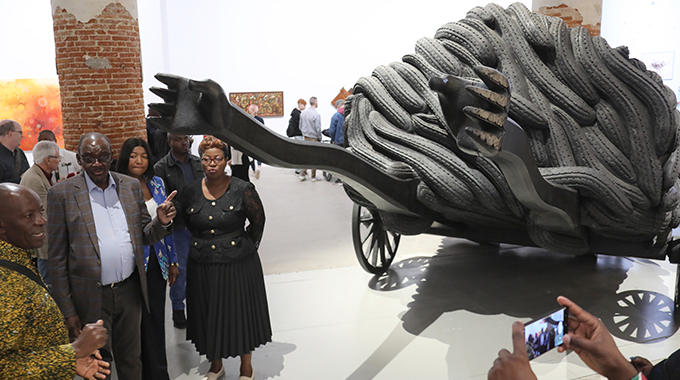
Africa Moyo in VENICE, Italy
Zimbabwe will take advantage of all materials previously taken for granted to develop massive artefacts that will create more jobs in the arts sector and attract foreign currency, Vice President Kembo Mohadi has said.
Speaking after a tour of the work by Zimbabwean Shalom Kufakwatenzi called Mubatanidzwa (adjoined) made from hessian fabric, wool, tobacco twine, leather and upholstery canvas, VP Mohadi said many things are being thrown away daily when they could be used to make artefacts that will position Zimbabwe as a visual arts powerhouse.
Yesterday he visited the Benin Pavilion where he was shown the La Bouche du Roi, an artefact made from discarded gasoline canisters made by Romuald Hazoumè, which is a reworking of the 1789 image of the slave ship Brookes.

In a recent interview, Hazoumè explained his works saying: “I send back to the West that which belongs to them, that is to say, the refuse of consumer society that invades us every day.”
From the Benin Pavilion, VP Mohadi visited the Senegal Pavilion where they are displaying several artefacts, including an old boat that is broken into two pieces and finally the South African Pavilion where they are displaying an artefact made from Mufandichimuka (Resurrection Bush).
In most rural areas such as Mberengwa, Mufandichimuka is used as a broom (mutsvairo).
At least, during Covid-19, Mufandichimuka became one of the concoctions taken by many to beat down the virus.

One of Zimbabwe’s artists, Moffat Takawira, whose works are being showcased, made an artefact out of toothpaste tubes, clothing tags, toothbrushes and computer keys.
Takawira picked most of the things from bins, but today, they are attracting thousands of world art collectors from across the globe, with the potential to sell at a huge price.

Said VP Mohadi: “Since we came here in the last three or four days, we have been seeing new things. We have (also) been to different places.
“This Biennale here in Venice, I did not know that it is such a huge thing where the entire world exhibits its artworks. We in Zimbabwe also, are honoured to have our artists that we did not even know could exhibit internationally.

“But what I have realised is that there are quite several things that we take for granted back home, which can be put into expression through art.

“So, we need when we go home, we will look at those things so that we become a powerhouse when it comes to art, both regionally, continentally and internationally. I am happy I brought the Deputy Minister (Sport, Recreation, Arts and Culture Emily Jesaya) here, so we are going to vigorously pursue this.”

VP Mohadi said the visual arts sector was an industry that had not been quite developed in Zimbabwe, but promised a major shift towards supporting local artists so they grow and shine at home and abroad.

“Usually we just say sculptors and other painters just do it as a hobby, yet it is actually an industry. We need to cultivate that so that our people can exhibit internationally.
“Maybe, one day host we will host the biennale in Zimbabwe where we will invite artists from all over the world. But I think the ministry has got to consider where exactly we can do it (the Biennale) because I don’t think we have got such huge facilities,” he said.

But he proposed that if the facilities were inadequate, then the Zimbabwe Biennale could be held in different cities such as Harare, Bulawayo, Mutare and others, to expose as many people to artworks as possible so as to attract many people into the sector.
At the Venice Biennale, people of all ages, from infant school to university to the elderly from across the world, flock to Venice, with camera in hand, to have an appreciation of the artefacts on display.

Yesterday school children were led by their teachers to the Biennale and as they waited for the gates to open, they sat down, opened their lunch boxes and munched their food.



 Online Reporter