dyton mupawaenda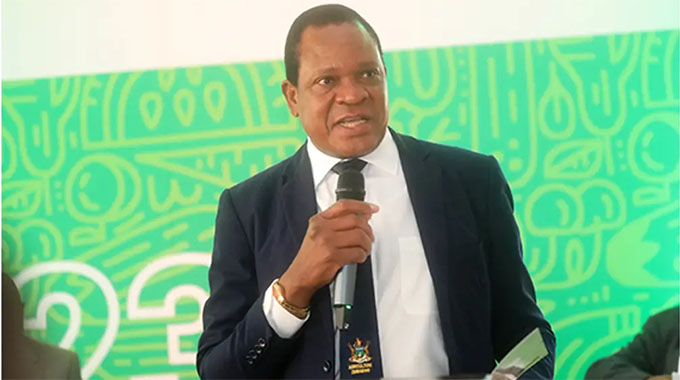
Precious Manomano-Herald Reporter
Raw water charges have been cut by 31 percent to ensure that farmers increase their irrigation hectarage this season and cope with the likely effects of the El Nino phenomenon which was recently predicted by the Meteorological Services Department.
Speaking during a press conference on proposed water pricing model to incentivise cereal production in the coming season, Lands, Agriculture, Fisheries, Water and Rural Development Minister Anxious Masuka said the move will incentivise more farmers to commit more area under irrigation for the 2023/24 summer season.
‘’By intervening, it means we are going to motivate more farmers to commit more area under irrigation for cereals, specifically for maize, so that the country can produce maize by identifying more hectarage which is about 80 000 hectares to date and the identification process is continuing.
“If we are to focus on that and improve on Pfumvudza, whether we have normal or abnormal rains we will be able to produce sufficient to meet our requirements which is 2,2 million tonnes for both human and animal consumption,’’ he said.
The current price for raw water is US$16,41 a megalitre (5 000 drums) comprising the ZINWA tariff of US$14,35 plus US$1 sub catchment levy and US$1,06 water fund levy. The new rates will see the Zinwa tariff cut 25 percent from $14,35 to $10,76 when irrigating maize, with the removal of the $1,06 water levy and the cut in the catchment levy to 50c. This brings the total cost of a megalitre of irrigation water down from $16,41 to $11,36.
There are four farmer categories considered for the purpose of raw water tariffs: communal, A1 farmers, A2 farmers and commercial estates. Farmers in each category, abstracting water from national dams pay the same tariff regardless of their location and dam which they are supplied.
The current charges for raw water tariffs are set to recover costs for the operation and maintenance of raw water infrastructure.
A postpaid arrangement for water payable at the time of grain delivery to GMB in 2024 will be instituted charged in indicative US dollars but payable in Zimbabwe dollars.
Dr Masuka indicated that there is a need to accelerate and consolidate the climate proofing interventions that the Government started in 2020.
Government climate proofs agriculture at two levels, the first one is at household level through the intensive conservation method Pfumvudza/Intwasa and at national level there is dam construction.
Eight varieties of crops given to farmers are determined by the agroecological zone, the region and not what the farmer wants.
He extended the deadline for preparation of Pfumvudza from October 31 to November 15 to allow farmers to take advantage of these showers to be able to expedite the preparation of these plots so that no one is left behind.
Farmers said irrigation schemes are critical for small-holder farmers to improve agricultural production adding that the Government’s move to reduce water tariffs is greatly appreciated.
Mr Taurai Mangisi of Katawa in Raffingora said because of climate change, rainfall patterns were no longer predictable and it was risky to depend on rain-fed agriculture.
“Some of us have been at the land for many years and we cannot be spoon-fed all the time. We ask for loan facilities where we can get irrigation equipment and pay in instalments,” he said.
Zimbabwe Indigenous Women Farmers Trust Mrs Depinah Nkomo said irrigation facilities are critical adding that this will boost production if more farmers have access to them.
“If every farmer can have one hectare under irrigation, we will be able to boost production of earnings from agriculture. We have the land and zeal to farm, but lack of irrigation facilities is affecting us. With irrigation we can grow different types of crops throughout the year and increase profits,” she said.
In a recent interview, the Permanent secretary of the same ministry Professor Obert Jiri said there is a need to move more towards irrigation development as it is vital for ensuring food security.
The programme is part of the Government’s efforts to create an enabling environment for accelerated growth through enhancing irrigation development’s viability and effectiveness to build the country’s resilience to vulnerabilities and shocks that come as a result of climate change.


 Online Reporter