admin
admin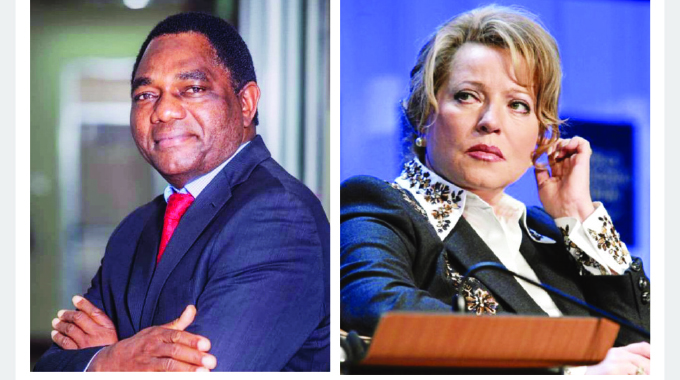
Gibson Nyikadzino-Diplomatic Telescope
The international political system is a theatre of the absurd. We have seen where morals and rationality were supposed to be applied, but were left in the wilderness.
This international system has two main characteristics that nudge states to pursue their interests following the established hierarchy.
Two aspects characterise this system: power and self-interests.
Did you know that Russia is surviving economic strangulation from the US and her European allies through an unjustified combined total of 13 000 set of sanctions?
If people think it is about rationality, how big-power states interact, that is an off-tangent assumption. It is about power!
The actions, inactions and reactions of states in the international political system, which Zimbabwe is part of, has left some countries losing their sovereignty and grovelling in shame.
But for Zimbabwe, the doctrine of sovereignty and independence, both economic and political, is what makes it an attractive country for friends and foes alike because of its form, ideological content and non-interventionist character.
The import of today’s offering is to speak only that which is enough and sufficient regards last week’s visit by the Russian delegation led by Ms Valentina Ivanovna Matviyenko and this week’s dialogue Zimbabwe had with the EU delegation led by Ambassador Timo Olkkonen. Both engagements were equally important, but the former has key geopolitical takeaways to talk about compared to the latter.
Geopolitical Pressure?
Russia’s delegation came at a time of great geopolitical interest in the SADC region.
It comes just seven months after the Commander of the US Africa Command (AFRICOM), General Stephen J Townsend, was in Botswana.
The purpose of Gen Townsend’s visit was to “strengthening the security partnership with bilateral and multilateral training, educational opportunities for military personnel, and humanitarian crisis response preparedness in Southern Africa.”
At the same time, on April 25, the US embassy in neighbouring Zambia announced that it had established an AFRICOM Office of Strategic Co-operation in Lusaka where President Hakainde Hichilema met with American Brigadier General Peter Bailey.
In Zambia, AFRICOM will “enhance military to military relations and expand areas of cooperation in force management”. Zimbabwe is, therefore, sandwiched with a hawkish military that uses force wherever it goes and whose arrival is a siren for disaster if not dealt with carefully.
The essence of the US AFRICOM establishments in SADC is a mascara strategy that Americans want to be in Botswana and Zambia, but to keep an eye on Zimbabwe.
Americans still cannot take lightly the economic defeat they suffered as a result of the land reform.
Americans are so obsessed and interested in Zimbabwe that they regard its evolution as their duty and responsibility to take care of.
More so, they are also trying to deter Russia and China, who have been friends of Zimbabwe since the liberation struggle.
The Americans also want to pressure Zimbabwe by military establishments and postures in neighbouring countries and also encircle the motherland by moving its proxies like the Crisis in Zimbabwe Coalition to South Africa.
The USA wants to transfer geopolitical problems from its traditional locations, Eurasia and the Middle-East, taking them to SADC whose peace it wants to disrupt, and this calls for regional leaders to make haste and bring heads together.
But Russia’s presence in Zimbabwe is strategic for ideological, economic, technological, developmental, scientific and cultural reasons. The same is for the Chinese presence that the USA through AFRICOM and non-governmental organisations (NGOs) want to “checkmate.”
Delinking Western modernity
Some friendships will never be broken, because they are based on mutual trust. Both China and Russia have never vacillated nor been indecisive when dealing with Zimbabwe.
The Zimbabwe-China relations can be traced back to the Ming and Qing dynasty when the Chinese established ties with the Munhumutapa Empire based on trade and cultural exchange over 600 years ago.
With Russia, leaders of the 1917 revolution, Vladimir Lenin and Joseph Stalin reiterated that they would endeavour to expand the Marxist-Leninist ideology through every corner of the globe.
Because Marxism-Leninism and Maoism remain doctrines of political and economic independence, the struggle for Zimbabwe’s independence will never bypass China-Russia contributions.
Increasingly, it appears Russia intends divorcing itself from relations with the West in terms of its economy.
Some might think this is a temporary arrangement, but once it rotates to the global South, these newly established trade deals will become permanent.
Zimbabwe is and should be ready to embrace economic opportunities and gains coming from Russia as defined by its short term, mid-range and long-term objectives.
We are a democracy!
This columnist wants to applaud those presenting the face of Zimbabwe’s dialogue with the EU and even those giving advice behind the scenes.
Remember, the EU is a bloc of 27-member states and Zimbabwe was interacting with this consensus-run bloc that also has an interest in Zimbabwe. The re-engagement and engagement policy remains a cornerstone in mending relations and building trust, especially with the West.
Diplomacy is the prime currency of the international system and it occupies the bulk of activity between states.
Trust is a defining characteristic in foreign policy engagements. Alliances, meetings and diplomatic engagements are done to gain trust of the other partner. It should be clear that the other partner is willing to be trusted by being mutual in respecting another partner’s sovereign rule.
While conversing with other personnel in the Western diplomatic circles, this writer extracted an impression that Western countries think Zimbabwe is not a democratic country.
But Zimbabwe, born out of protracted war against an obdurate racist establishment that received sympathy and support from the West, knows how to shape its democracy. Its values, ethos and ideological orientations are influenced by its association with countries that share the same.
For the past three decades, the world was made to believe that the synonym of the word “democracy” was the “west”.
But overtime, democracy the world over has grown in its own way, according to a country’s history, culture and circumstances.
Since then, it has come in many different forms, shapes and sizes.
In 1992, American political thinker Francis Fukuyama said this at the collapse of the USSR: “What we are witnessing is not just the end of the Cold War, or a passing of a particular phase of post-war history, but the end of history as such. That is the endpoint of humankind’s ideological evolution and the universalisation of Western liberal democracy as the final form of human government.”
But the values that make up the Western liberal democratic template have little room to fit in those of the exploited nations of the South, to which Zimbabwe belongs.
For a long time, the Western liberal democratic system that continues to be foisted upon Africa, specifically, remains disruptive, incoherent to local values and is objectionable in terms of formula and context. At the same time, some aspects may be borrowed.
Struggle for the right
Zimbabwe prefers alliances with like-minded states or at least states that share a common perception of values, threat, respect of sovereignty, non-interference and trade relations as those are common topics in the diplomatic arena. The liberation values inform how Zimbabwe’s foreign policy dealings with all countries are to be handled.
In enhancing the country’s foreign policy, Zimbabwe keenly expresses its willingness to avoid the entrapments of those that supported colonial subjugation, though it has room to engage with them.
European colonialism and Western imperialism have done (and still do) serious damage to a very large number of people, to culture as well as to social and political institutions in those areas of the world in which European colonialism and Western imperialism have taken and are taking action.
History teaches that it is not geographical advantage that helped the West to develop. It is colonialism, population displacement, genocide and looting. With colonialism and industrial revolution, they leaped ahead.
Ours is a struggle for what is just, right and true, without pretence and falsifications. That is what Zimbabwe stands for!


 Online Reporter