malvernmugadzikwa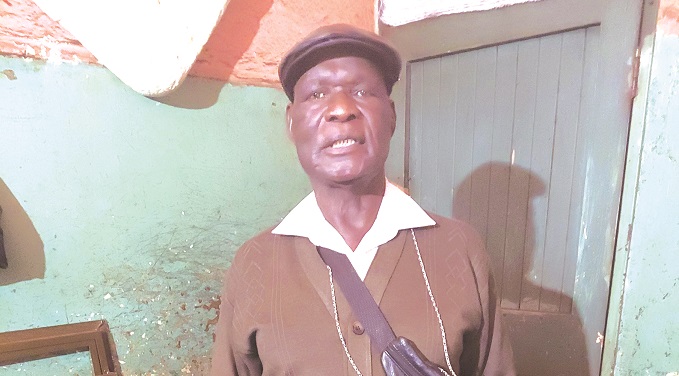
FOR CDE ELIAS CHIRAMBAI, whose nom de guerre was Jikinya Masendeke, the incident that forced him to make up his mind to join the liberation struggle was when he was forced by his employer — an abusive white fisherman — to dive into Gwenoro Dam to retrieve a fish-hook that had become entangled. Cde Chirambai, however, dreaded the place, for he believed it was a sanctuary for mermaids. This week, he narrates to our Features and Arts Editor PRINCE MUSHAWEVATO how the incident, coupled with several other episodes of abuse, drove him to join other boys and girls who were determined to fight to liberate the country from white minority rule.
********
Q: Can you start by identifying yourself?
A: My name is Elias Chirambai. I was born in Masvingo, when it was still Fort Victoria. I come from Murinye Village, under headman Chirambai, who happens to be my father. I was born on March 27, 1957 in a family of 11 — five boys and six girls. I am the only one who managed to join the liberation struggle.
Before joining the war, I used to have a recurrent dream in which I would be fighting Indians. I told my brother about the dream, and he said it meant something to do with betting since I used to bet on horse racing.
However, I was not convinced with his interpretation. I then decided to go to Matonjeni (a shrine) to consult and I was told that some of my ancestors were warriors, and I had the spirit in me. I interpreted this to mean I was supposed to join the struggle.
Q: Is that what inspired you to join the liberation struggle?
A: I was a troubled man during the colonial era. I used to work as a gardener for a white man, who was into fishing. He was abusive. One day, we went fishing at Gwenoro Dam in Gweru, which was close to where we used to stay in Riverside.
While fishing, his hook got snagged underwater. He instructed me to dive in and release it.
I was scared and initially refused to dive into the water, as I suspected the place had mermaids. He threatened to shoot me if I did not get into the water.
Out of fear, I lunged into the dam and managed to retrieve the entangled hook.
We travelled back home, but the incident proved beyond reasonable doubt that he was ruthless. I already knew the white man was cruel, but the Gweru incident took my hatred for the colonisers to another level.
Q: Did you continue working for him after the incident?
A: Yes, I did. We did not have many options back then. I continued working for him, though with a heavy heart. My mind was not at peace. With time, I could not take it anymore and eventually quit before travelling to Salisbury, now Harare.
I settled in Waterfalls after securing a new job. The white man I now worked for had a son who was in the Rhodesian army. One day, the young man said he wanted me to become his batman (officer’s personal servant). I was advised not to take the offer by some of my black colleagues who were employed by the same guy.
They had migrated to Harare from Mount Darwin, where the struggle was now in full swing. My fellow employees told me freedom fighters were breathing fire and destroying the enemy like crazy, thus I would be killed for a wrong cause.
I then enquired more about the comrades and where they were coming from.
They told me they were training in Mozambique and returning to fight in the country to dismantle colonial rule.
I knew Mozambique since I had previously visited the place with my sister who was not well. So, I decided not to take the batman offer by escaping.
If I stayed after turning down the offer, I am sure something bad would have happened to me. Together with other people, among them Jimmy Madzvara, we embarked on our journey to Mozambique in 1974. This was towards Christmas. In fact, ndakatozodyira Christmas ikoko (I celebrated my Christmas in Mozambique).
Q: You can carry on.
A: I led the way and when we got to the Mozambican border, we crossed through a place called Tamandai. We were very cautious along the way as the colonial forces were either capturing or killing those who intended to cross the border to join the war.
At the border, there was a popular traditional healer called Chinengozi Mupedzahasha, a Frelimo chairperson in the area, who offered us a place to stay before transferring us to a camarada’s camp.
After crossing the border, the camaradas took care of us at Poshto Gogoi.
We stayed longer than we expected there. At some point, we even started assuming it was the end of the road for us, as we believed we were no longer going to get military training, let alone get a chance to join the struggle back home.
However, some trucks were later sent to ferry us to another camp.
When we got there, food was a challenge. We resorted to collecting spilled mealie-meal from a grinding mill that was being operated in the area. That is what sustained us during the tough period. Around that time, the Rhodesian forces had just attacked Nyadzonya. Some of the surviving comrades were moved to Doroi, where we eventually joined them.
Q: How was the situation there?
A: We got to Doroi when they were still constructing their first barracks. We started assisting in the construction work at a place called Kaitano. But one day, a spotter plane was noticed hovering over the camp.
We had not yet received any military training and the only logical reaction for us was to disperse, running in different directions. We wandered in the jungle and some even got lost. We managed to remain in a group of four.
While we were still trying to retrace our steps back to the camp, we bumped into a group of four ladies, who had also escaped from the camp. They joined us and we kept on moving until we got to a small village that was in the area.
The villagers bolted upon seeing us and never came back that night.
They did not even give us a chance to ask or explain anything.
We were very tired and had no option but to take refuge at the place as it was late.
In the morning, we resumed searching our path back to the camp.
We struggled navigating the jungle because we were still new in the area.
Our camp leaders dispatched a security team to look for us.
When they found us, all hell broke loose. They assumed, because of the mere coincidence of us being in a group of four girls and four boys, we had escaped from the camp so as to engage in immoral sexual activities.
The security team led us back to the camp. The head of security was Cde Tsuro, while Cde Hambakwe was the camp commander.
They called for a parade and told our fellow comrades that we were a promiscuous lot that needed to be disciplined.
We were thoroughly bashed in front of the parade.
The ladies were quizzed but they reassured the leadership that nothing had happened.
We simply did not return to the camp because we were not sure what the spotter plane’s mission was. We were still terrified by what had transpired at Nyadzonya.
They later on understood our explanations and we were integrated with others in the camp.
Asi takarohwa chaizvo!
Next week, Cde Chirambai will share stories of bravery, hardships and the battles that he was involved in before undergoing military training.


 Online Reporter