Online Reporter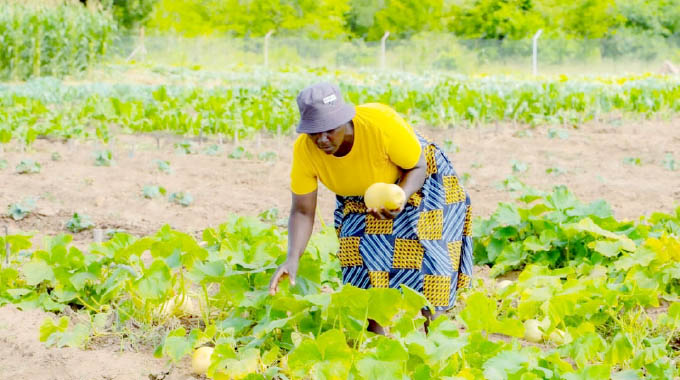
Tatenda Macheka and Rutendo Botsa, Correspondents
AT dawn in Mutenda Village, Masvingo, 52-year-old Mrs Elinah Chinamora walks across her maize field, phone in hand. She pauses, scanning the daily weather advisory flashing on her screen — a guide that now determines whether her crops will thrive or fail.
A year ago, this same field lay parched after a miscalculated planting season. Today, thanks to a small, humming weather station at Chekai School, she knows precisely when to plant, irrigate and protect her crops.
For Mrs Chinamora, access to real time weather data has been transformative.
“I have been farming most of my life,” she said, shading her eyes against the morning sun.
“But in the past, lack of accurate information led to many poor decisions. I remember one drought season when I invested heavily in maize instead of drought-tolerant traditional grains. I lost everything I planted and it took a long time to recover.”
Her experience mirrors that of countless farmers across Zimbabwe, who have long grappled with unpredictable weather, prolonged dry spells and rising input costs. Yet food production remains central to national food security and rural livelihoods.
In Mutenda, however, a small piece of equipment is reshaping that reality.
In the heart of the village, beside the grounds of Chekai School, stands a white box enclosed in a steel perimeter fence, its small propeller spinning quietly in the wind. To an outsider, it may appear simple, almost industrial. But to the community it is a sentinel — a source of continuous weather intelligence.
This is an Automatic Weather Station (AWS), a solar powered machine that records atmospheric and ground conditions around the clock, providing farmers with precise, real time information and enabling the Meteorological Services Department (MSD) to issue more accurate forecasts.
In 2025, the World Food Programme (WFP) supported the Government in installing five AWS units. Today, MSD operates 123 stations nationwide, including 103 synoptic stations and 20 agromet/climate stations. While synoptic stations support national forecasting, agromet stations deliver microclimate monitoring specific to local farming needs.
“Automation changes everything. These stations eliminate human error, save time and can operate in remote areas because they are solar-powered and wireless. In the past, rainfall was measured with conical gauges that often overflowed or gave inaccurate readings during heavy storms. Now, data is captured continuously and shared digitally, allowing farmers to make timely decisions,” said Agriculture Business Advisory Officer, Ms Rumbidzai Masvingise.
Mrs Chinamora’s day begins with checking the hourly updates transmitted from the Chekai School AWS. The station beams data on rainfall, temperature, humidity and wind speed to a digital dashboard. Where connectivity is weak, the system stores the information until it can safely transmit it.
“We now have these powerful machines that never sleep. They constantly send us information. In the past, we relied on radio forecasts covering entire provinces. Those updates were too general, making accurate planning almost impossible,” she said.
MSD deputy director Engineer Pomokai Mazhara explained the technical sophistication behind the system.
“An AWS is equipped with specialised sensors — electronic thermometers, tipping bucket rain gauges, wind vanes, and data loggers. The system captures measurements every few minutes, applies date and time stamps, and stores the data on an SD card. Once online, this information is transmitted in real time and visualised on the dashboard,” he said.
Ms Masvingise said her office translates this data into practical agricultural advisories.
“We tell them when to plant, when to irrigate, and how to protect their crops from pests or extreme weather. With consistent data collection over time, communities can analyse trends and adapt their farming practices,” she said.
The results are already clear. Last season, Mrs Chinamora doubled her usual harvest after planting drought tolerant traditional grains alongside maize, timing her irrigation precisely and protecting her crops from sudden heavy rains.
“I am very optimistic,” she said, smiling. “This season, I expect an even better harvest. For the first time in years, I feel in control of my farm.”
Beyond individual gains, the AWS initiative is strengthening Zimbabwe’s early warning systems.
Head of WFP’s Masvingo Field Office, Mrs Lynn Chiripamberi, said: “Real-time, district-specific data allows authorities and development partners to act before droughts, floods, or heatwaves escalate. Communities can plan, adapt and respond with greater confidence. This initiative is a major step towards building resilience against climate shocks.”
In regions like Mutenda, where weather patterns can shift abruptly, the impact is profound.
“In Mutenda, weather patterns change suddenly. Before, we were always reacting, always guessing. Now, we stay ahead of the weather. It is like having a guardian watching over the fields every day,” said Mrs Chinamora.
The technology also supports long term planning.
“After 10 years, we will have reliable information on seasonal trends, rainfall patterns and temperature fluctuations,” said Ms Masvingise. “Farmers and local authorities can then make strategic decisions — what crops to prioritise, when to expand irrigation, and how to manage resources sustainably.”
The broader development impact is significant. Supported by the Green Climate Fund, UNDP, UNESCO and other partners, the AWS project aligns with national efforts to promote climate smart agriculture and build resilient food systems.
In Mutenda, the transformation is already visible. Farmers discuss daily forecasts with neighbours, adjust planting schedules and consult the data dashboard. Local youths are learning to maintain the stations, opening pathways to new skills and livelihoods.
For Mrs Chinamora, the change is deeply personal.
“I no longer plant blindly. I know the right crops to plant at the right time. I have hope for the future — not just for me, but for my children and my community,” she said.
Across Zimbabwe, the weather still changes — but farming has changed even more. With automatic weather stations quietly collecting data, farmers are no longer at the mercy of unpredictable rains or sudden droughts. They are informed, empowered and resilient, ready to turn knowledge into food and uncertainty into opportunity.