malvernmugadzikwa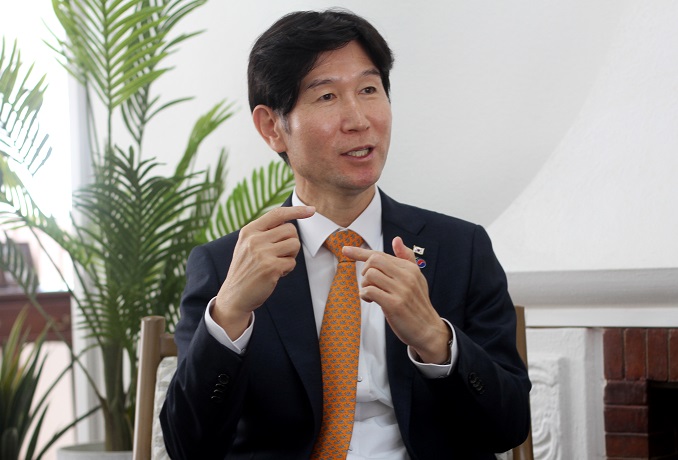
In June, President Mnangagwa attended the inaugural Korea-Africa Summit in Seoul, South Korea. During the visit, he held bilateral talks with his South Korean counterpart, Yoon Suk Yeol, where the two leaders undertook to enhance cooperation between the two countries. The Sunday Mail’s TANYARADZWA RUSIKE interviewed South Korea’s Ambassador to Zimbabwe MR PARK JAE KYUNG on the current state of relations between Harare and Seoul.
***************
Q: Can you begin by outlining the state of diplomatic relations between Zimbabwe and South Korea?
A: Zimbabwe and Korea enjoy cordial relations. There is not so much dynamic between the two countries, so we need some momentum to invigorate our bilateral relations on various fronts, be it political, economic and people-to-people exchanges.
This year, that momentum has been in the making. The presidential visit to Korea in June this year for the Korea-Africa Summit, where President Mnangagwa had bilateral meetings with the Korean president, means a lot.
Also, this year marks the 30th anniversary of our relationship, and the Korean embassy is undertaking lots of events.
In September, we will have big celebrations at the Celebration Centre, where there will be an event called the Korea Festival 2024.

We will have food, cosmetics and taekwondo exhibitions, while companies such as Hyundai, Kia, Samsung and LG will also be present.
So, with this strong progress, we should not miss this momentum, and we must continue working towards building more vibrant and dynamic relations in the years ahead.
Q: Can you outline the state of bilateral trade between the two countries?
A: For the past decades, our trade volumes have been quite dormant.
The volumes have been between US$30 million and US$40 million, which is a very small amount. Investment is the same, but the trend with Africa also looks the same.
Korea and Africa trade in general is about US$20 billion. That accounts for less than 2 percent of Korea’s total external trade.

As you know, Africa has 50-plus countries and accounts for about 25 percent of the world.
Korea’s trade with this big continent remains only less than 2 percent.
That is why Korea is now moving towards renewing relations and renewing focus on Africa, both bilaterally and regionally.
That is why, in June this year, my president invited the leaders from Africa to the Korea-Africa Summit.
That is why I said the situation, the relations have been quite okay, but they leave much to be desired, particularly in the trade volumes.
However, when it comes to people-to-people exchange, the situation seems to be better than the economic statistics.
In 2018-2019, the pre-pandemic period, the number of Korean tourists visiting Zimbabwe were over 20 000 to a maximum point of about 33 000. During the pandemic period, the number, of course, declined.
This year as well, thanks to the Korea-Africa Summit, thanks to the President’s visit to Korea, the numbers continue to rise.
Q: Can you outline how you plan to increase economic and trade cooperation?
A: Direct trade may not account for the entire or the real trade between our two countries. There is some kind of indirect trade.
This trade is possible through third countries, be it South Africa or elsewhere . . . whether it’s cars, cosmetics and other items.
But still, even so, we have to work hard towards promoting more trade and investments.
At the government level, we need to create a conducive environment for the private sector to do business with each other.
Governments themselves cannot make big investments. Businesses need information, they need good impressions, interaction and communication with their counterparts.
In that sense, in June this year, when President Mnangagwa visited Korea, there was the signing of a memorandum of understanding (MOU) between the two countries in trade and investment promotion.
At the same time, at the business-to-business level, the JNCC, the Zimbabwe Chamber of Commerce and the Korean Chamber of Commerce also signed an MOU.
Following the signing of the MOUs in Korea, next week (this week), I am inviting some Korean businesspeople and then some local businesspeople to my residence for a kind of networking gathering. The embassy will continue working towards creating a conducive environment for businesspeople to know and do business with each other. Right after the summit in June, some businesspeople from Korea visited Zimbabwe and I hope more will come.
Q: How have Korean investors responded to Zimbabwe’s open-for-business call?
A: The businesspeople whom I mentioned who visited right after the summit are into minerals-related enterprises.
They told us that they did not know about Zimbabwe and that they didn’t know that Zimbabwe has an abundance of minerals, particularly nickel.
So, we explained to them a little bit more.
We were wondering how they got to know about Zimbabwe, and they said they had heard about it at the Korea-Africa Summit.
After they contacted us, we explained to them about the country, and just a week after the summit, in July, they visited Zimbabwe. They had a survey tour and they met some people here.
So, it’s quite encouraging to see this development and we believe they will come back for an additional survey.
They will talk about Zimbabwe with their neighbours or their counterparts in Korea.
There are a lot of opportunities in Zimbabwe: nice weather; nice people; and abundant mineral resources, particularly those minerals like lithium, nickel, graphite and copper. Those are critical minerals for developing electric vehicles.
Q: Can you outline Korea’s position on Zimbabwe’s engagement and re-engagement efforts.
A: All the 193 countries in the world that are members of the United Nations need diplomacy. So, we cannot close our borders to all countries. We want engagement, rather than confrontation, tension and conflict.
So, in that sense, it is very important for Zimbabwe to maintain the policy of engagement or re-engagement. When it comes to economic development, it is really important to have a policy of engagement with Europe, the Americas and Asia.
As Korea, we are trying to diversify our relations with countries in Africa.
Similarly, for Zimbabwe, it is important to engage more and more countries.
It is the right direction for the new Government, for the Second Republic here, to pursue that policy.
Q: President Mnangagwa recently attended the South Korea-Africa Summit. Can you outline the significance of this in enhancing Zimbabwe and Korea relations?
A: It was in 2010, when the then-Prime Minister Morgan Tsvangirai visited Prime Minister Chiang Kai-shek.
But this time, it was the very first presidential-level visit from Zimbabwe to Korea.
The presidential visit means a lot.
What that means is that there will be follow-up meetings and activities through the bureaucrats.
Together, we are working on cooperating in the agriculture sector, people-to-people exchanges and the mining sector as a follow-up to the discussions between our two leaders.
To be more specific, there was another MOU signed for cooperation in the agriculture sector during the President’s visit. It focused on rice production in Zimbabwe.
Of course, you have maize as your staple, but we hear an increasing number of people here are diversifying their diets to include rice.
Korea has rice as a staple food and we have the experience of overcoming food insecurity.
We are now working on developing a rice variety fit for Zimbabwe’s climate and soil.
With that in mind, the MOU was signed between the two countries on how to increase production of rice in Zimbabwe.
Seven countries in West Africa, including Senegal, have already started this project, and Zimbabwe is now on board, thanks to the signing of the MOU in June.
We will soon begin undertaking a feasibility study as a follow-up measure.
We have our agricultural research agency that is already here at SIRDC (Scientific and Industrial Research and Development Centre).
The Korea Programme for Innovation on Agriculture (KOPIA) is currently working with local researchers at SIRDC.
Q: Can you outline work being done to enhance cooperation between Korea and Zimbabwe in the technology sector?
A: There are about 26 Korean embassies in Africa and our embassy here in Zimbabwe wants to have the best initiative for technology development. In June, we announced an initiative to support technology development for African countries, which is called Tech for Africa. Through this project, we will provide equipment such as tablets and computers to young people and university students.
I know we have the Harare Institute of Technology and the Ministry of ICT (Information Communication Technology) that we are working with.
We are going to discuss how to implement those initiatives in a concrete manner.
In terms of funding, my president announced that up until 2030, about US$10 billion will be spent on that project in African countries. In order to access the funding, we need to first have bankable and concrete projects in place. So, we are trying to come up with very good projects, in close consultation with the relevant ministries and universities.
We hope that by next year, we will have a good project for the Tech for Africa initiative.
Q: What is Korea’s position on sanctions imposed on Zimbabwe by some Western countries?
A: I understand there is an issue of sanctions between Zimbabwe and some other countries.
Korea is not a direct party to the issue.
We are well aware of the issue and continue to monitor it, including the recent change of the US sanctions regime on Zimbabwe announced in March this year.
And we also took note of the relevant paragraph of the communique of the 44th SADC Summit, which reads: “Summit reiterated the regional call made at the 39th Summit for the unconditional removal of sanctions imposed on the Republic of Zimbabwe and acknowledged that the sanctions continue to hinder the progress and prosperity of the people of the Republic of Zimbabwe and the SADC region.”
As sovereign nations, we may have different political and legal systems, different culture and history, and sometimes different views on values, where we all may not agree.
That is why we often find issues where we must disagree with each other. But even so, as responsible members of the international community, we all need to try to address any concerns through dialogue and interaction. That being the case, Zimbabwe and other relevant countries must continue to address concerns through meaningful dialogue.
At the same time, Zimbabwe and other relevant countries can develop friendly cooperative relations.
Guiding principles in leading the dialogue may include respect for sovereignty, self-determination of peoples and respect for human rights and for fundamental freedoms for all, as enshrined in the UN Charter.


 Online Reporter