admin
admin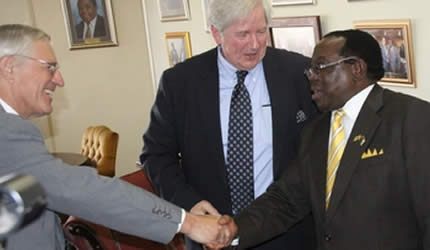
ruinous sanctions regime they imposed in 2002.
The diplomats from Germany and Spain said this in separate meetings they held with Zanu-PF national chairman Ambassador Simon Khaya Moyo at his offices in Harare.
This comes hard on the heels of a similar plea from US State Department spokesperson Jen Psaki who last week urged the Government to allow international observers to monitor the harmonised elections, saying that would enhance their credibility.
“The United States sincerely hopes Zimbabwe will hold peaceful, credible presidential and parliamentary elections this year.
“We believe the credibility of these elections would be enhanced if a broad range of international monitors led by Sadc were accredited to observe,” Ms Psaki said, adding “this would help to verify that the elections are truly representative of the will of the Zimbabwean people.”
Germany’s Regional Director for Sub-Saharan Africa Mr Egon Kochanke echoed the US’ statement.
“I think if your country is able to have free, fair, transparent and credible elections and for this I think it’s also important to have some sort of international observation,” he said.
Related Stories…
“I know that Sadc is very much involved, the African Union is involved, if the EU can be involved so that this will give these elections more credibility and I think we can start then a new page of our co-operation.
“I think we would like to work and engage with any Government coming out of this kind of free, fair and credible elections so that we can tap into this enormous potential.”
Mr Kochanke said the EU would only remove the illegal sanctions if it was satisfied that the polls were credible.
Spain’s deputy ambassador to Zimbabwe, Ms Ximena Sartori, said: “It’s now time to look forward. Spain looks forward to peaceful elections. We agree Sadc is playing a key role though we are in a position to work with you.”
Ms Sartori lobbied Zimbabwe to support Spain when it bids for a non-permanent seat at the United Nations Security Council in 2016 and to host the 2020 Olympics.
Ironically the EU and its allies who recently convened in London under the banner of Friends of Zimbabwe revealed that they had bankrolled regime change activities in Zimbabwe to the tune of $2,6billion over the years, a development that effectively makes them participants by proxy and precludes them from impartial observation.
Cde Khaya told the two diplomats that countries that imposed illegal sanctions on Zimbabwe would not be invited for the elections, even if they dangled the carrot of sanctions removal.
He dismissed claims by Ambassador Kochanke that polls would only be deemed credible if they were observed by the EU under the disguise of the international community.
“As a country, this is not the first election that we are having since independence and at no time have we been told that we are not able to hold them,” Cde Khaya Moyo said.
“These elections are ours as Zimbabwe. They are ours as Sadc. They are ours as the African Union. We believe we are capable as we have done in the past. We don’t expect anybody to impose themselves on us. We are not amused by that interference from countries that want to observe our elections.
“Worse still, countries that imposed sanctions on us will not observe our elections because they cannot be seen to be fair. We are very principled on this one. We want to work with everyone, but certainly not with countries that have declared illegal sanctions on us.
“If Sadc, the AU and other countries that are friendly to Zimbabwe are to observe these elections and declare that they are free and fair, then why should any part of the world dispute that?” he asked.
Cde Khaya Moyo said Zimbabwe was going to comply with the Constitutional Court ruling that harmonised elections be held by July 31.
“As Zanu-PF we strongly believe in the rule of law,” he said. “We can’t be seen to be contemptuous of the ruling. We must all abide by the ruling.
“We are not the first ones to experience this because George W. Bush had to get the White House after a ruling of the Supreme Court.”
Cde Khaya Moyo pledged Zanu-PF’s commitment to bring to conclusion problems bedevilling the Save Valley Conservancy where some properties are owned by Germany citizens under Bippas.
He told Ms Sartori that Zimbabwe would not change its position on not inviting Western countries to observe the harmonised elections.
“We are concerned about those countries that imposed illegal sanctions on us, so we are not going to allow them to come and observe our elections,” said Cde Khaya Moyo.
“This is a Zimbabwean election, an African election which we are going to conduct in the manner of free and fair elections.”
President Mugabe has also made it clear that Zimbabwe would be careful in inviting election observers and would only have regional groups and friendly countries.
Analysts note that Western countries imposed sanctions on the country to give the MDC-T, which they helped form, to have an unfair advantage during elections.
The sanctions were imposed in retaliation to the land reform programme which ensured previously marginalised blacks benefited from 70 percent of the country’s fertile land that was monopolised by 6 000 white commercial farmers.


 Online Reporter