Online Reporter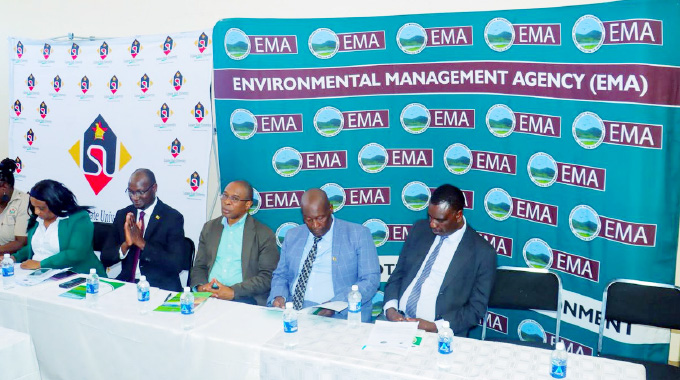
Rutendo Nyeve, [email protected]
THE strategic rejuvenation of wetlands across Matabeleland North Province has emerged as a lifeline for rural communities, strengthening food security, restoring water sources and knitting villages together through shared ecological stewardship.
Zimbabwe is home to thousands of wetlands that play a crucial role in water regulation, agriculture, biodiversity conservation and climate resilience. However, many have come under severe pressure from cultivation, overgrazing, mining and settlement expansion, prompting Government and environmental agencies to intensify protection and restoration efforts in recent years.
These issues came into focus at the Matabeleland North Provincial World Wetlands Day Symposium held at Lupane State University on Monday, where environmental experts, traditional leaders and Government officials gathered to reflect on this year’s theme: “Wetlands and Traditional Knowledge: Celebrating Cultural Heritage.”
In a speech read on his behalf by the Provincial Director of Local Government, Mr Tapera Mugoriya, the Minister of State for Matabeleland North Provincial Affairs and Devolution, Cde Richard Moyo, said wetlands play a critical role in national development.
“The National Development Strategy 2 (NDS2) recognises environmental protection and sustainable natural resource management as pillars of national progress. Wetland conservation is therefore not a peripheral issue, but a key component of our developmental agenda,” said Minister Moyo.
“The NDS2 prioritises food security, climate resilience and environmental protection. By safeguarding these ecosystems, we are investing in sustainable growth and the prosperity of future generations.”
Minister Moyo also highlighted the collective responsibility required to protect wetlands, many of which are located in communal areas and are traditionally managed by local communities.
“As we reflect on today’s theme, let us remember that wetland protection is not the responsibility of the Government alone. It requires collective action from academia, traditional leaders, communities, civil society and development partners,” he said.
Minister Moyo commended Lupane State University for its role in advancing research and community engagement.
“Academic institutions such as Lupane State University are incubators of knowledge, research and innovation. The university is uniquely positioned to lead wetland research and outreach in this region, ensuring that both traditional knowledge and modern science inform sustainable management practices,” he said.
One of the key success stories highlighted at the symposium was the recovery of Kasibo Wetland, a project spearheaded by the Environmental Management Agency (EMA) in partnership with local communities.
EMA Matabeleland North Provincial Manager Mrs Chipo Mpofu-Zuze outlined the wetland’s transformation.
“When we first engaged the community at Kasibo, the wetland was severely degraded. Only a few large trees and a small pond remained, with cultivation extending into the core area and compromising its ecological function,” she said.
“We agreed with the community to demarcate and protect the wetland core, and fencing was installed.
Two to three years later, water began flowing throughout the year.”
Mrs Mpofu-Zuze said Kasibo has since been restored into a vibrant two-hectare wetland rich in biodiversity.
“You can no longer walk through it without protection. Species that had disappeared have returned,” she said.
She noted that the benefits extended well beyond the immediate area.
“Because of its restored ability to absorb, store and release water, two downstream dams are now consistently full, sometimes spilling over, recharging the riverine system all the way to the Zambezi,” she said.
“The wetland also acts as a natural filter. Sediment and debris enter from upstream farmland, but clean water flows out.”
The value of the restored wetland became especially evident during the severe 2024–25 drought.
“While many water sources dried up, Kasibo continued to supply water for domestic use, livestock and small-scale irrigation. Neighbouring villages accessed water here, and the community voluntarily reduced cultivation to allow others to water their livestock,” said Mrs Mpofu-Zuze.
She also highlighted the cultural significance of wetlands, noting that many have historically been regarded as sacred spaces.
“Elders told us that people from as far as Binga would come here to hunt and draw water, believing the spirits resided in this place. That cultural reverence helped preserve it,” she said.
“Today, we are rediscovering that blending traditional respect with scientific management yields the best results.”
Mrs Mpofu-Zuze urged communities to value indigenous conservation practices.
“In many parts of the world, there is now a push to return to community-based, culturally rooted conservation. We still have that identity. Let us protect it and allow it to guide our environmental stewardship,” she said.