Chronicle Editor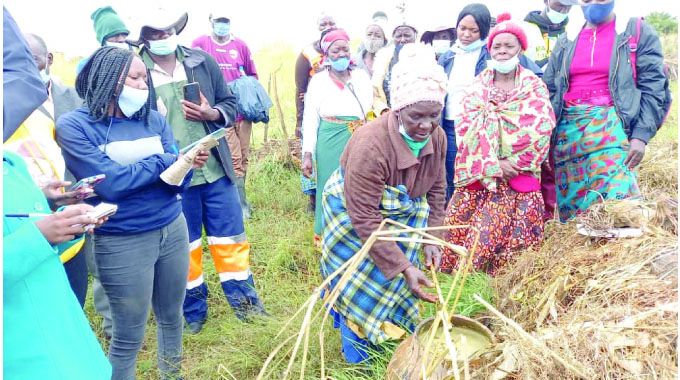
Patrick Chitumba, Midlands Bureau Chief
A WETLAND has become a hub of hope for Gogo Nyoka (67) and other people from Chitora Village in Reskelf area in Shurugwi as they have embarked on income-generating gardening projects through organic farming.
Gogo Nyoka who is taking care of her husband and three grandchildren never runs out of food all year round and is able to send the grandchildren to school through returns from gardening at Reskelf wetland.
Wetlands are areas where water covers the soil, or is present either at or near the surface of the soil all year or for varying periods of time during the year, including during the growing season.
Wetlands play an integral role in the ecology of the watershed. The combination of shallow water, high levels of nutrients and primary productivity is ideal for the development of organisms that form the base of the food web and feed many species of fish, amphibians, shellfish and insects.
Many species of birds and mammals rely on wetlands for food, water and shelter, especially during migration and breeding.
The world commemorates the role played by the wetlands in any given country especially in the face of climate change.
February 2 is the World Wetlands Day aimed at promoting awareness of wetlands as people take stock of how they have been looking after these important carbon sinks.
From 1971, the World Wetlands Day was adopted as a treaty in the Iranian city of Ramsar. While other villagers wait for the rain, which has become erratic due to climate change, Gogo Nyoka and 31 other villagers formed Takashinga Garden Club and are busy from January to December on six hectares at the Reskelf wetland. They mainly grow tomatoes, beans, maize, rape, carrots and wheat.
They also do aquaculture and bee-keeping. The villagers sell their produce locally in Chitora while the excess is sold in Shurugwi town.
Gogo Nyoka and other villagers have not only enhanced food security, but also realised income from selling their produce. She said the standard of living for her family has improved greatly as they are benefiting from proper use of the wetland with the help of the Environmental and Management Agency (EMA) and Local Initiative Development (LID) agency.
“I am benefiting tremendously from the wetland. I have two children and three grandchildren. We are surviving from this wetland. I send my grandchildren to school, they eat well, I have cattle and goats,” she said.
Chairperson for Tashinga Garden Club Mr Fidelis Peresi said they are not feeling the effects of climate change as they are growing different crops throughout the year, and they are also making money from fish farming.’We were introduced to fish farming by the Local Initiative Development (LID) agency and through that we have managed to harvest, sell and make profit hence enabling us to earn a living. Moreover, we get our protein from the fish farming project,’ he said.
Another beneficiary Mr Simon Nyathi said his life largely depended on the wetland. Mr Nyathi said he built a homestead and bought livestock using money he gets from the wetland.
“EMA has equipped us with enough knowledge on how to conserve the wetland and be productive on it. Another plus is that they taught us how to do organic farming.
“We don”t use chemicals for pest control as they also kill non-targeted organisms. We also have our own pest repellent using shrubs and cattle urine,” he said.
LID project officer Mr William Pisirai said they opted for organic farming in order to secure all components of the ecosystem.
‘Wetlands are regarded as a sensitive ecosystem, so we opted to use organic farming as it is in harmony with the sensitivity of wetlands so that all organisms in the wetland should survive for it to remain functional,’ he said. Mr Pisirai said the wetland has accommodated various projects such as farming and bee keeping to improve the basket of harvest from the garden.
“Bees have become vital for cross pollination of crops and plants,” he said. “Farmers have testified that beekeeping has helped in eliminating and controlling diseases such as tuberculosis, flu, asthma and hypertension.”
EMA environmental education and publicity officer for Midlands province Mr Oswald Ndlovu applauded the villagers for the good upkeep of the wetland and urged them to continue preserving the wetland.
‘I urge you all to learn and put into practice all the things we teach you at such gatherings so that we continue to preserve our wetlands,’ he said.
Mr Ndlovu added that the environmental agency takes stock of wetlands to conserve biological diversity. He said communities, including those in rural areas, appreciated the importance of wetlands since agriculture has always been the backbone of their livelihoods.
“We account for wetlands in the province to enable their use and conservation. The recurrence of droughts in the country calls for the need to intensify the utilisation of wetlands.
The province boasts other well-preserved wetlands in areas such as Zvishavane-Runde, Tongogara, Chirumanzu and Gokwe, among others,” he said.
Environment experts say the protection of wetlands is important in conserving biological diversity. They also note that wetlands are the most threatened ecosystem in developing countries.



 Online Reporter