Chronicle Editor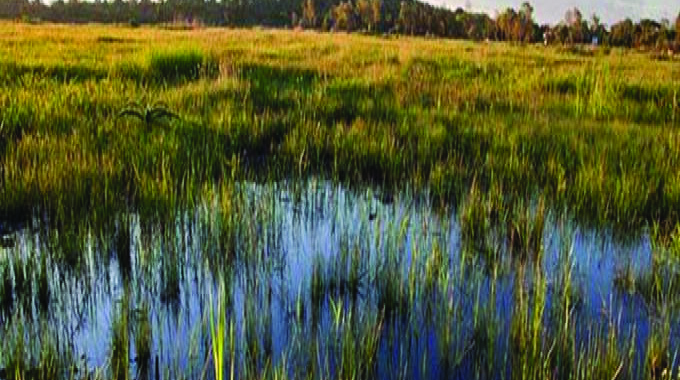
Leonard Ncube, [email protected]
WETLANDS are contributing immensely to socio-economic development in Binga with about 90 percent of people living closer to the natural resource earning a living out of it.
This was said by Safe Environment Wildlife Africa (Sewa) director Mr Kalulu Mumpande during the World Wetlands Day (WWD) at Masibinta wetland near Manjolo recently.
Zimbabwean wetlands make up 136 595.8km2 of areal cover excluding dams and lakes and Matabeleland North contributes 39 400.80km2, which is 21 percent with Binga District having the highest number of wetlands in Matabeleland North despite the district being generally dry, studies show.
These include cold and hot springs, dams and rivers.
Of the total wetlands in the country, 61 percent are moderately degraded and 18 percent severely degraded.
Mr Mumpande said globally, including in Binga, humanity is totally dependent on the environment.
“The Masibinta wetland harbours the Malende rain-making site and supports 387 households, with livelihoods, water, fruits, and income and about 90 percent of Manjolo villagers attained formal education through support from gardening in the wetlands,” he said.
“The Masibinta wetland, though not among the seven Ramsar sites in Zimbabwe, is important in the conservation of biological diversity and the natural wealth, fostering adaptation and building resilience to effects of climate change.
“The wetland became a top restoration priority in the district due to its socio-economic, cultural and biodiversity significance.”
The Masibinta wetland has 180 gardens from where the community practice horticulture and the whole community including youth and women have been empowered.
Mr Mumpande said 387 households in Manjolo had no access to clean and adequate water and are getting benefits from the Masibinta wetland.
He said more than 350 women have no property rights in Manjolo where 88 are female headed households and 20 are people with disabilities depending entirely on Masibinta wetlands for livelihoods, making the resource critical.
The project started last year with the aim of increasing access to clean water, protect, rehabilitate and conserve 13ha of Masibinta wetland and increase capacity of the community to conserve biodiversity and improve management of natural resources and income.
The community received the first tranche of US$25 000 on 30 June 2023 and are waiting for another batch in April.
Mr Mumpande said restoration of both terrestrial and aquatic habitat, such as Masibinta wetland are in line with vision to see indigenous communities of biodiversity and natural resources conservation excellence, which are highly resilient to effects of climate change.
He said in the face of climate change, wetlands remain one of the sustainable resources to reduce extreme poverty and hunger, increase access to education and reduce social inequalities and challenge communities to jealously guard natural resources.
He said wetland restoration is a top priority in the district due to its socio-economic, cultural and biodiversity significance.
“In the face of climate change, wetlands in the district and the whole of Matabeleland North remain one of the sustainable resources to reduce extreme poverty and hunger, increase access to education and reduce social inequalities.
As Sewa we noted that if the degradation of Masibinta wetland is not halted, the lives of 387 households including vulnerable groups, will be at stake,” he said.
Sewa works with the Environmental Management Agency (EMA) and Binga Rural District Council.
The world has lost 85 percent of its wetlands that are disappearing three times faster than forests. Wetlands serve as natural sponges, absorbing excess water during floods and releasing it slowly during dry periods thereby helping mitigate the impacts of climate change-induced disasters.
They also act as carbon sinks, sequestrating/absorbing carbon dioxide from the atmosphere and helping to mitigate global warming.
Masibinta wetland, once a pristine ecosystem, is under threat from cultivation with over 180 gardens, excavation to get water to irrigate crops, livestock trampling, invasive alien species, brick moulding activities, deforestation for firewood and fencing and effluent discharge from laundry activities at a borehole located within the wetland.
Litterbugs have also violated the wetland, which is littered with plastic bags, bottles and other debris. The effects of climate change have not spared the wetland as rising temperatures and erratic weather patterns have altered the hydrological regime of the wetland, posing significant challenges to its ecological integrity.
According to the Ramsar, wetlands or (masensa/masawu in Tonga) are areas of marsh, fen, peatland or water, whether natural or artificial, permanent or temporary, with water that is static or flowing, fresh, brackish or salt, including areas of marine water the depth of which at low tide does not exceed six metres.
Government has demonstrated its commitment to the importance of protecting and sustainable utilization of wetlands by putting in place robust strategies as included in the National Development Strategy 1 (NDS1) to halt and reverse wetland loss and restore ecosystem goods and services.


 Online Reporter