Online Reporter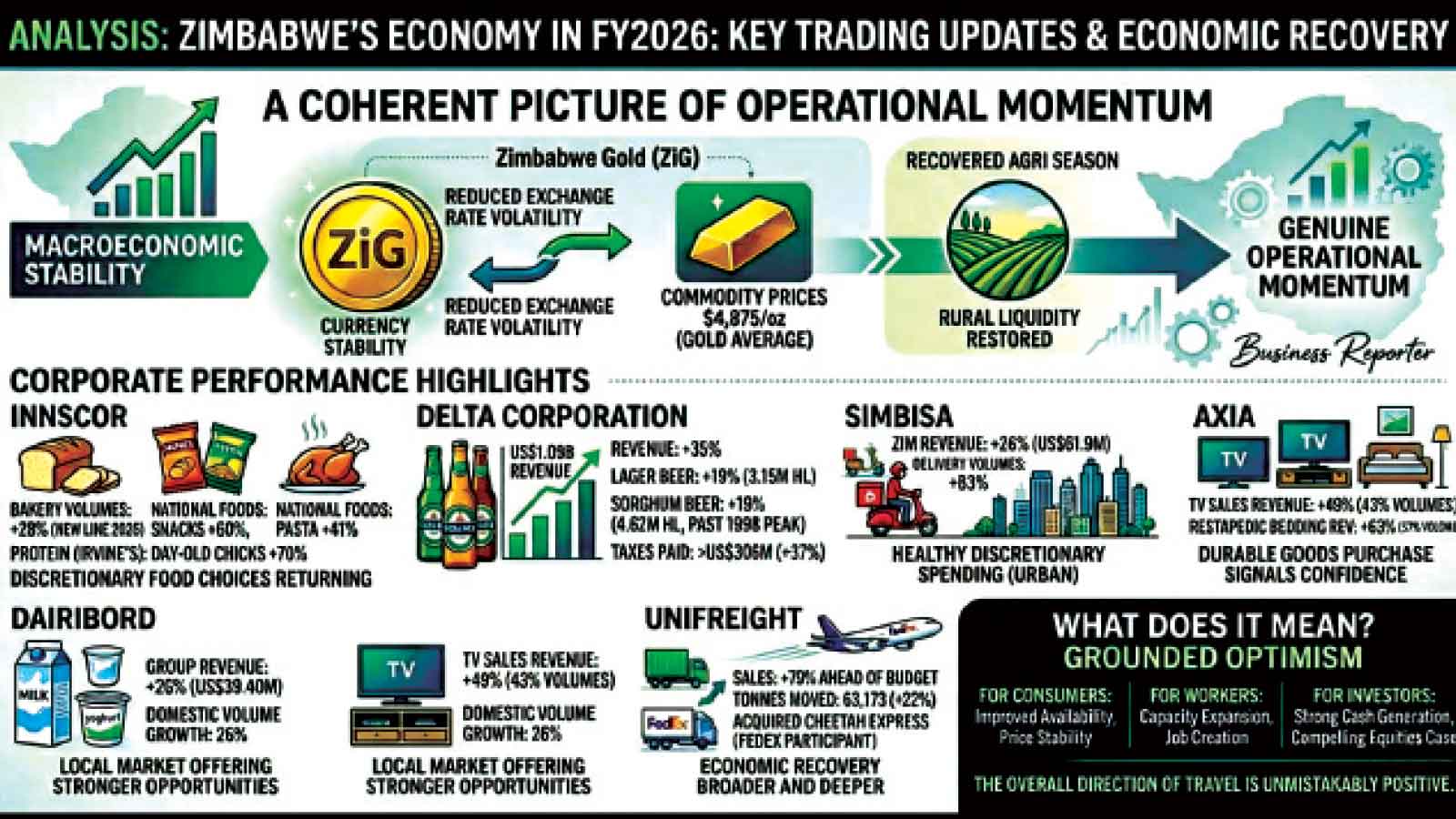
Business Reporter
IF Delta Corporation’s results for the financial year ended March 31, 2026 offered the first glimpse of a Zimbabwean economy stirring from a long slumber, the wider body of corporate trading updates released in May 2026 confirms the picture.
Across manufacturing, logistics, mining, retail and agriculture, a coherent story is emerging: A combination of currency stability, firm commodity prices, a recovered agricultural season and improving consumer confidence is translating into genuine operational momentum.
No economy recovers in a straight line, but the direction of travel is unmistakably positive.
Several common factors appear repeatedly across the updates.
The local currency, Zimbabwe Gold (ZiG), has held remarkably steady since the September 2024 devaluation, with multiple companies citing reduced exchange rate volatility as enabling better planning and pricing.
Commodity prices have been exceptionally supportive, with gold averaging US$4,875 per ounce, flooding the economy with foreign currency.
The agricultural recovery after the El Niño-induced drought has been transformative, restoring rural liquidity.
Diaspora remittances have remained strong and even the electricity grid has shown signs of improvement.
Global supply chain pressures persist, but firms are responding through efficiency measures rather than simply passing on every cost increase.
Innscor’s trading update offers perhaps the most comprehensive view of Zimbabwe’s consumer economy.
The bakery division recorded a 28 percent increase in local volumes, driven by a new automated production line commissioned in May 2025.
At National Foods, the flour division grew by 15 percent, snacks (60 percent) and pasta (41 percent), while maize contracted by 56 percent — a temporary normalisation following drought-induced demand in the prior season.
In the protein division, Irvine’s day-old-chick volumes increased by 70 percent, signalling that poultry farmers are restocking aggressively.
Colcom’s aggregate volumes grew by 29 percent, driven by a 35 percent uplift in fresh pork.
These are not survival purchases; they are discretionary food choices returning to household baskets.
Innscor’s capital expenditure across bakeries, biscuit plants and packaging facilities represents confidence in sustained recovery rather than a short-term opportunistic event.
Delta Corporation’s performance sets the benchmark for the year. Revenue grew by 35 percent to US$1,09 billion, with operating income up by 42 percent to US$209 million.
Lager beer volumes grew by 19 percent to 3,15 million hectolitres, while sorghum beer volumes rose by 19 percent to 4,62 million hectolitres — surpassing a 1998 peak that many thought would never be reached again.
Volumes of sparkling beverages grew by 14 percent, and the newly consolidated Schweppes business added US$101 million in revenue.
These are not the volumes of a population merely surviving; they suggest discretionary spending is returning in earnest, with Zimbabweans gathering in social settings and enjoying small luxuries that were deferred during past economic problems.
Delta increased its stake in Schweppes Holdings Africa from 49 percent to 69 percent, consolidating control of a major local manufacturer, and paid over US$306 million in taxes during the year — an increase of 37 percent.
Simbisa’s third-quarter update provides a direct window into household spending patterns, because when people choose to eat out or order deliveries, they are making a conscious decision that their finances can absorb a non-essential expense.
In Zimbabwe specifically, revenue grew by 26 percent to US$61,9 million, with delivery volumes up by an extraordinary 83 percent.
This suggests discretionary spending is healthy among urban Zimbabweans in a way that would have seemed improbable just two or three years ago.
Axia’s update tells a story of robust domestic demand that goes far deeper than mere necessity purchases.
The TV Sales division saw revenue grow by 49 percent and volumes went up by 43 percent to 50 399 units — discretionary purchases that signal growing confidence, because nobody buys a new television set if they are worried about paying rent.
Restapedic Bedding’s revenue went up by 63 percent and volumes rose by 57 percent to 17 275 units. DGA Zimbabwe, the distribution business, delivered volume growth of 52 percent to 950 938 units, translating into revenue growth of 82 percent.
Television sets, bedding and lounge furniture are durable purchases that consumers make when confidence is improving, and the trend is firmly upward.
Dairibord’s trading update shows a business firing on most cylinders after a period when the dairy sector had been severely constrained by drought.
Group revenue reached US$39,40 million, a 26 percent increase, with volume growth of 26 percent across all core product categories.
The beverages category grew by 29 percent, and the foods segment, particularly yoghurt, achieved a 31 percent increase.
Export volumes declined by 40 percent as the group prioritised servicing increased domestic demand — a telling indicator that the local market is currently offering stronger opportunities than regional export markets, which is exactly what you want to see in a recovering economy.
Finally, Unifreight’s first-quarter update provides the logistics perspective. Sales were 79 percent ahead of budget, with gross profit 108 percent above budget.
The business moved from a projected loss to a solid profit in a single quarter.
The group moved 63 173 tonnes, 22 percent ahead of budget, despite operating fewer trucks than planned. This means better fleet utilisation and route discipline drove this outperformance.
Strategically, Unifreight acquired Cheetah Express Logistics, the sole authorised FedEx participant in Zimbabwe, giving it entry into the express courier segment.
Goods do not move unless businesses are producing, importing or exporting, and this over-performance suggests the economic recovery is broader and deeper than forecasters anticipated even a few months ago.
What does all this add up to?
For consumers, the next 12 to 18 months should see continued improvement in product availability and pricing stability.
For workers, expanding capacity means job creation, with new production lines and new stores translating into employment opportunities.
For the Government, corporate tax receipts are rising — Delta alone paid US$306 million — and the challenge is to use these increased revenues wisely, investing in infrastructure, education and health rather than allowing them to be absorbed by recurrent expenditure.
For investors, strong cash generation and returning profitability make a compelling case for Zimbabwean equities, with the risk-reward ratio having improved materially as currency stability has taken hold.
The overall direction of travel is unmistakably positive.
For the Zimbabwean consumer, worker and taxpayer, these results offer grounds for measured optimism.