Chronicle Editor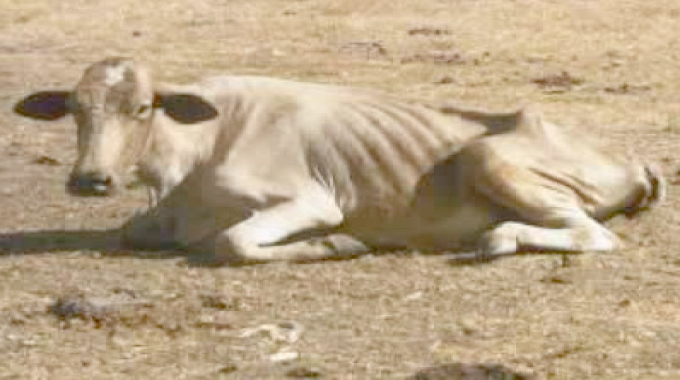
DURING the course of this week which has just ended, I met a number of people from different districts and they all asked me the same question.
This was a wide spectrum of people ranging from senior civil servants in the Ministry of Agriculture, a chief, a broadcaster, politicians to ordinary community members. They all asked about what message should be given to livestock farmers in view of the devastating drought which has now been fully loaded and delivered to most of the southern regions of the country including Matabeleland region.
The fact that all these people found it important to consult with me, tells me a number of things. The first one being that the drought and its potential damage is now very apparent and the need for action is now appreciated by all and sundry.
Secondly, that they know our farmers need to be told what to do even regarding something as recurrent as drought. We still need to drive a call to action to victims of previous droughts. Strangely despite the devastating and damaging nature of droughts, with the most recent one being the El Nino of 2015/2016 which killed over sixteen thousand animals in the southern part of the country, farmers still need to be warned to prepare for a drought which is happening right in front of their eyes!
Thirdly, the consult was an acknowledgement of the role this pen is playing within the livestock fraternity and a validation of the coverage of the column. We appreciate the vote of confidence. However, let us share again what farmers need to do in view of this very bad agricultural season.
The first thing is to paint a picture of how the year will look like to the livestock farmer so that they appreciate what is coming and act now. Water sources as you know them will dry up except for very large dams like Bubi/Lupane dam in Matabeleland because of its sheer size. As I write, some major rivers did not flow at all, water pans in some areas did not collect anything, wetlands were not recharged and are drained out.
In some areas they are already watering their animals from boreholes, a practice which usually resumes around June in normal years. The reality therefore is, livestock farmers will struggle to water their animals and some perennial boreholes will dry out this year because of excessive demand and poor recharge of the water table.
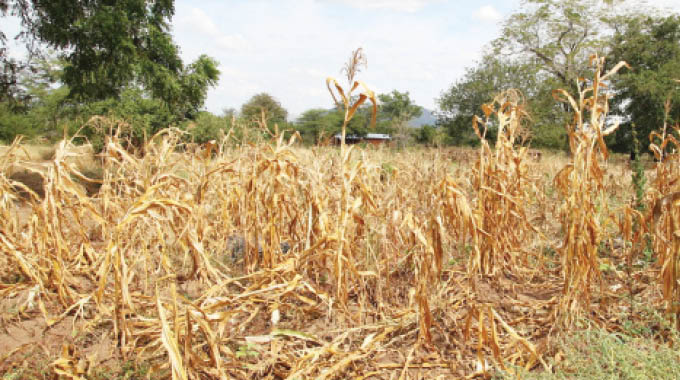
In terms of grazing, the little grass which had germinated is already drying out and being wiped out by animals. Crops from the fields are mostly written off which means there will be nothing for consumption by the families and also some of the crops failed at very young stage, meaning there is no meaningful stover to be benefited from the failed crop.
The immediate advice to those with a grown cereal crop which is now failed because of drought, is to make silage out of the failed crop especially if it is still green. Farmers can also harvest and stock the stover if the crops have dried out beyond making a meaningful silage. However, the most important advice which livestock farmers should hid if they want to remain livestock farmers in the coming year, is to destock and use the proceeds to buy stock feed to save the remaining herd.
This is the most viable option that livestock farmers have and should take. Please take out the older animals as these will definitely succumb first to drought. Sell these at whatever price you can get now and use the money to buy stock feed and grain for your family. In the next two months the market will flood with animals as farmers panic and begin to offload animals. The price will drop to a pittance but it is wise for the farmers to take whatever is offered and purchase stock feed including hay bales for their animals.
The objective is not to profit from what you are selling buy to raise income to buy stock feed. If you wanted to profit you would have sold when the market was better in December! You have ten animals, sell four and help the remaining six including your family to survive.
Also, exchanging animals for stock feed is a strategy which has worked well in some districts in the past. Farmers give their animals to abattoir operators who then evaluate the animals and buy and deliver to the farmer, stock feed of equivalent value.
If you can buy a miller to produce bush mill, now is the time to do it. With the grasses being wiped out so early, the next thing available to you will be trees leaves and twigs and these you can mill and feed your animals as survival ration.
This will be a drought reminiscent of the 1992 drought which killed a million cattle in Zimbabwe, the time to prepare is now.
The government will do what it does under such circumstances and mobilise resources including from development partners and funding agencies with an interest in livelihood area. This may not come at the very time you need it, such that when it does come it could be late for you hence the need to make own preparations now.
As extension agencies of government even including the private sector, let us drive this message home that farmers need to start acting now. Anytime around May, the stock feed will become scarce and very expensive because of the demand. This my fellow readers, is the advice to give to farmers and it is not at all novel but very effective.
Uyabonga umntaka MaKhumalo. Mhlupheki Dube is a livestock specialist and farmer. He writes in his personal capacity. Feedback [email protected]/ 0772851275


 Online Reporter