Online Reporter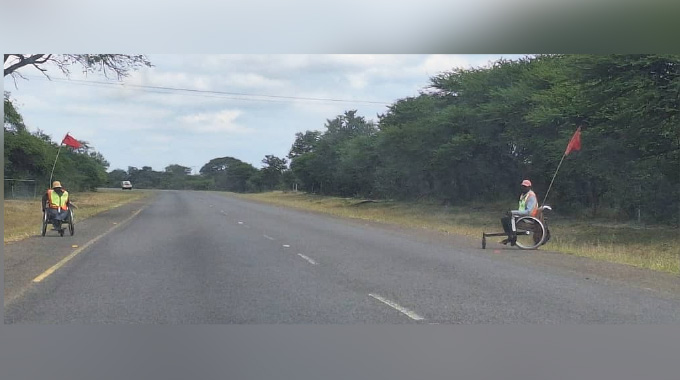
Mkhululi Ncube, [email protected]
PERCHED precariously on opposite verges of the busy Bulawayo-Plumtree highway, just before the West Acre Shopping Centre, two men in wheelchairs have made the dangerous roadside their permanent place of work. Braving the constant and considerable danger of speeding traffic, they strategically position themselves on either side of the dual carriageway, each with a hand outstretched and a begging bowl offered to every passing vehicle in a desperate plea for assistance.
Their wheelchairs, marked by distinctive red flags and reflectors, are the first indication for approaching motorists. These men have spent nearly two years at this particular location and over 25 years on other highways, knowingly risking their lives in their pursuit of a livelihood from charitable drivers.
Despite the grim reality that the country’s highways claim approximately 150 lives each month, these two men have come to terms with the possibility of becoming part of those statistics. Nevertheless, their will to live surpasses their fear of death. They have families who depend on them to provide for their daily needs, demonstrating their resilience despite their physical limitations.
Conducting an interview with them presents a considerable danger, with a constant stream of various types of vehicles speeding past every minute on the heavily trafficked road. This is the story of Joseph Hwata (52) and Maxwell Mpofu (54), both of whom were disabled by polio in their early childhood, a shared condition that has forged a lifelong friendship between them.
“We live together at a homestead in Mcwazini Village, about 3 km away from here. A Good Samaritan offered us a home to stay. Originally from Chivhu, we moved here a few years back, seeking more favorable circumstances due to increased competition from other individuals begging there. We have been begging on the highways for decades. Currently, our aim is to raise about US$300 to buy an egg hatcher machine and start a chicken project.
“I am a married father of two children, and polio resulted in me being disabled from the waist down. I went to St Michael’s Mission in Mhondoro up to Form Four. My life was affected by this condition, which made it hard for me to live a normal life,” said Hwata as a Toyota Corolla hoots while passing by.
Hwata said that begging on highways has been their lifelong means of supporting their families. However, with advancing age, they now desire to retire from this precarious existence and pursue alternative employment, specifically the chicken project.
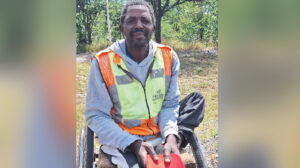
His long-time colleague, Mpofu, a married father of four working on the opposite side of the road, recounted his education at Mount St Mary’s and Danhiko Secondary School. He attained three O-level passes, which marked the end of his formal education.
“Polio hit me at a young age, and just like my friend, I was paralysed from the waist down. After a day’s work, we share equally what we have received. We use that money to support our families, but it is not enough. This is why we are now working on getting something that can keep us at home rather than on the roads,” he said.
Mpofu said that they maintain constant vigilance, their eyes fixed on approaching vehicles, prepared to “escape” should any danger arise. Despite spending their entire day begging on the roadside, they have somehow managed to persevere.
“We always wear reflectors and tiered flags on our wheelchairs so that drivers see us. Accidents happen, we know, but as you can see, our spot is on the clear part of the road. We also use the roadside when travelling, and so far, we have been good,” he said as a haulage truck “shook” the road while passing.
Having endured the wear and tear of various terrains, their wheelchairs is a constant maintenance concern, and the two men invariably carry repair tools in a satchel for any eventualities. Mpofu noted that their shared existence on the road spans over three decades, a bond that will not be broken.
“We are always together; we even travel together to see our children back home in Chivhu. We have been to many highways like Harare-Masvingo Road, Harare-Mutare Road, Bulawayo-Victoria Falls, and here. We appeal for help to get an egg hatchery machine, and once we get it, we will retire from the roads. We would do well with a project that demands less movement than what we are doing now,” he said.
Throughout the day, passing motorists mostly provide their food, supplemented occasionally by locals from nearby shops. Lucy Kuwandira Mapfumo, from the Traffic Safety Council of Zimbabwe Media and Corporate Communications, stated that their presence on the road is unsafe, exposing them to a significant risk of being struck by vehicles.
“In terms of safety on the roads, it is unsafe for people to be standing on dotted lines, whether attempting to cross the road or even selling to passengers in passing vehicles. We encourage pedestrians to desist from such activities as it puts their lives in danger,” she said.
@themkhust