Online Reporter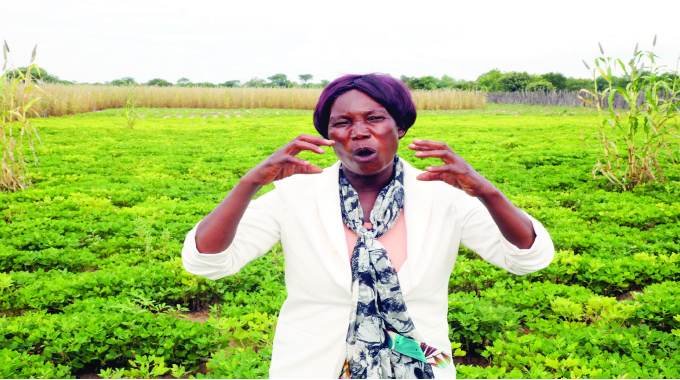
WHAT stands out the most in Mrs Sitshengisiwe Moyo’s field is her pearl millet crop that appears as a vast expanse of tall, slender, erect grass plants with long, narrow leaves, topped with feathery, finger-like panicles (flower heads) that resemble small pearls.
The farmer from Tshitatshawa Village in the sprawling Tsholotsho District of Matabeleland North Province has one of the best pearl millet plants on 27 plots that stand relatively close together in rows.
The other eight plants comprise groundnuts, bambara nuts and maize.
Pearl millet does well in Tsholotsho which falls in the agro-ecological regions 4 and 5 characterised by low rainfall, high temperatures and a variety of soils, with traditional grains performing better in such climates due to their drought-resistant nature.
At a farmer field day at her homestead on Wednesday, Mrs Moyo who attributed her farming success to Pfumvudza/Intwasa initiative, Government support through the Presidential Inputs Scheme and Agritex officer assistance is looking forward to harvesting over five (50kg) bags per plot.
“At first, I was a bit sceptical when the Agritex officer would come encouraging us to do Pfumvudza/Intwasa initiative, which is a conservation farming technique that involves planting crops in small holes,” she said.
“He never got tired and would keep on coming encouraging farmers to do Pfumvudza/Intwasa initiative. I started off with five plots and I was impressed with the harvest and gradually over the years I have been adding the number of plots, having done a combined 35 plots for pearl millet, groundnuts, mbambara nuts and maize for the 2024/25 cropping season.”
She said in order for her crop to come out well, she started her Pfumvudza/Intwasa holes in July 2024 and mulching, in August she put lime fertiliser to neutralise acidity in the soil and that helps to release soil nutrients, which she was taught must be in the holes three months before putting in the seeds.
Mrs Moyo said towards the end of October she started planting and finished just in time for when the rains started.

“Looking at the fields I am very happy with the way my crop turned out. I foresee a bumper harvest and with five (50kg) bags per plot I am looking forward to over 175 (50kg) bags. Our plea to Government is for the seeds to come early so that we plant on time to maximise our yields,” she added.
Tsholotsho Ward 8 Agritex officer, Mr Mandla Moyo said he was happy with the uptake of Pfumvudza/Intwasainitiative by the farmers.
“When we started Pfumvudza/Intwasa initiative, four farmers were willing to try it out, while the rest opted to stick to their old farming practices. To date, over 1 000 homesteads in the Ward are now doing potholing. I always encourage the farmers to do traditional grains that do well in our region and they can also do grain swap for maize,” he said.
He said in the face of climate change, if traditional grains were ensuring food security in the Ward, its uptake by all farmers will ensure food security in Tsholotsho District and Matabeleland North Province as well positively contribute to the national traditional grains stock.
Agricultural and Rural Development Advisory Services (Ardas), acting chief director Mr Leonard Munamati commended Mrs Moyo for her fields that showcased the potential of small grains, such as pearl millet, in enhancing food security and mitigating climate change impacts in drier regions.
“Mrs Moyo’s pearl millet demonstrates the effectiveness of adopting smart agriculture practices to improve yields. We encourage other farmers to follow her lead and grow more traditional grains, which are better suited for drier regions,” he said.
“The shift towards traditional grains is already evident in Tsholotsho District, where maize production is declining, and pearl millet production is increasing significantly. This trend is expected to continue, as small grains are more resilient to harsh weather conditions and require less water and inputs than maize.”
He emphasised the Government’s commitment to promoting climate-resilient agricultural practices and supporting farmers in adapting to changing climate conditions.
Mr Munamati said the Pfumvudza/Intwasa programme has been instrumental in boosting agricultural resilience and productivity across Zimbabwe, while assuring that the Government will work on the timely distribution of inputs to farmers.
The initiative is part of Zimbabwe’s broader efforts to achieve Vision 2030, which aims to elevate the country to an upper-middle-income society by improving rural economies.
By promoting small grains and climate-smart farming techniques, Zimbabwe is taking a significant step towards enhancing food security, mitigating climate change impacts, and improving the livelihoods of rural communities.