Online Reporter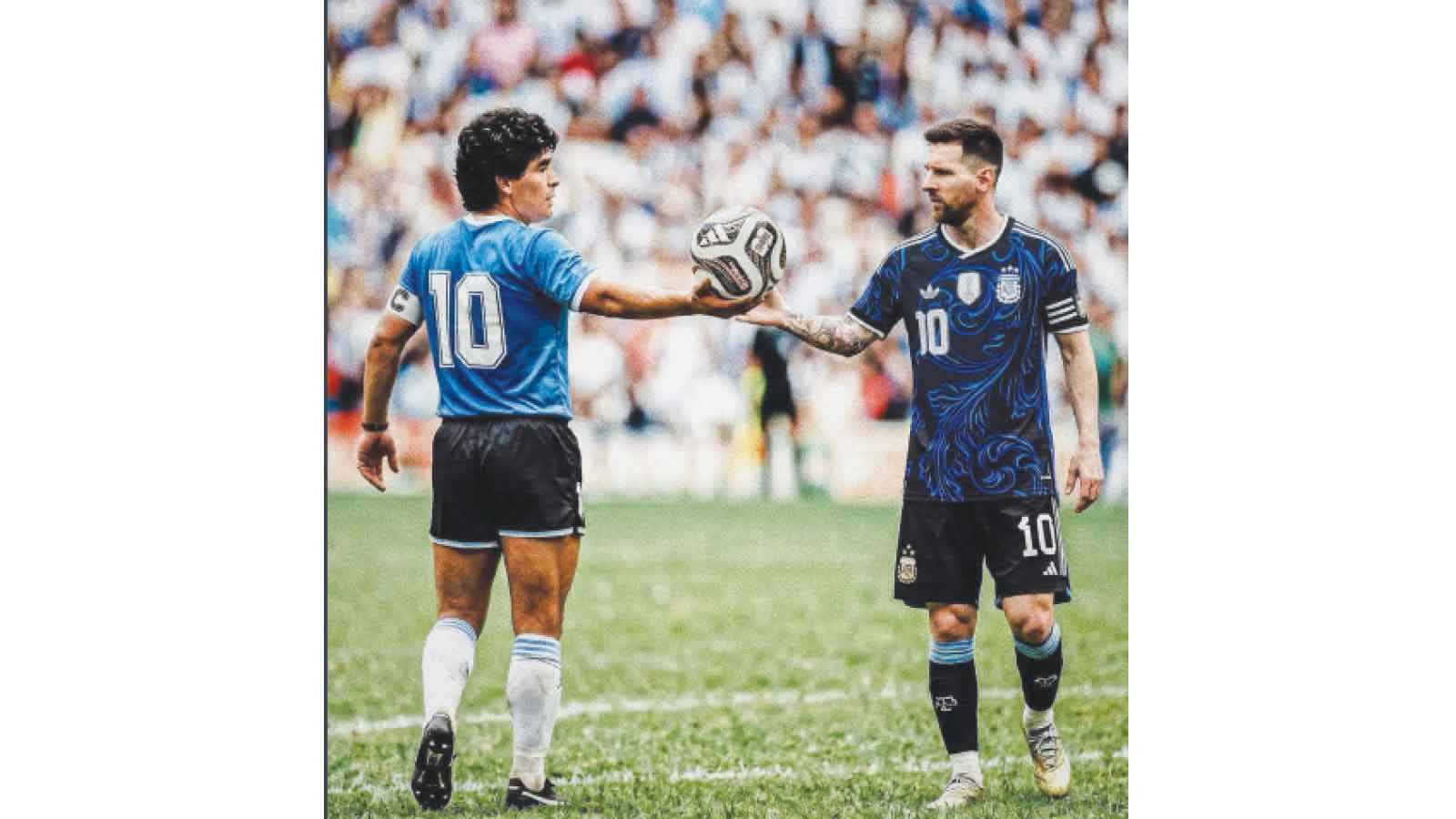
THERE are countries that produce champions. There are countries that create footballing schools. And then there is Argentina, a nation that, at two distant moments in history, seemed determined to test the world’s ability to explain genius.
Diego Armando Maradona and Lionel Andrés Messi were not from another planet, but perhaps from the place where football reaches its apex.
In the impoverished neighbourhood of Villa Fiorito, a short boy chased a worn leather football, unaware that one day the world would know him as Diego Armando Maradona.
Twenty-seven years later, in the city of Rosario, another boy, smaller than his peers in stature, but greater than them in talent, battled growth hormone deficiency before he ever had to battle defenders. That boy would become Lionel Andrés Messi.
TWO NUMBER 10s, TWO EXCEPTIONS
Time may change. Stadiums may change. Tactics evolve, and the game becomes ever faster. Yet one thing has remained constant: whenever Argentina’s number 10 pulls on the national shirt, the laws of football seem to bend ever so slightly.
At its core, football is a game of probabilities. A pass may succeed or fail. A shot may find the target or miss. A tactical plan may collapse because of the smallest detail. But Maradona and Messi were the exceptions that defied this rule.
They did not merely increase the odds of success; they seemed to eliminate uncertainty altogether. The ball arrived exactly where they had imagined it before any defender had even recognised the possibility, as though time itself granted them an extra second unavailable to anyone else.
Johan Cruyff famously said that playing football is simple, but playing simple football is the hardest thing of all. Had Cruyff witnessed the entirety of Messi’s career, he might have found an even deeper meaning in those words.
For Messi, simplicity was never about reducing movement, but about eliminating chaos. He receives the ball, lifts his head, and chooses a decision that, once executed, appears to have been the only logical option, despite having been the most difficult of them all.
TWO KINDS OF GENIUS
Maradona, by contrast, was never searching for the simplest solution. He searched for the solution no one else could see. He was a footballer born from chaos, nourished by it, and always emerging victorious. If a match was locked, he unlocked it. If it was already ablaze, he made it burn even brighter. And when victory appeared impossible, he treated the challenge as a personal invitation.
The difference between the two men, therefore, was never one of quality. It was one of music.
Maradona was a solo performance on an instrument no one else knew how to play. Messi was an entire orchestra conducted by his left foot.
From a tactical perspective, their influence cannot be reduced to goals or assists. Both redefined the role of the free playmaker. Before Maradona, the traditional number 10 waited for the ball. Maradona sought it out where the battle was fiercest. He received possession surrounded by four defenders as though entering a room whose every exit he already knew. He never feared physical contact. Instead, he used it to change direction.
His low centre of gravity, remarkable ball protection, and extraordinary vision made defenders appear as though they were chasing a shadow rather than a man.
Then came Messi, taking the same concept into an era dominated by relentless pressing and extraordinary speed. At a time when spaces disappeared in fractions of a second, he discovered passing lanes that television cameras often recognised only during slow-motion replays. His dribbling was never built upon an abundance of touches, but upon impeccable timing.
He did not always outrun opponents with pace, but with thought. That is why Pep Guardiola once remarked that Messi sees what others simply cannot.
LEADERSHIP IN THEIR OWN WAY
Yet genius is measured not only by what you do with the ball, but by what you inspire in those around you.
Maradona made his teammates believe that the impossible could become reality. His personality arrived before he did, and his presence arrived before kick-off.
He was a leader who fuelled his team with emotion, dragging them into battle even when the road ahead was filled with possible defeat. He was never perfect, nor did he pretend to be.
Perhaps that is why people loved him so deeply, because he was a genius who carried every contradiction of human nature.
Messi led in an entirely different way. For years, he was criticised for being too quiet, his silence deemed incompatible with traditional leadership. Time, however, revealed that leadership is not measured by volume, but by consistency.
He never demanded the impossible from his teammates. Instead, he demanded it first from himself. He ran first. He pressed first. He made the difference first. In doing so, his calm became a language, and his silence became a speech that required no words.
THIRTY-SIX YEARS APART
At the 1986 FIFA World Cup, Maradona carried Argentina on his shoulders to the summit of world football. At the 2022 FIFA World Cup, Messi accomplished the same feat, albeit in his own unmistakable way. Between those two triumphs lay thirty-six years, during which almost everything changed, except the feeling experienced by Argentinians whenever their number 10 carried the nation’s dreams.
That is why comparisons between the two often narrow the truth instead of expanding it.
Maradona is not an earlier version of Messi.
Messi is not an upgraded version of Maradona.
Each stands as an original in his own right.
The first taught the world that a single footballer could alter the destiny of a nation in 90 minutes.
The second proved that genius is not merely a fleeting moment of brilliance but can become a masterpiece sustained for more than two decades without losing its radiance.
A LEGACY BEYOND NUMBERS
Jorge Valdano once said that while some players score goals, others write literature with the ball. Perhaps he was not speaking of both men together, yet the phrase feels as though it was written precisely for them.
Neither left us with mere highlights replayed on sports bulletins. They left behind an entire memory that lives within the soul of the game.
There will undoubtedly be more great footballers. Records will fall. Trophies will be lifted. New stars will emerge. Yet some phenomena cannot be measured against those who follow them, because they were never simply chapters in football history. They were turning points that redefined it.
Perhaps, then, the finest thing that can be said about Maradona and Messi is not that they are the greatest footballers of all time, nor that they came from another planet.
Rather, they made this planet, if only for fleeting moments, a more beautiful place for everyone who loves football.
THE TRUE LEGACY OF GREATNESS
And when the history of Argentine football is written a hundred years from now, statistics may differ. Records may change. Historians may continue their endless debates over who was the greatest.
But they will agree on one undeniable truth that requires no vote: this land gave birth to two men who transformed not merely the history of a national team or a football club, but the very way the world sees the game itself.
That, in the end, is the true legacy of greatness. It is not the number of trophies lifted, but the number of hearts inspired to believe that the impossible can become possible, if it passes through the right left foot. – AIPS.