

 admin
admin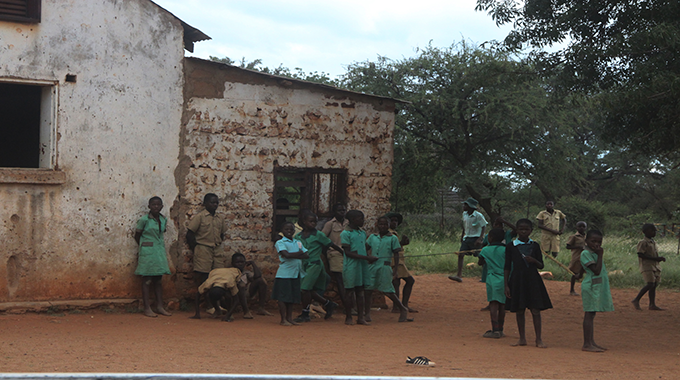
Obey Sibanda, Features reporter
Walking around Bubi district’s resettlement areas, one is greeted by a sorry state of decrepit infrastructure used as makeshift places of learning.
So rickety are the structures that they look like they can collapse onto the occupants any time. The learning environment is deplorable as it takes place in all manner of unlikely spaces such as farm homesteads, improvised shelters, mud houses, places of worship, people’s homes and so on.
At worst some pupils learn under trees exposed to bad weather conditions and lessons are sometimes abandoned in terrible weather conditions. Pupils learning in such an environment see acquiring knowledge as more stressful than the envisaged benefits said to be a key to improve their lives.
Unlike many people who thanked God for opening up the sky and bringing rain to the country, pupils at institutions such as Bantu Kuqala, Gravesand, Enaleni, Daiset, Mqabuko and Fairburns Primary schools to name but a few could not wait for the rains to just be over.
No wonder, in the 2018 Zimbabwe School Examinations Council (ZIMSEC) Grade seven examinations 29 schools in Matabeleland North Province recorded zero percent pass rate. The same number of primary schools scored a zero percent pass rate in 2017.
The 2018 pass rate by subject for the province by subject is 30,4 percent and by units it’s 43 percent, an improvement from 2017 record of 37 percent against the national pass rate of 52,08 percent which is an increase on the 2017 national pass rate of 44,73 percent.
It is not a secret that the Government has made substantial progress towards widening access to primary education over the years but very little has been done in improving the quality of rural education.
The poor learning environment puts a dent on the discourse that education is rising at a significant rate in Matabeleland North.
Fairburns Primary School Development Committee (SDC) chairperson Mr Daniel Baatjes believes that even though the enrolment rate in rural primary schools has undoubtedly risen, those in class seem not to be learning. He said more than half of Grade Seven pupils at his school can read only at Grade Two level.
“The numbers are impressive unfortunately the quality of education is not. Despite being enrolled in school, many of them do not seem to be learning much.
“Even though children are enrolled in numbers in primary schools, they will finish their primary education unable to read, write and perform basic numeracy even after seven years of schooling,” observed Mr Baatjes.
Schools in Matabeleland North face a number of challenges that are unique to their environment. These challenges stem from a number of sources, such as from within the school division structure, community perspective, and from the school setting itself.
The resettlements have one of the highest proportions of pupils who have to walk more than an hour to get to school.
For most pupils in resettlements such as Leighton, Breama 20 and 22 in Bubi district getting to school every morning remains a daunting task as they have to walk more than eight kilometres to the nearest satellite school and usually on an empty stomach. As a result concentration is compromised.
A psychologist Mr Robson Ncube said long distances travelled to school does not only endanger pupils but also fatigues them as by the time they arrive at school they will be completely exhausted.
“As a result of long distances, learners struggle to concentrate or stay awake in class,” said Mr Ncube.
Most schools in settlement zones are characterised by overcrowded classrooms, poorly qualified teachers and lack of teaching and learning materials. Pupils are crammed in classrooms which are composite or multi-grade. This means it is not unusual to find grades 1 to 5 crammed into one class. Such classes usually have only one teacher.
According to a headmaster at one of the schools, preparing for lessons for multi-grade classes is every teacher’s worst nightmare.
“Excessive work load is the single most significant contributor to stress and low morale for teachers. They are always exhausted, as they have to prepare lessons for different grades to be taught simultaneously making teaching virtually impossible. In these scenarios pupils are in class but are not learning anything. Both the teacher and pupils are exhausted even before lessons start,” he said.
In an interview after 2018 grade seven results were released, Deputy Provincial Director responsible for primary education in Matabeleland North, Mrs Beatrice Manjere made an undertaking that they will assist teachers to handle multi grade teaching.
“We have to staff develop them (teachers) on multi grade teaching and equip them with some teaching strategies like early reading initiative which means encouraging pupils to have a culture of reading ,” said Mrs Manjere.
Enaleni Primary School SDC treasurer Ms Judith Ncube said rural pupils perform dismally compared to pupils in urban areas since rural pupils only study during the day unless they want to risk losing eye sight and exposing themselves to fire-related domestic accidents by using candles and other primitive sources of light.
Ms Ncube stated that children in rural areas may be considered more difficult to educate as they are likely to have less parental encouragement to go to school, and more alternative demands on their time, such as helping with agricultural tasks.
“Parents in rural areas are less likely to be educated themselves, and so have less ability to provide support for their children. Even where parents place a value on schooling, they may be less able to help their children learn or focus in class,” said Ms Ncube.
Parents say the lack of furniture is another factor contributing to poor performance by the pupils in rural schools. In most of these schools pupils are required to bring chairs from home.
“Many sit on the floor or bricks, stand or squeeze onto desks shared with others making reading, writing, supervision and monitoring almost impractical,” said a Mr Nkomazana a parent from village 2 in Umguza.
The deplorable working conditions for teachers also contribute to teachers’ levels of job dissatisfaction leading to poor performance by pupils.
Some teachers in the remote schools of the province are reported to be sleeping in storerooms or classrooms. They conduct lessons in classrooms during the day and convert those same classrooms to bedrooms at night.
“Some of these rooms that are used by classes, teachers convert them to bedrooms at night. The ugly situation is having adverse effects on teachers’ morale and zeal to teach hence affecting dissemination of information to pupils,” said a teacher at a satellite school.
Matabeleland North Provincial Education Director Mr Jabulani Mpofu said the ministry is working hard to improve teachers’ living conditions and alleviate education crisis in the province by recruiting more teachers, building new schools which are friendly to both teachers and pupils.
“We have benefited from teachers recruitment exercise undertaken by the Ministry of Primary and Secondary Education. As I speak newly deployed teachers are busy with their kits,” said Mr Mpofu.
Mr Mpofu further highlighted that they are also constructing two fully fledged primary schools in the province, Thame primary school in Bubi and Kokoloza primary school in Binga.



 Online Reporter