Online Reporter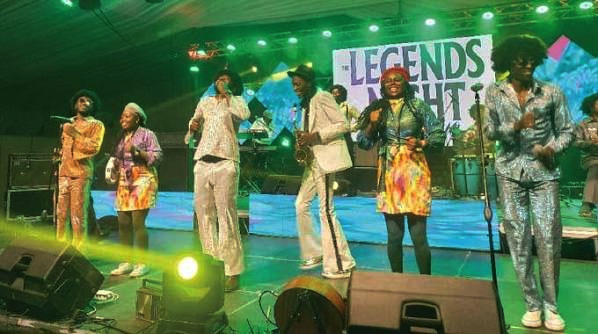
Lloyd Makonya
Correspondent
ONE of the major stories which trended in the entertainment circles this week was the controversy surrounding InTotal Band’s Legends Night and Fungisai Zvakavapano-Mashavave’s concerns which opened a much bigger debate about copyright, commercial exploitation, artistic ownership and the future of Zimbabwe’s music industry.
There is something almost magical mainly for the older generation about hearing an old Zimbabwean song performed live like Fungisai’s hit song, Makomborero.
The opening notes can transport an audience across decades, back to weddings, family gatherings, church services and the golden years of Zimbabwean music. For younger listeners, the same performance can be an introduction to a musical heritage they inherited, but never experienced first-hand.
That is the appeal of InTotal Band’s Legends Night, a concept that has taken some of Zimbabwe’s most recognisable songs from an earlier generation and repackaged them for contemporary audiences. The concept has proved commercially successful, attracting large audiences and corporate interest while travelling beyond Zimbabwe’s borders.
In many respects, it is a celebration of Zimbabwean musical heritage and an acknowledgement that the songs created by the country’s pioneers remain commercially and culturally relevant decades after they were first released.
But the success of Legends Night has also exposed an uncomfortable question that Zimbabwe’s music industry has largely avoided. When the music of yesterday is used to create commercial value today, who gets to decide how it is used and who gets paid?
That question came sharply into focus following comments by gospel artiste, Fungisai Zvakavapano-Mashavave, who expressed her displeasure at what she regarded as the reproduction of her music and artistic identity without her consent. Her complaint was not merely that another band was singing her songs. She questioned the broader practice of reproducing an artiste’s work, musical arrangements and artistic mannerisms for commercial purposes without first engaging the creator.
Her frustration is understandable.
For an artiste, a song is not simply three or four minutes of entertainment. It can represent years of writing, rehearsing, recording, promotion, touring and building a reputation. When another performer takes that work and places it at the centre of a commercially successful show, it is perfectly legitimate for the original creator to ask whether there should be some economic or legal recognition for that use.
Yet this is precisely where the emotional understanding of ownership begins to collide with the legal reality of copyright.
Zimbabwean copyright law does give creators important rights.
Under the Copyright and Neighbouring Rights Act (Chapter 26:05), the owner of copyright in a musical work has exclusive rights that include the right to perform the work in public and to authorise others to do so. In other words, public performance of a copyrighted song is not automatically free simply because the performer calls it a “cover”.
But there is an equally important qualification. The law does not necessarily require a cover band to obtain a personal permission letter from every artiste whose music it performs.
Copyright systems around the world have developed collective licencing precisely because it would be impractical for every hotel, restaurant, wedding band, broadcaster or concert promoter to negotiate individually with thousands of composers and rights-holders.
That is where collective management organisations such as the Zimbabwe Music Rights Association (ZIMURA) established in 1982 to protect the copyright and intellectual property of music creators in Zimbabwe enter the picture. Their purpose is, among other things, to administer rights on behalf of the creators they represent and to facilitate licensing and royalty collection. The principle is straightforward, rather than a performer having to locate every individual copyright owner, a properly authorised collecting society can grant licences covering the repertoire over which it has authority.
Consequently, one of the most important questions in the InTotal debate is not necessarily whether the band personally asked Fungisai for permission. The more legally relevant question is whether the band obtained a valid licence from the person or organisation legally entitled to authorise the public performance of the particular works being performed.
That distinction is critical because an artist and a copyright owner are not always the same person.
The public often refers to a song as belonging to the person who made it famous. Legally, however, a song can involve several different rights and several different rights-holders. The person singing may not have written the song. The composer may own the underlying musical work. The lyricist may own the lyrics. A record company may own a particular sound recording. A performer may have neighbouring rights in his or her performance. A publisher may administer certain rights. An artist may therefore have a powerful connection to a song without necessarily owning every right associated with it.
This is one of the areas where Zimbabwe’s music industry needs much more education.
Before an artiste says: “That is my song and nobody can perform it without my permission,” the first question should be: What exactly do I own? That is not intended to diminish the artist. It is actually the foundation of effective copyright protection.
The same caution applies to complaints about artistic mannerisms.
Copyright can protect a musical work, lyrics, particular arrangements and certain other creative expressions, but it does not generally give an artist a monopoly over a style.
A singer cannot normally claim exclusive ownership of a particular way of moving on stage, dressing, interacting with an audience or singing gospel music. There may be separate legal questions where someone reproduces a protected choreography, recording, trademark or creates a misleading impression that they are the original artist or have been endorsed by that artist, but simply imitating a general artistic style is not automatically copyright infringement.
The reverse misconception is equally dangerous. The fact that a performance is described as a “cover” does not give a band a blanket licence to perform whatever it wants without regard to copyright. If a copyrighted musical work is being performed publicly, the relevant rights need to have been lawfully cleared. Calling something a cover does not make the copyright disappear.
This brings us back to the contentious question of the ZIMURA licence. Zimbabwe has already witnessed a major dispute over cover-band licencing.
In 2025, ZIMURA proposed a US$150 per event fee for live bands performing cover music, triggering strong opposition from sections of the music industry. The dispute was not simply about whether composers should be paid. There was considerable disagreement over the amount, who should pay it and how such a tariff should be structured.
The Government subsequently directed ZIMURA to suspend the disputed tariff and proposed 30 percent sponsorship levy pending further regulatory consideration and consultation.
That episode revealed an important weakness in Zimbabwe’s system. There is broad agreement on the principle that creators deserve compensation when their work generates commercial value. What remains contested is how that compensation should be collected.
Imagine, for example, two very different performances. The first is a small wedding band performing three copyrighted songs to 80 people. The second is a major corporate-sponsored concert with thousands of people, substantial ticket revenue and dozens of copyrighted songs. Treating those two events in exactly the same way may satisfy administrative simplicity, but it does not necessarily produce a fair economic result.
Zimbabwe therefore needs to move beyond the argument about whether a fee should be paid and start discussing what a sensible licensing system should actually look like.
One possibility would be to place greater responsibility on venues and promoters to obtain blanket public-performance licences. This would be consistent with approaches used in a number of jurisdictions and would remove much of the uncertainty surrounding individual performers. Instead of every band having to worry about licencing every song, the venue or promoter would obtain the appropriate licence for the event, with the repertoire subsequently reported through a digital setlist system.
Such a system could be particularly useful for something like Legends Night. Before the concert, the promoter would declare the event, venue, expected audience and commercial nature of the show.
The relevant licence would then be obtained. After the concert, the band would submit the songs performed. The collecting society would identify the relevant rights-holders and distribute royalties accordingly.
The technology to do this already exists. What is missing could be the institutional architecture, transparency and trust. And trust is perhaps the biggest problem facing collective rights management in Zimbabwe.
We saw the much publicised fall out between sungura artistes, First Farai and Gift Amuli who had a high-profile public dispute and legal fallout in early 2026 stemming from social media accusations and tensions at ZIMURA.
Artistes understandably want to know what happens to the money collected in their name.
If a band pays a licencing fee because it has performed a particular songwriter’s music, that songwriter should ultimately be able to see evidence that the money reached the rights-holder. A modern collecting society should be able to tell an artist which songs were used, where they were used, how much was collected and how much was ultimately distributed.
Without that transparency, artistes may understandably become suspicious of the entire licensing system. The question of fairness becomes even more complicated when one considers the criticism that some musicians have directed at private cover bands while similar music is performed by police, military and prison bands for paid engagements.
There is some merit in asking whether the same copyright principles should apply consistently. Zimbabwe’s Copyright and Neighbouring Rights Act expressly provides that the legislation binds the State.
But the fact that a Government band performs a copyrighted song for a fee does not, by itself, prove that copyright has been infringed. There may be a licence, an agreement or another lawful basis for the performance. The appropriate principle should therefore be neither to accuse government bands automatically nor to exempt them automatically. It should simply be that comparable uses of copyrighted music are governed by transparent and consistently applied rules.
The same logic applies to churches. Being a Christian does not create a general exemption from copyright.
Zimbabwean law contains specific exceptions and limitations, but there is no sweeping rule saying that copyrighted music ceases to be protected simply because it is being performed in a religious setting. At the same time, it would be commercially and socially absurd to treat a small congregation singing during worship in exactly the same way as a major commercial gospel concert or a monetised online broadcast reaching hundreds of thousands of people.
The law therefore needs to recognise the difference between use and exploitation. Perhaps the most useful way to understand the current dispute is to stop thinking of it as a fight between artists and cover bands. Both sides actually have legitimate interests.
Artistes are entitled to say that their creative works have value and that commercial exploitation should not simply be free. Cover bands are entitled to say that tribute and cover performances are legitimate forms of musical expression and that the law should provide a practical way for them to obtain the necessary permissions without negotiating individually with every songwriter in the country.
The challenge is to make both propositions true at the same time.
This is where the concept of Legends Night becomes particularly interesting. There is nothing inherently wrong with taking the music of Zimbabwe’s pioneers and introducing it to a new generation. In fact, there is considerable cultural value in doing so.
A young Zimbabwean who never saw Oliver Mtukudzi perform can hear his songs live. Someone who grew up after Leonard Dembo’s death can discover his music. Songs that might otherwise disappear from public consciousness can remain part of the national cultural conversation.
The problem arises when cultural preservation and commercial exploitation become disconnected from the creators. If thousands of people attend a concert, a corporate sponsor associates its brand with Zimbabwean musical heritage, a promoter makes money and the performing band earns its fee, but the composer whose song draws the audience receives nothing, then something has gone wrong. Copyright exists partly to prevent that outcome.
But the solution cannot be to prohibit cover bands from performing the music. Doing so would also impoverish the musical ecosystem. Cover bands provide employment for musicians, sound engineers, promoters and event workers. They keep old songs alive. They introduce audiences to music they might otherwise never hear. The better solution is lawful access at a fair price.
Zimbabwe could therefore use the present controversy as an opportunity to redesign its live-music licencing system. A single, transparent licence for venues or events would remove much of the uncertainty. Digital setlists would make royalty distribution more accurate. Tariffs could take account of venue size, ticket revenue, sponsorship, frequency of performance and the commercial nature of the event. Small operators could receive proportionate tariffs rather than being treated like major corporate concerts. Most importantly, artists should have access to transparent royalty statements showing where and how their works were used.
There should also be a fast and inexpensive mechanism for resolving disputes. The Copyright and Neighbouring Rights Act already provides avenues for challenging unreasonable licensing schemes and licence terms through the regulatory system. But the industry needs to use those mechanisms more effectively instead of allowing every disagreement to become a social-media confrontation.
Ultimately, the Fungisai-InTotal debate should not become another celebrity dispute that disappears after a few weeks. It has exposed a genuine structural problem in Zimbabwe’s creative economy. Zimbabwe has a copyright law. It has a collecting society. It has talented musicians, promoters, venues and audiences. What it lacks is a licensing culture that is sufficiently clear, transparent and trusted by all of them.
Perhaps the most constructive outcome would therefore be for artists, cover bands, promoters, venues, ZIMURA, the National Arts Council and the relevant government authorities to sit around the same table and develop a workable framework for tribute concerts and live cover performances.
InTotal could continue celebrating the music of Zimbabwe’s legends. Fungisai and other creators could continue demanding that their intellectual property be respected. ZIMURA could continue collecting royalties. Promoters could continue organising commercially viable concerts. And audiences could continue singing along to the songs that form part of Zimbabwe’s collective memory.
The difference would be that everyone would know the rules. Perhaps Legends Night should ultimately become more than a successful concert concept. It could become an example of how Zimbabwe’s music industry reconciles cultural heritage with intellectual-property rights.
The artists who created the music should not be excluded from the value their work continues to generate. But neither should the musicians who keep that music alive be treated as if they are automatically pirates. There is room for both. The question is whether Zimbabwe can build the legal and commercial system to make that coexistence possible.
Because the real issue is not whether Fungisai is right and InTotal is wrong, or whether InTotal is right and the artists are wrong. The real question is much bigger. How do we build a Zimbabwean music industry where people are free to celebrate the songs of our legends, while the people who created those songs are fairly recognised, properly credited and appropriately compensated?