admin
admin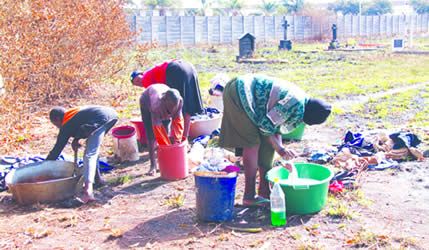
allowed to see his corpse. Only his close friends and relatives had the opportunity to do so.
Ntando, grandfather’s five-year-old daughter and his official last born child, was told to join her friends who were playing some homesteads away. The eldest aunt had to tell her that her father had gone on a very long journey and would return months later.
It was taboo to point a finger at the coffin bearing his corpse. And, it was also taboo to point fingers at any grave. The dead were a respected lot. No over played in graveyards.
During bereavement all close relatives had white pieces of cloth tied around their wrists or heads to show bereavement. Close family members were shaved clean. Many close family members wore black. That is how we respected the dead.
The respect for the dead has always been essential in our day-to-day lives although modernisation and cultural pollution are slowly eroding that.
Back in the days a corpse was respected and was treated in a special way as some spiritualists said this was the state when the soul, “a place holder” would have left the body to its original place.
The body, they said, was just but a special pocket where the soul lived — homwe.
Back then when a hearse was on the road, motorists and pedestrians would give way or stop as a sign of respect. Back then, you could not spit after smelling a decomposing corpse. That would made you spit habitually.
Today, it is the other way round. It is no longer that important because one can see motorists racing with the hearse.
Christians believe praying and spraying holy essence around the body before burying makes the deceased go to heaven. On the other hand, traditionalists plead with ancestors to welcome the dead, who would effectively be coming to join them in becoming an ancestor.
Today, there has been an infusion of culture and beliefs that have influenced negatively the way people respect the dead.
Today, it is common to hear stories of people stealing from dead. Graves are tampered with, caskets, coffins and even burial regalia like cloths and blankets are stolen and resold.
It still remains a mystery how people specialise in stealing from the dead. Day in, day out graves are found open with coffins or caskets missing.
Traditionally, disrespecting a dead person was a way of inviting a buffet of misfortunes in one’s life. There could be a curse bestowed upon you, almost immediately.
“One could respect the dead by not saying bad things about them. In other cultures you could respect the dead by doing what the late loved doing,” said Mrs Lindiwe Ncube from Nambya Cultural Association.
She also explained that it was taboo to comment on the smell of corpses or spit saliva against a decomposing corpse.
“It was believed that if one spat on a dead body he or she would invite bad luck,” she said.
Mr Oscar Sibanda one of the village heads from Mwemba village said it is very vital to respect the dead no matter how far or close you are related to the deceased.
“Some people are now mentally challenged because of disrespecting the dead,” he explained.
However the respect of the dead is slowly taken away by time. Some say the HIV/Aids pandemic which is influencing a high death rate has played a major role in eroding the cultural and traditional norms of respecting the dead.
With the advent and subsequent increased access to television sets, films of violence and a scullery of wars the world over that are beamed in our homes, it has become almost impossible for a child to grow up to three years without seeing violent scenes.
Movies and DVDs containing violent material are found all over the streets and almost everybody sees scenes of violence at least once a week.
Music videos with violent scenes are also found plenty in our homes and that makes death cheap.
Newspapers too carry gory pictures and they are readily available on the street to everybody, making it easy for people to accept death so easily.
Death has become cheap. People now easily play with death and funerals are no longer the same as the ones in the past.
Funerals have become places to show off new cars, trendy dressing and jokes.
Going forward, there will be more and more cases of people robbing the dead. More and more cases of people robbing graves and more and more cases of people, disrespecting the dead.
Rutendo Mapfumo is a journalist based in Hwange. [email protected]


 Online Reporter