Fatima Bulla-Musakwa, Features Writer
GROWING up in rural Esigodini, Matabeleland South Province, far from the hustle and bustle of urban life, Sithembisile Sibanda never imagined she would one day take the international stage alongside elite drivers in Germany.
Of all the paths that could lead her to the top, driving seemed the least likely. It was a career rarely coveted and traditionally dominated by men.
Yet, the steering wheel proved to be her key to the world. It carried her all the way to the streets of Eppelheim last month for the 33rd UICR Professional Driver World Championship. There, competing head-to-head against the world’s finest commercial drivers across four demanding core disciplines, she placed ninth in the bus category.
Other divisions included articulated truck and rigid truck categories, featuring competitors from Europe, North and South America, Asia, and Oceania. With this feat, she became Zimbabwe’s top performer among the six-member national team in which she was the only woman.
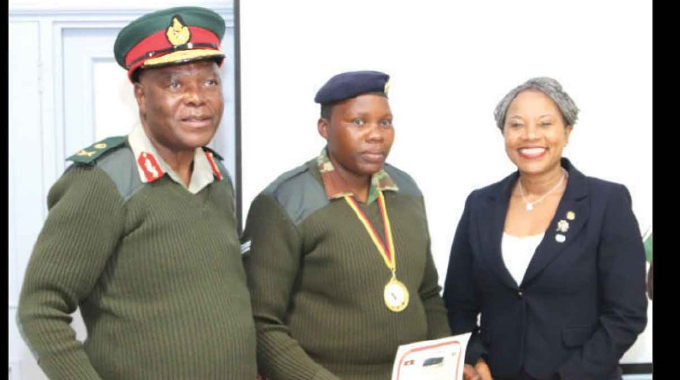
Her stellar performance earned her a promotion within the Zimbabwe National Army (ZNA) to the rank of Staff Sergeant, alongside a monetary award of US$1 000.
“It was a high-standard environment, very disciplined and safety-focused. I learnt a lot about international driving standards and brought that experience back home,” she said.
The road to the prestigious global championship began when Staff Sergeant Sibanda shone as the sole female among six drivers who topped a rigorous national selection process.
Conducted by the Traffic Safety Council of Zimbabwe (TSCZ), the contest started at the provincial
level, where at least 57 drivers per province competed in a gender-blind field.
The top three from each category advanced to the national finals in Bulawayo. Having navigated the tough selection process and outshone both male and female drivers, Staff Sergeant Sibanda set her sights on Germany.
Reflecting on her journey to Germany, TSCZ managing director, Munesu Munodawafa, emphasised that she competed on equal footing with everyone, as there was no separate female category in the national trials.
“She competed fairly and squarely. She is sitting where she is sitting because she got it right, not because there was a female category.”
In Eppelheim, 132 professional drivers from 12 countries competed to demonstrate the highest standards of road safety, precision, technical knowledge, and environmental performance. The global platform seeks to promote driving excellence, sustainability, and mutual respect among professional drivers worldwide.
“What struck me the most was the discipline and safety culture,” noted Staff Sergeant Sibanda, reflecting on the contrast with home, where human error accounts for a large proportion of road traffic accidents.
“Everything is timed, checked, and done by the book. There is huge respect for professional drivers there, and being a woman on that track made me even more proud to represent Zimbabwe.”
The competition challenged her across multiple stages, starting with a computer-based multiple-choice examination on road rules.
She was then assessed on a pre-trip inspection to verify that the vehicle was in safe operating condition. Next came skill driving, where her precision manoeuvres, spatial judgement, and composure under pressure were put to the test.
Finally, she was evaluated on operational efficiency, smoothness, fuel and energy management, and optimal brake and clutch control.
“On the first day, the bus felt different; left-hand drive and all electronic mirrors. But after two practice runs, I adapted. It taught me that a good driver adapts quickly,” she shared.
Upon the team’s return, the Zimbabwe National Army and the Traffic Safety Council of Zimbabwe hosted a reception to celebrate their efforts and commend Traffic Safety Council of Zimbabwe Sibanda’s outstanding achievement.
Chief of Staff, Major General Simo Maseko, representing Commander Zimbabwe National Army, Lieutenant General Asher Walter Tapfumaneyi, stated that the championship was a true test of professionalism, discipline, precision, adaptability, and composure under pressure.
For Staff Sergeant Sibanda, the knowledge gained abroad must cascade back to the community that raised her.
She plans to train and mentor other drivers on precision control, safety compliance, daily vehicle inspections, and fuel management, reducing accidents and operational costs along the way.
Through these efforts, she aims to uphold the ZNA’s image by driving professionally, disciplined, and safely both on and off duty, proving that a soldier can excel at the highest international levels.
Her ambition also hits close to home.
“I wish to open a driving school if I get the money and resources, because I am a driving instructor,” she said, driven by a desire to uplift Esigodini.
Staff Sergeant Sibanda joined the ZNA in 2011. She obtained her Class 2 driver’s licence in 2017 before passing the Junior Mechanical Transport Course for Administration in 2019. Two years later, she completed the Driver and Maintenance Instruction Course, leading to her Class 1 licence in 2023. By 2024, she earned her certification as an examiner, qualifying her to assess and license drivers within the ZNA.
Born into a family of eight, she is deeply grateful to her father, who provided well for the family and whose unwavering support helped her break gender barriers.
However, her triumph is bittersweet as her late mother did not live to see her transcend the gender norms that often deter women from driving heavy trucks and buses.
As Staff Sergeant Sibanda carries out her daily work as an instructor, she remains focused on curbing poor driving habits on the roads and fostering a culture of discipline, safety, and excellence among the next generation of drivers.