admin
admin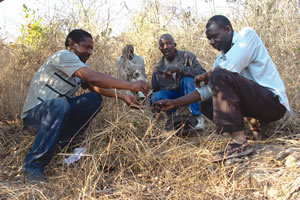
started as cattle grazing land of stunted bush shrubbery and savanna grasslands, before giving in to dense mountain forest.
Every October the mountain we were about to climb, roars and rumbles, shaking the neighbourhood like an earthquake and when that happens, villagers know that it must rain within a week.
“The ancestors have spoken!” shout the villagers, each time it happens.
The excursion was fierce, nerve-wrecking, hair-raising and spine-chilling as we were all oblivious of the fact that many people had gone into Magweto Caves, never to return.
“You only go there and come back at the benevolence of the spirits, who guard the caves, jealously. Who knows what they think about you?” said a villager who refused to partake the trip.
Their supposed bravery had made them meet the jaws of death and the same could actually happen to us this day, if any one of us dared circumvent the rules and meddle with taboos.
“No story is worth your life,” echoed the journalism school training adage, yet I soldiered on.
We were now halfway atop the sacred mountain when village head Ephraim Gombarago Matsvaire, suddenly stopped and instructed us to kneel down in a shaky shriek of a voice.
An aura of fear surrounded us.
His hands trembled as he took snuff from a worn pouch, sprinkled it on the ground and pleaded with the ancestral spirits – the sacred vanguards of the Magweto Mountain and its chain of inter-connected caves – to understand our cause, protect and guide us.
We bowed our heads, removed our hats and clapped systematically, along with him.
More fearful than before, we took off for the final journey into the mountain.
Of course, no one was sure weather the ancestors had approved of our presence or not but he had to proceed.
Dry leaves cracked under our boots, sending feeding termites into a rattling protest.
We used our hands to push aside fluffy heads of the tinder dry grass to clear the way.
Tree branches swayed with the rhythm of strong mountain top winds, while our bodies formed ghostly shadows, off the silhouette western horizon.
Fish eagles performed a piecing evocative duet, atop a huge Msasa tree almost sending us scampering for cover.
I looked up and at a glance, saw the eagles’ distinctive, black white and chestnut feather patterns, gleaming boldly in the sunset hue as they tossed their heads backwards and forth.
On the other side of the slope Musuka River which seemed to be on its final journey to its confluence with Sanyati River was flowing quietly.
Banana groves, luxuriant water reeds, water cabbages, lilies and thickets of riverine vegetation accompanied the water, undisturbed by human activity.
Suddenly, we came to the large caves that are home to thousands if not millions of bats.
Each day around 7pm the bats fly out in all directions in a noisy flap of wings and cover a huge area that one cannot see the sky until they fly away.
“This is it,” Matsvaire shrieked again.
To stay and watch the spectacle, all team members, should not have “touched the breast of a woman the previous night.”
I insisted in going into the cave but the village head could not take it.
“There is no guarantee that all off us did not sleep with women last night. We must have slept in one room to trust each other.
“The best I have done is to lead you to this cave. We can look from the outside. No one will go in today,” declared the village head.
For the villagers bats are a delicacy. They are taken as relish with sadza but it is the cooking that sounds crazy.
Villagers chop off the head that looks like a dog’s and the cut off the flabby and rubberish wings then remove the fur with hot water or fire then finally boil.
The bats have too much fat that remains in the pot and villagers use the fat to fuel lamps. It burns like paraffin.
“The bats are a delicacy. It is good meat. It tastes like goat meat, except that it is too fatty.
“One or two bats can do for a person’s meal. The fat at the bottom of the pot is used for lighting purposes.
“It takes real men to go into the caves. You need candles because torch battery won’t last five minutes. The bats are attracted to the light and they swarm you as soon as you get in with light.
“There are huge pythons that can easily swallow a man. They also feed on the bats. I personally know of three people from this village went in and never returned.
Bats there are ravenous eaters the quantity of dropping is huge and renewable. It was amazing.
The droppings are eaten by cockroaches and other insects. The result is the best organic fertiliser in the world.
At Magweto, villagers collect guano for fertiliser and a recent survey by a Germany consultant, showed that the caves have huge guano deposits that can be mined for fertiliser for 15 to 20 years.
The report is now with the Hurungwe Rural District Council, which is now looking for investment partners.
According to research, Cave Bat Guano is the collection of droppings from the cave floor, including bat and insect manure, animal remains and minerals.
Rich in nitrogen, phosphorous, potassium and other organic matter, Cave Bat Guano delivers premium fertilisation along with fungicidal and nematocidal ingredients, which protect plants from diseases such as root rot.
The organic manure produced is rich in natural nitrogen, phosphorus, potassium, magnesium, calcium and other organic elements. The highest element value is phosphorus whose content is 11 to 16 percent nitrogen, 8 to 12 percent equivalent phosphoric acid, and 2 to 3 percent equivalent potash.
Phosphorus plays an important part in how plants function and grow. Phosphorus is known to help plants during photosynthesis and helps plants to respire.
Seedlings and roots grow more quickly and vegetable and fruit production is increased when plants get enough phosphorus. It is good because it lacks odor.
Hydroponics growers, in contrast to normal fertilisation, are finding that bat guano and water are a natural alternative to chemical solutions. This product could be blended with topsoil before laying sod or grass-seed and while planting trees and shrubs. Add bat guano to your container growing mix for a supercharged potting soil.
Unlike chicken manure, it will not burn and is suitable for all plants.
Agriculturally, guano has a wide range of chelates (natural organic-mineral compounds with a high molecular weight), which gives bat guano great structural stability and produces high residual effect
in the soil and substrate where it is applied.
Bat guano slow released fertilisers continue to work for the soil and plant for long term. The high concentration of organic matter and nutrients means that it can be used in lower doses than other organic fertilisers, which can save money.
Suitable for indoor or outdoor fruit, flowers, trees, vegetables, shrubs, lawns, bonsai, cacti, and just about everything in the garden, Zimbabwe must be sitting on another gem. It is not recommended on germinating plants.
In November 1802, Alexander von Humboldt studied guano and its fertilising properties at Callao in Peru, and his subsequent writings on this topic made the subject known in Europe.
The high concentration of nitrates also made guano an important strategic commodity.
For interest’s sake, the War of the Pacific (1879 to 1883) between the Peru-Bolivia alliance and Chile was primarily based upon Bolivia’s attempt to tax Chilean guano harvesters and over control of a part of the Atacama Desert that lies between the 23rd and 26th parallels on the Pacific coast.
The discovery during the 1840s of the use of guano as a fertiliser and its Chile salt-petre content as a key ingredient in explosives made the area strategically valuable.
In this context the US passed the Guano Islands Act in 1856 giving citizens discovering a source of guano the right to take possession of unclaimed land and entitlement to exclusive rights to the deposits. However, the guano could only be removed for the use of citizens of the United States. This enabled US citizens to take possession of unoccupied islands containing guano.
By the end of the 19th century, the importance of guano declined with the rise of artificial fertiliser, although guano is still used by organic gardeners and farmers. Super phosphate made from guano is used for aerial top-dressing.
The ideal type of guano is found in exceptionally dry climates, as rainwater drains the guano of nitrates.
Guano is harvested on various islands in the Pacific Ocean (for example, the Chincha Islands) and in other oceans (for example, Juan de Nova Island and Christmas Island). These islands have been home to mass seabird colonies for many centuries, and the guano has collected to a depth of many metres. In the 19th century, Peru was famous for its supply of guano.
Outside the myth and mystery is bats guano, which when properly explored could save this country, Zimbabwe could be sitting on another gem. Are we not going to have a guano rush? Again time will tell.
[email protected]



 Online Reporter