admin
admin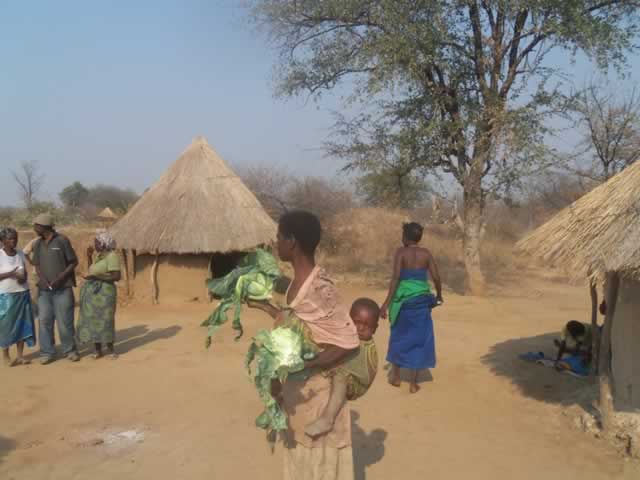
Isdore Guvamombe Features Editor
WHEN news broke out that poachers had used cyanide to kill about a hundred elephants in Hwange National Park in August, there was local and international outrage.
Immediately, the Government put its act together and on at least three occasions, high-powered delegations comprising Government ministers and technocrats flew to Hwange National Park for fact finding and subsequent solutions.
Within a week a special task force was put in place to fund-raise and pool resources together and, to date, 40 four-wheel-drive vehicles have been donated, 10 of which have already been delivered. Other resources have also been pooled for the protection of the elephants in Hwange.
Yet, in Yirira communal lands under Chief Chisunga in Mbire district, near Zimbabwe’s border with Zambia, is a place where the geography that flung it to almost anonymity came with the extra condemnation of nature at the expense of a community of more than 100 families in transition from being hunters and gatherers to permanent settlement.
Here is where the vagaries of nature, chiefly drought, unbearable heat and the attendant maladies such as malaria present a continuing menace that the people of this area contend with everyday.
Yet, even if one becomes hardened to the elements, not so many would resist the hunger that gnaws the belly. Members of the Kafamauro family together with about 100 other families settled there can neither write nor read and they are battling with the transition from being part of the larger nomadic Doma mountain people to permanent settlers, as needed for a richer modern life. No cash is in circulation here, no livestock is kept. At marriage, no lobola is paid. Yet, no one is prepared to invest in assisting them acquire skills and settle down. No one is prepared to donate food to them yet day in day out they live on the brink of starvation.
Kanyepi Kafamauro is a mother of four. She has never been to school and neither has her husband and their children seen the door of a school. All they know is bush life — fishing, hunting and gathering. They have never tilled the land. They know every tree by its name.
They know every animal by its name and indeed they know every hillock, hill, mountain, stream, river and pool in the area.
In neighbouring Chewore National Park, the place from which they used to hunt for meat and gather food, honey and fruits, National Parks rangers have declared them poachers and sealed off the area. There, the wildlife is more important than the people in as much as the elephants in Hwange are more important than people.
It is now a no-go area and they are typically in the between a hard rock and hard surface scenario. Gnawed by hunger, their bellies rumble in protest, day in and day out.
Each day that comes and passes is a struggle for survival and not for living since there, living becomes a luxury but survival, a must.
At sunrise, Kanyepi Kafamauro’s ghostly figure is hued by the silhouetted horizon, which she uses a clock to start boiling katunguru beans.
Katunguru is highly toxic and poisonous. Under normal circumstances, villagers use it to poison fish. When chopped into pieces in its raw state, katunguru kills every living organism in a pool. It can easily kill a person within minutes.
But it being October, these are lean times and starvation is stalking the Yirira villagers. Kafamauro boils katunguru the whole day until sunset, intermittently throwing away the frothing boiling water and pouring fresh one. She repeats the process seven or eight times a day, to detoxicate the beans.
The other normal fruits are now scarce or out of season.
“When the water is boiling but no longer frothing, then we can start eating the katunguru beans. We make sure the beans boil throughout the day.
“If you eat the beans at the early stage of boiling you die and if you eat after boiling for half the day you get very sick but when you boil the whole day, you are safe.
“The cook has to be one and very thorough to ensure that the family is safe.
“With katunguru don’t change cooks. It is not safe. That is what we are having for relish. It does not taste good but it fills the stomach.
“For the sadza, we dig for a wild tuber garatondo. It is a potato like tuber the size of a man’s fist. After digging it out, we soak it in water for a week. Each day we throw away the water and put fresh one. On the eighth day, we crush the tuber and dry it. After drying we pound it into powder (like mealie meal) then use it to cook porridge. This is how we are surviving,’’ she says with confidence.
At the end of last month, spirit mediums of the area gathered to find a lasting solution to the hunger that has become a permanent feature of this small community. With no draught power, no farming skills and no inputs, this is a community facing starvation.
“When we see people like you coming here we thank God and the ancestors. You saw that many people were running away from you once they saw you? It is because of your dressing. No one dresses like you here.
“Our people are still primitive. They run away from strangers. You see there are no houses like the ones up there. Our people sleep up in our own upstairs made of poles, because on the ground lions attack.
“Our people are not farmers. Life is unbearable here. Our original place is Chewore but we are no longer allowed to hunt and gather food there. There are armed rangers and if you go there, you will be killed. Hunger is also threatening to kill us. We go on empty stomachs for many days than we go with full or half full stomachs.
“We have been promised that the Government will come and assist us but we are still waiting. Nothing is happening. Day in day out, we suffer from hunger,’’ said the Spirit Medium Chimhawu.
Regarded by many as the autochthon of the land, Spirit Medium Chimhawu took me deep into the community but even with him, it was not easy to talk to the villagers there. The moment they saw me — a stranger — they disappeared. It is a strange and almost magical stunt, passed from generation to generation.
On many occasions Sekuru Chimhawu had to convince them to come back from their hiding places. When you look at the flamboyancy in cities, the way we are choosy with food and then the food people throw away every day at the food courts and hotels then compare with more than 12 hours of preparing a single meal in Yirira, you will certainly be justified to think the world has become highly irresponsible.
What with porridge powder taking eight days to prepare? Spare a thought for the people of Yirira.
Feedback: [email protected]



 Online Reporter