Online Reporter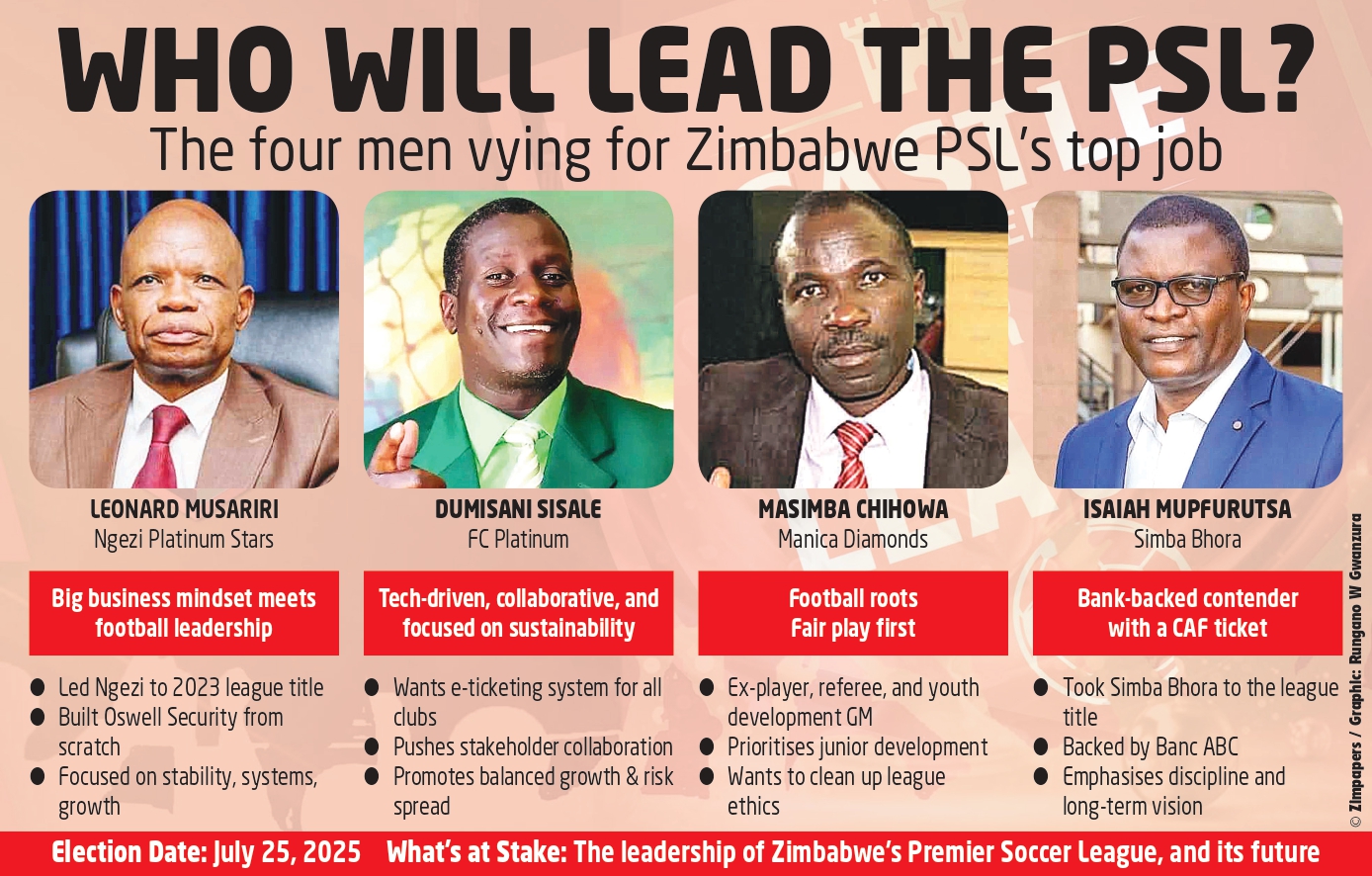
Mugove Chigada
Deputy Sports Editor
IT is the biggest football job no one wants to mess up, yet only four people are lining up for it.
When Gary Hoffman was pushed out as English Premier League (EPL) chairperson in 2022 over the controversial sale of Newcastle United to Saudi Arabia’s Public Investment Fund, it was a brutal reminder that being the boss of a top-flight football league is no ceremonial role.
Here was a man who had helped steer the EPL through the chaos of Covid-19.
Still, the backlash over the Newcastle takeover was too strong, and he had to go. In hindsight, Hoffman will still be remembered as one of the most effective short-term leaders of the EPL, despite lasting for only 18 months.
“When you’re a sports addict, it should be the dream job,” Hoffman recently told The Guardian.
“But it wasn’t.”
In Zimbabwe, the chairperson’s role carries the same weight and potentially even more risk, given the fragile state of football governance in the country.
On July 25, four Zimbabwe Premier Soccer League (PSL) governors will contest for that job, fully aware that whoever wins will face one of the most demanding leadership roles in local sport.
The PSL’s stability, or lack of it, directly shapes the future of the domestic game.
Still, four men have thrown their hats in the ring: Ngezi Platinum chairperson Leonard Musariri; FC Platinum boss Dumisani Sisale; Simba Bhora chairperson Isaiah Mupfurutsa; and Masimba Chihowa, who leads Manica Diamonds.
In many ways, this is a race of contrasting profiles — a self-made executive with strong corporate ties; two seasoned football administrators with a solid grasp of boardroom politics; and a figure grounded in football’s grassroots, someone who has seen it all, from officiating to youth development.
They are all promising a better PSL. Some speak the language of growth, others of fairness and reform. One comes with surprise corporate backing that has raised questions. All believe they can deliver a league that does not just function, but thrives.
Musariri’s campaign hinges on his track record, both in football and business.
While chairing Ngezi Platinum Stars (NPS) last season, the club captured its first Castle Lager Premier Soccer League title under his leadership. But long before that, Musariri was already building something else, Oswell Security, a company he started with just 15 people in 2001.
Now, it employs over 2 000 across Zimbabwe.
“That sets me apart from the other candidates,” he says. “By 2015, when we were ISO-certified, we already had 1 000 people. Now, we’re over 2 000.
“That experience of leading such an organisation to that growth, and putting in place systems that work even when I’m not too hands on is the reason I believe I’m capable of leading PSL through the different growth stages.”
He is not just talking theory. His time at Ngezi shows how strategy breeds stability.
“When I got into NPS, I had a clear mandate, to ensure the club was self-sustainable and deliver silverware. We achieved that. We had to first look at some practical issues. How many coaches were fired before Chiragwi? Too many. I said, ‘This can’t continue.’ We stuck with Chiragwi in his first season, and that’s when we won the league. Stability is crucial in any setup,” said Musariri.
On why the PSL should trust him with the top job, Musariri is clear: “You need someone with a clear strategy, someone capable of leading policy formulation. The CEO will handle execution.
“My experience in business taught me the importance of understanding markets. That’s why I’ve also diversified into farming and the transport sector.”
He adds: “The biggest challenge in football is funding. The first step will be ensuring we’re aligned with ZIFA and FIFA statutes. That alignment unlocks opportunities.”
Sisale took over in late 2024 after FC Platinum failed to retain its PSL crown. Despite that, they have kept their structure intact.
He says he wants to strike a balance between commercial growth and long-term resilience.
“We need to minimise capital cost and spread risk,” he says.
Sisale stresses the importance of communication across the league.
“Stakeholders need to be heard. It’s the only way we grow together,” he says.
Sisale wants the league to be smarter, faster and more efficient.
“I would want the league to leverage technology, extend the e-ticketing system to all clubs and enhance both profitability and competition.”
He also does not want to see a repeat of what happened in their abandoned match against Dynamos.
“That should not happen under a well-run league. We must respect different stakeholders,” he says.
On sponsorship, Sisale is balanced, but direct.
“Castle Lager have done well. They’ve played their part. But we must look for other sponsors to complement what’s already there, like we see in other leagues. That will be crucial,” he says.
Chihowa is bringing something different to the table — experience that cuts across the game.
“I’ve been a player, a referee and I’ve worked in junior development as a general manager for the Youth Games,” he says. “That’s experience the others don’t have.”
He believes the PSL’s future rests heavily on youth systems.
“Look at those five junior players registered by clubs. How many of them actually get a chance to play? Development is being compromised,” he said.
Chihowa is also speaking openly about fair play.
“When you win, you must win fairly. That’s at the centre of what I believe in, and what must be brought to PSL. You must not win by hook or crook. We need to stop that. I want to help build a culture of integrity,” he said.
His club is yet to win the league title, but he is unfazed.
“Our time will come. What matters now is fixing the game, from the bottom up,” he said.
Mupfurutsa has walked this path before.
He first tried to implement his football vision at Dynamos, but was frustrated by the chaos at the club. His move to Simba Bhora has since paid off — they won the PSL title and booked a CAF Champions League slot last year.
Even after losing coach Tonderai Ndiraya to Scottland, the team has stayed focused under Joel Luphahla.
Mupfurutsa’s leadership style mirrors that of the other candidates, focused on systems, sustainability and club empowerment.
But his most headline-grabbing moment came days before the election: public endorsement by BancABC.
“Poised. Proven. Passionate. Isaiah Mupfurutsa isn’t just a contender for the Premier League chairmanship, he’s a visionary with the discipline, drive and leadership we know well at BancABC Zimbabwe,” the financial institution said in a statement. We’re proud to stand behind one of our own as he steps up to shape the future of the beautiful game.”
This endorsement has left many wondering: Could BancABC be preparing for a return to football sponsorship?
Whoever wins this month’s election will not just be managing fixtures and fines. They will be tasked with rethinking the business of local football, modernising its systems and holding the trust of clubs, sponsors and fans alike.
The PSL is not in crisis, but it is not thriving. For a league still searching for consistency, the next chairperson will need to be more than just a figurehead.
This time, it is not just about who wants the job; it is about who is ready to fix it.
It is game on.



 Online Reporter