
Gareth Willard Production Editor
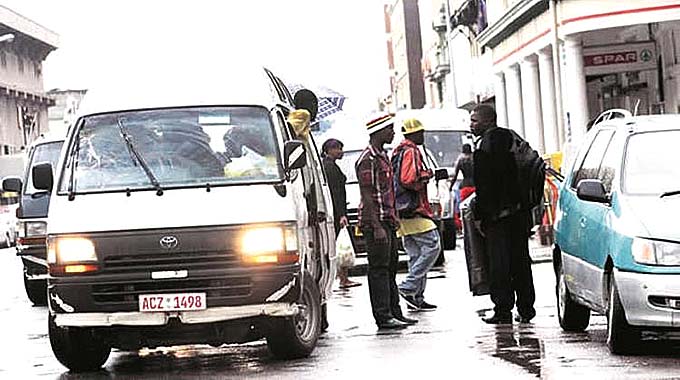
The total failure of the Harare City Council scheme to ban kombis from the city centre was predictable and this failure was part of the council’s complete misunderstanding of what public transport is, what it can do, how it operates and what makes it successful or otherwise.
Solutions need to be win-win-win, that is a win for passengers, kombi drivers and other road users. There may be no grand solutions, but rather a set of 100 tweeks that combined transform the system.
To get the debate going, there is need to examine and accept a number of fundamental propositions that have been proved by experience in most cities of the world and apply to all, including Harare.
- All public transport automatically helps to de-congest a city centre, the central business district, even if it is a bad system and the better the system the more de-congestion.
- Passengers using public transport want a system that is safe, efficient, speedy and requires the minimum number of changes on a particular journey. It also needs to be affordable.
Kombis ease congestion
To take the first. It seems obvious but it is clear that many Harare council officials and their political masters miss the point. They talk about banning kombis to de-congest the city centre. In fact, even the fairly bad kombi system reduces congestion considerably.
The 10 000 or so kombis working the Harare routes must move close to one million people a day. That calculation rests on the economics of a system whereby a driver needs to pay $80 to the bus owner, cover his fuel and police fines (a diminishing charge), pay off the tout at the city centre loading end and sometimes the other end as well, pay off the conductor and still have something to take home.
All this requires close on $200 a day and with 18 passengers paying 50c on each journey that in turn means each kombi on average must sell about 400 fares, or on average move a minimum of 200 a day in each direction on his route.
If those 200 people used private cars the congestion would be totally intolerable. Even if every private car packed in five people as car-owners got neighbours and colleagues to share expenses, that would still mean each kombi would be replaced by 20 cars, and putting another 200 000 cars on Harare’s roads each day would simply gridlock the city. No one would move. And that excludes the parking bays that would be needed in the city centre, industrial sites and other places of formal and informal employment.
The replacement of scores of private cars by one bus or train is the reason why so many cities encourage and create efficient public transport systems, and try and figure out ways to get just about everyone to use them. Many German cities, in a country where almost everyone owns a car, go to the extreme of banning private vehicles from their central business districts.
But most major European cities have built up systems using underground railways, dedicated bus lanes and other programmes to make public transport much faster, more efficient and a lot cheaper than using a private car.
The economic laws thus ensure that most people in those cities leave their cars at home for after-hours and weekends use and go to and from work by train, metro or bus.
Some in outer suburbs and satellite towns will drive to a station, park there and commute the rest of the way. But they still pay a lot less in time, as well as money, than if they drove into the central metropolis. And the time savings attract the rich and middle classes.
We are already seeing the start of this in Harare. Shop-owners in some suburban shopping centres, and especially Avondale and Belgravia, are complaining that there are people, still in the scores rather than the hundreds or thousands, who park all day outside their shops for free and spend $1 on a return bus fare to the city centre, thus avoiding a lot of hassle in finding city parking and then paying around $9 a day using it.
Of course, kombis themselves, with their 18 passengers, are not exactly the most efficient system of public transport. Large buses would do the job a lot better. A decent bus can carry four kombi-loads of passengers sitting and another kombi-load standing. So a decent fleet of big buses for Harare would have just 2 000 vehicles.
In fact, since some routes have lighter traffic, and a big bus would need a couple of hours to load enough paying passengers to be viable, and because traffic is lighter in off-peak hours, a decent bus service might go for say 1 500 large buses and 2 500 mini-buses to get the advantages of both.
But that would require an investment of well over $500 million and with the associated infrastructure, an investor would need in round figures a cool $1 billion. This is unlikely tomorrow.
Harare used to have such an investor, the Harare United Omnibus Company. Older readers will remember the maroon and cream buses. That company had built up its fleet over decades, expanding as the city expanded.
It had a complex contract with the city council, which had brought it in when its own little bus service totally failed; councils in the old days were not more efficient than councils now.
But the basic HUOC contract was a monopoly (so competitors would not cream off the profitable routes leaving the basic service routes to the official provider) coupled with a performance contract to supply an agreed service to all suburbs at a ticket price that was negotiated after very careful analysis by accountants to give HUOC a profit if it was totally efficient and a loss if it was just 1 percent off efficiency.
But some of the systems used by HUOC could be used by the council or bus-driver co-operatives to boost the efficiency of the kombi-fleet and reduce congestion a great deal. HUOC itself was nationalised, combined with ZUOC that served the other cities into Zupco which was slowly but deliberately run into the ground by bad management and a fare structure that made no sense. Hence the kombis.
Passengers matter
The second vital point to take into account is that public transport is not about kombis, or buses or trains. It is about people, to be precise the hundreds of thousands of people who are the passengers. This is something Harare City Council forgets.
These people simply want to get to work, or get to where they do business even if it is the informal sector, or get their children to school as quickly, efficiently and as cheaply as possible. These are not ignoble ends.
To do this they want as many single journeys between destinations, with the absolute minimum of bus or station changes. Time is money for everyone, including the poor.
Why Harare plan was doomed to failure
So this is the first objection to the Harare council plan to have all routes converge at three outside holding centres and passengers transferred to “shuttle buses” that would carry on into the city centre.
As economists have noted, this imposes a double tax on those using kombis, a tax in cash by almost doubling fares and a tax in time as they wait for a shuttle to fill. And that time tax might well be long; Harare City Council is not famous for efficiently managing systems.
The second objection to the Harare plan was that it simply could not work in achieving its desired objectives.
The number of buses driving into the city centre would be exactly the same, simply because the same number of people needed to be moved. And the problem of buses parking in the city centre waiting for passengers would be exactly the same as they would have to park to wait for a loading slot and then fill with their 18 passengers to make the service financially viable.
So the congestion that the council was worried about, and was the main reason for the scheme, was not going to change significantly. The same number of buses on the road in peak hours and parked in off-peak hours would be unaltered.
The third reason for the failure, and the reason for the intense hatred, and that word is not too strong, of the council on Thursday, was its colonial-style attitude that passengers were “them” not “us”.
This is common in countries like Zimbabwe where senior officials in the private and public sector would rather spend an hour commuting by car than half an hour by bus because they see bus travel as low status.
Again turning to Europe, we have CEOs going by metro or train. A CEO might even be in the same metro carriage as the young man who makes his/her tea, but they will take care not to notice each other unless the CEO happens to be a strap-hanging standing passenger and the tea-maker has both a seat and a desire to avoid a lateral transfer to cleaning bathrooms.
So since the rich also ride the trains and buses, including senior council officials, there tends to be both an understanding of what is involved and top-end pressure to make sure problems are sorted out and the systems improved.
This is one reason why there are suggestions that all senior council officials, from the town clerk downwards, spend at least a fortnight, and preferably a month, commuting by kombi before even thinking about fancy schemes.
The economics of the kombi system
Before changes and improvements can be made everyone needs to understand the economics of the kombi system of public transport. The most important point to realise is that ownership and operations are both very diverse and separate. There is no one in charge to negotiate with.
The kombi-owners are generally small-scale businesses, a lot of owners just have one or two vehicles and even the biggest fleets are rarely more than a couple of score. So the 10 000 kombis have more than 1 000 owners.
Owners are responsible for licensing, maintenance and repairs. In other words their responsibility begins and ends with providing a suitable vehicle to a driver each day.
The drivers are not employees. They are all independent contractors in economic jargon. Each driver rents a bus for between $80 and $100 a day and is totally responsible for the operations of that bus. The owner neither knows or cares how many people the driver carries and how he does his business. The drivers are the operators, not the owners, so there are 10 000 operators.
Each driver is responsible for operational expenses, that is the fuel, the employment of the conductor (often a relative), the payment to the touts (the equivalent of one fare), fines police might raise although this is now rare and odd goodwill payments to police (still there although at low rates).
With odd exceptions of very long routes, such as to Ruwa, outer Borrowdale, or to Chitungwiza and sometimes Budiriro in peak hours, the standard fare is 50c and the standard load is 18 passengers, giving $9 a trip.
The margins are very very tight and the financial the system could not work on a 50c fare unless every bus leaves its terminus each end with the a full load, or at least something close to a guarantee that extra passengers can be picked up on route, although even here most drivers would prefer to sell the same seat twice by dropping off an original passenger and picking up a replacement. But that is not always possible.
Non-kombi users may be surprised to hear that both drivers and conductors tend to avoid being rude to customers and do in their own way try and treat the customer as king. This explains those sudden stops and starts that so irritate car drivers.
It is not the bright idea of the driver to do this, it is the bright idea of the passenger who wants to be dropped off right outside their home or place of employment or the potential passenger raising their hand to signal that they want a ride. So schedules setting up stopping places need input from both drivers and passengers.
There is a third group involved in the business – the touts at terminuses and loading ranks. These are not really necessary. The conductor can quite easily shout out the destination and does in fact load his bus efficiently, making sure that each row of seats has four passengers as well as helping little old ladies with large bags on and off the bus. Touts run more of a protection racket, collecting their 50c for each bus for doing very little.
Problems
The first problem that many bring up is the number of buses on the road. That cannot be cut. Car drivers need to imagine how worse it would be without buses. And as explained, shuttle services will not cut numbers; in fact they may well increase them with the double journeys required.
The second is the sudden stopping. Here people who actually use the routes need to designate the bus stops. They should not be more than 500m apart on the trip, and preferably less, and should be at least one every two blocks in the city centre. Positioning can then be done so that they are at least 20m from any intersection.
The campaign to enforce these needs to involve passengers as well as drivers; but frequent bus stops in the needed places will help secure passenger co-operation. The third problem is the vast areas of road and verge occupied by buses in off-peak hours.
With each driver an independent operator and in competition, co-operation is low. Drivers, or most drivers, will accept the fact that have to queue, but that means that only drivers physically present in the queue can establish prior rights. Disappearing to buy fuel or even a burger will lose your place.
This is the main reason why one of the council’s better ideas – to have a holding area in Coventry Road – failed. There was no system in place to avoid rampant queue jumping.
The parking and queueing for the eastern and central northern routes is not too large a problem. The S. V. Muzenda Street terminus (still Fourth Street in kombi land) is large and can accommodate most buses using routes exiting along Borrowdale Road, Enterprise Road, Samora Machel Avenue, Robert Mugabe Road and Chiremba Road. Overflow into Muzenda Street and Fifth Street is a modest nuisance that does not block the roads.
For the limited number of routes that drive Mount Pleasant way, exiting along Sam Nujoma Street, the Rezende terminus is also just big enough.
But then come the two horror stories, the southern routes that use Seke Road and the western routes that all seem to start at what is known as Copacabana after a famous Portuguese restaurant that used to be in the area but which actually covers a lot of city blocks. The Charge Office terminus is a joke and Market Square is not much better, so most buses and most ranks are along verges and many roads, narrower than the eastern side of town to start with, are choked.
It is this choking that the Harare plan wanted to solve, and which was never going to work.
Solutions
The council before it takes action has to consult widely and understand the needs of both passengers and kombi-drivers, and understand the pressures that the system of thousands of independent contractors imposes.
But solutions are possible.
Most passengers, and probably most drivers, would prefer dealing with a municipal policeman managing a loading rank so long as that person was polite and honest. So touts could be replaced by uniformed staff.
With these council staff managing the ranks, the waiting area in Coventry Road could be re-examined, at least for buses on the southern and western routes.
The system would almost certainly have to involve queue numbers being distributed at Coventry Road, the sort of thing the passport office or banks issue, and when the rank marshals, the council employees, asked for another pair of buses the dispatcher at Coventry Road would take the two lowest numbers in the queue for that rank and they would not be allowed to pick up passengers unless they showed their ticket to the marshal.
There would still be problems of queue jumpers entering the route at a later stop, so any system might have to have enforcement, perhaps that buses could not wait at bus stop, just stop for a couple of minutes to let people on or off.
Almost certainly drivers and passengers might have better ideas.
Any system will be difficult to implement, simply because no one is in charge, and because there are three groups who all have to win in any change: the passengers, the drivers and the other road users. But council staff can call driver meetings in off peak hours, encourage drivers on each route to elect a representative or two, and by riding the kombis themselves, can start getting a good idea of what passengers want as well as talking to pas- sengers.
No solution is going to satisfy everyone and no solution is going to stop kombis in the city centre. We have to start with what we have, not what we want.
But it is not impossible through consultation and careful thought to find improvements, each improvement having to be a triple win for passengers, kombi-drivers and other road users. That is a high standard to meet, but in a city as large as Harare there should be enough imagination to generate dozens of ideas, some of which might actually be worth trying and an even smaller number might actually work.
The council is perhaps the only organisation that has the authority and interest to start the debate and process, but it has to be open to all needs, not just those of the vocal “other road users” who desire simplistic solutions that cause major suffering, do not work and in the end create triple losers of passengers, drivers and people stuck in huge traffic jams. The motto must be win-win-win.