admin
admin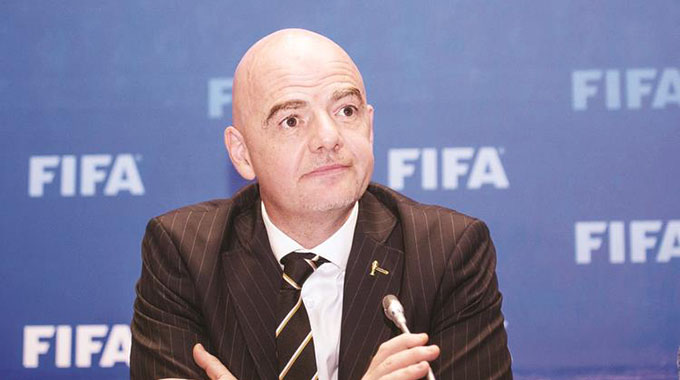
Robson Sharuko
H-Metro Editor
IN his New Year’s message, FIFA president Gianni Infantino placed a lot of emphasis on the massive role football has been playing to cheer the world, amid the gloom brought by the Covid-19 pandemic.
He spoke about how he hopes the 2022 World Cup in Qatar will provide a rainbow of joy to the dark cloud, which has been hanging over the globe, amid the chaos, uncertainty and millions of deaths inflicted by the pandemic.
There is a reason why the 2022 World Cup, just like the 2010 World Cup, is generating a lot of curiosity within the global football family.
The showcase is rolling into virgin territory, which has never hosted such a tournament before, in yet another demonstration by FIFA of their commitment to ensure football belongs to the entire world.
“The FIFA World Cup Qatar 2022 will be a truly unique occasion to re-unite the World again in a celebration of football and social inclusion. We all need it,” said Infantino.
“Football has many different levels but in its magical essence it is the same game, the people’s game, for everyone, in every continent, every region, every country.
“FIFA is the only governing body that looks after and cares about the entire world.
“We will continue working hard to live up to the mission of not forgetting the ones who need most and who have no voice, while also protecting the healthy growth of everyone else and the global football movement.
“We continue to strive towards making football truly global through football and corporate governance, through competitions and events and through the development of our sport, widening its impact on the youth and wider society, for women and men, for girls and boys.
“The new FIFA is a democratic body and together with our stakeholders, we will design the path for football’s future, making the game fit for purpose in the modern era and ensuring that we can boost global competitiveness.
“We will work together for unity and the ultimate benefit of everyone.”
Just four years ago, Infantino was in this country and even took to the dance floor, at the Rainbow Hotel, amid the birthday celebrations, which were being held, for the then ZIFA president, Philip Chiyangwa.
Infantino, who was accompanied by FIFA secretary-general Fatma Samoura, and other top world and African football leaders, during the two-day visit, revealed his passion to help football in Zimbabwe grow to another level.
“There are some concrete projects which have already started, which we are fully supporting, and we would like to thank the Government for having embraced these projects,” said Infantino.
“Such as the project to create 8 000 football clubs, around the whole country, to develop grassroots football in a structured way, from the grassroots up the pyramid to the elite football.” Of course, the establishment of 8 000 football clubs is yet to be realised, thanks largely to the chronic lack of leadership in domestic football, but FIFA cannot be accused of not having provided support towards this noble cause.
Somehow, for all the leadership challenges, which domestic football continues to face, the national game has stubbornly refused to be crippled by the shortcomings of those who come pretending to be its leaders, when their mission is to destroy it.
It must have cheered Infantino that, just a month before his arrival in Harare, the Warriors had featured at the 2017 AFCON finals, marking their return to the tournament, after a nine-year absence.
And, that they were the only Southern African country to make it to the AFCON finals in Gabon, was itself a huge statement, made by the Warriors.
They had taken on Algeria at that tournament in Gabon and stretched the Desert Foxes to the limit, in a pulsating 2-2 draw, in a game in which Khama Billiat made more headlines, around the world, than Riyad Mahrez.
It must also have cheered Infantino that, just five months before his arrival in Harare, the Warriors had secured their place at the 2017 Nations Cup finals top of their group, beating Guinea to a place in Gabon.
For a team, which had suffered the ignominy of being thrown out of the 2018 World Cup qualifiers, for the sins of their fathers after the ZIFA leaders somehow failed to pay coach Valinhos his dues, this was an impressive comeback by the Warriors.
It was a perfect demonstration of the life, which Infantino and his colleagues at FIFA House in Zurich, want to see in the game, across the world.
Four years later, the Warriors are in Cameroon, for the 2021 AFCON finals, a feat which the South Africans, with all their financial might, which enabled them to even host the 2010 World Cup finals, failed to achieve.
A feat which the Zambians, who have a bigger international football profile, after being crowned champions of Africa in 2012, have failed to match.
However, the Warriors’ participation in Cameroon remains under threat, with FIFA ruling that the suspension of the ZIFA board, by the Sports and Recreation Commission, could be deemed third-party interference, and lead to Zimbabwe’s suspension from the international football family.
This could probably see the Warriors being thrown out of the 2021 AFCON finals, without kicking a ball, should FIFA proceed with their threats.
Once again, as was the case ahead of the 2018 World Cup qualifiers, the Warriors find themselves likely to be the pawns in the boardroom issues, which they have no control over.
Maybe, the time has come for Infantino, given his emphasis that this is a “New FIFA,” which is concerned with seeing football developing, rather than being suffocated to its death, fights in the corner of the Warriors.
Because, after all, they are the real embodiment of what FIFA want to see, a team which is usually let down by their leaders but which, now and again, finds a way to defy the odds, and keep football alive in their country.
They have had the worst administrators, in one form or the other, but they have kept going and they are now set to feature in their third AFCON finals, on the bounce.
They have pushed their two biggest rivals, Zambia and South Africa, two countries with very good football leaders, into the background and Chipolopolo will be missing from the AFCON finals, for the third tournament in a row. Bafana Bafana will be missing from the AFCON finals, for the second time, in the last three African football festivals.
Six years ago, the Atlas Lions of Morocco were barred by CAF from the 2017 and 2019 AFCON qualifiers, as punishment for the country’s decision to withdraw from hosting the 2015 Nations Cup finals, amid an Ebola outbreak in West Africa.
Morocco took their case to the Court of Arbitration for Sport, arguing the CAF decision was against the development of football in the Northern African country.
CAS ruled in their favour, largely for the sake of the players, who had no input whatsoever in the decision by their political leaders to withdraw from hosting the 2015 AFCON finals.
It’s something the Warriors, and their fans, are hoping for from Infantino.
They are the only reason football is still alive in this country.



 Online Reporter