admin
admin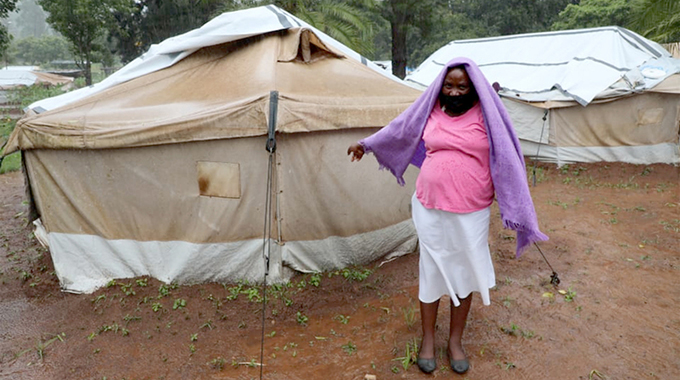
Rumbidzayi Zinyuke
Manicaland Bureau
When it rains in Chimanimani, the children do not run outside to play in the rain like we used to do as we were growing up.
They run outside to be safe.
The adults do not gaze outside and thank God for the precious liquid which brings with it, an abundance of food.
They pray to God for protection so that they can see one more day!
When it rains in Chimanimani, life stops until another ray of sunshine breaks the dark heavy sky.
Until that happens, no one appreciates the life giving rain. Because for them, the rain brings with it death, sorrow, despair and destruction.
After Cyclone Idai ravaged that part of the country in March 2019, life has never been the same for the villagers.
Since that disaster, the district has been receiving more rain than ever before and the situation has not been made any easier by the fact that Chimanimani now seems to be in the path of every Cyclone and tropical storm coming through the Mozambique channel.
According to the villagers, even without the storms and cyclones, the way it rains in Chimanimani is now different from everywhere else.
After experiencing 30 minutes of heavy rain in Chimanimani this week, I gained a new perspective on how intense the rain episodes can be.
What began as a journey to find out how the displaced villagers who are now living in camps are coping with the heavy rains and evacuations to safer areas, became an eye opening lesson on how disasters can change a people’s view of some of God’s gifts to humanity.
Our mission was to get to the camps, see the situation on the ground, talk to the people there and write an informed article about them.
But as we approached Ngangu village, dark heavy clouds began to descend over the area. We quickly went through our interviews at the first camp and went on to the second one.
We got to Aboretum camp and only went as far as introducing ourselves before the first drops of rain began falling.
Sitting in the shed the villagers use as a community kitchen where three fires had been lit, we ignored the rain and Gogo Tsengeni Matonhora began explaining how they had to be evacuated to safer places twice since the end of December.
Tropical storm Chalane had posed a danger to them and the Civil Protection Unit had to move them.
Barely two weeks after they returned to the camp, they had to be moved once more because tropical storm Eloise had hit them.
As if sensing what we were talking about, the rain suddenly intensified. The wind became stronger and I felt the drops land on my feet.
Within a few minutes, the fires started going out one by one and more water found its way into where we were sitting so we had to move.
We stood right at the edge of the shed and watched helplessly as the heavy wind shook the trees and water flowed freely into the tents.
I became worried when the wind changed direction and we suddenly had nowhere to hide. We could not avoid getting soaked.
Although I did not say a word, Gogo Matonhora could tell I was worried so she started talking to me. She spoke of how it had become the norm for them to seek refuge outside when it rained.
“These kids have seen a lot,” she said pointing to her grandchild who was standing next to her.
“They are afraid of the rain. Even us adults, we have suffered a great deal. You cannot cook, you cannot eat or do anything when it rains. If the rain comes in the middle of the night, you want to be outside because then you can see the water as it comes, or the tree as it falls.
“At least in the afternoon, you can see what is happening,” she said.
She pointed to a nearby tent that had a huge tree lying on top of it.
“The owner of that tent had to seek accommodation with relatives after that tree fell on the tent during tropical storm Chalane. Luckily, we had been evacuated,” she said.
As she spoke, another woman, Mrs Christine Maganda came out of her tent with her two year old child tightly strapped on her back and ran towards us.
Oblivious to the danger, the little girl laughed as the rain hit her face but her mother’s face showed nothing but worry.
“I just couldn’t sit in there anymore. The tent was moving as if it would be blown away by the wind. And the water was getting into the tent so I couldn’t take it any more so I just had to get out. It is much better to be outside where I can see where the danger is coming from,” she gasped.
After about 30 minutes of the gale, the wind died down and finally the rain turned into a lighter shower and we could finally continue with our interviews.
Mr Shadreck Jambakuyana said: “For two years, we have lived with the fear of the rain. We cannot take it anymore. We should be happy when it rains and be able to sleep peacefully but here, all we can do is worry. As you can see, just 30 minutes of rains here can cause so much destruction.
“The water will flow into the tents and cause more harm than good. All I can wish for is for the rain to go away so that I can sleep at night,” he said.
As I left the camp, I prayed that when the rains pounded Chimanimani again, the people would be as safe as I was in my house.
That they could look outside the window and smell the sweet scent of the mud.
Maybe someday they will be able to do that but for now, we should all pray for Chimanimani!



 Online Reporter