

 admin
admin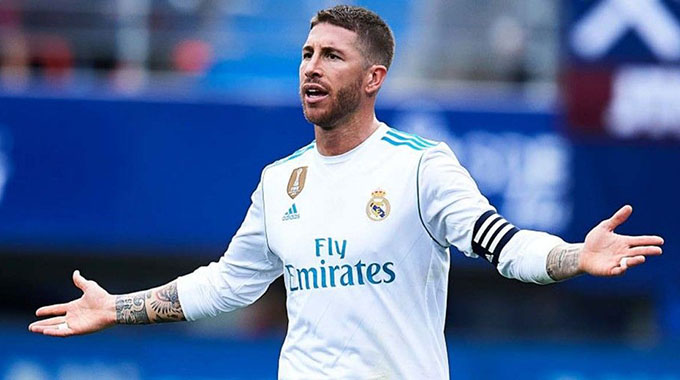
MADRID. — To understand Sergio Ramos, his longevity and his many successes, you do not have to look far. His CV is displayed proudly across his body, in tattoos which are so numerous that little space remains for any more.
On the knuckles of his left hand are the numbers 35, 19 and +90, which respectively make reference to the shirts he wore when starting out with Sevilla, the number used on his debut with Spain and the extra-time victory when Real Madrid won their iconic 10th Champions League, rescued by his 93rd-minute equaliser.
On the same hand there are the birth dates of his four sons. On his arms are the names of his parents. On the left one, the day he signed for Real Madrid (31 August 2005) and on the left biceps a trophy representing the World Cup won with Spain.
Perhaps a red card — he has been shown 26 of them in his career — is the major omission.
Whether the next inscription will be Real Madrid-related is a matter of increasing conjecture. Centre-back Ramos, 35, is out of contract in the summer and there is little sign of agreement over a new deal being reached.
The future of one of European football’s most successful modern captain-club relationships might be coming to an end. He has been on the brink before, but never in his 16 years at the Bernabeu has he been so close to leaving.
Ramos has been one of the great modern defenders for a decade and a half, a symbol of Real Madrid’s relentless pursuit of success, and throughout that time he has divided opinion — even in his own club’s boardroom.
He became the youngest player in 64 years to make his debut with the national side and his roll of honour includes four Champions Leagues, five La Ligas, one World Cup and two European Championships.
His success, both on and off the pitch, is the result of a mentality that does not believe in half measures.
If there was a moment that defines his personality more than any other, it was his decision to take a Panenka-style penalty in the 2012 European Championship semi-final shoot-out against Portugal.
Just six weeks earlier, he had missed a spot-kick in the same fashion against Bayern Munich in the last four of the Champions League. Real Madrid were knocked out and his was the only penalty missed out of the 21 that were taken. He converted the one against Portugal.
In bullfighting terms, a tradition he admires, in life you can either go out “through the main door, or you end up in hospital”. In his mind, mistakes are just part of the journey, adding recently on social media that “what defines us are not our errors, but how we face the next targets”.
Few defenders have had his influence in both penalty areas in the history of the game, and he is determined to transcend history with goals and records. He is Madrid’s seventh-highest scorer since the turn of the millennium, and has scored more than any other defender playing in Europe’s top five leagues since 2005.
The Madrid sports daily Diario AS described him as a “centre-back with the soul of a number nine”. He has scored a total of 126 goals in 891 senior games for club and country. Last season from the position of central defender he was the club’s second-highest scorer (behind Karim Benzema on 27 goals) with 13 in all competitions, a personal best for him.
His life off the pitch is as storied as the one on it. His presence in the tabloid media paints a picture of an eccentric millionaire: from his choice of clothes, to a Hollywood-style wedding with Pilar Rubio, to the acquisition of a mansion valued at around 12m euros and which is just part of a large portfolio of properties which puts his fortune above 100m euros.
As was evident in his Amazon series (Sergio Ramos’ Heart) he is a strong personality, a game changer and someone who embraced the idea of being a captain right from the start of his career with Real Madrid.
When he arrived from Sevilla in 2005 aged 19 he told media he wanted to be captain and follow on from legends like Fernando Hierro. He has succeeded in doing that and unquestionably has his place among the Bernabeu legends, whatever others in the footballing world might think of him.
So why is his future so uncertain?
With 161 days remaining on his contract, Ramos is free to talk to other clubs about a free transfer in the summer.
He has let it be known he wants to stay at the Bernabeu for the rest of his career, while the club has stated they don’t want him to leave.
So surely that should be that? Job done, where do I sign?
Except of course, when talking about a club like Real Madrid, things are never quite that simple. We’ve been here before and this is the latest “will he stay or will he go?” tortuous negotiation — or, depending on who you believe, non-negotiation — and represents yet another game of poker between Ramos and club president Florentino Perez.
But the difference this time is those conversations have previously never come this close to the wire.
If you listen to Ramos’ people, there has been no contract offer from the club. He has let it be known he has no intention of listening to offers from elsewhere and he is not on the market. For now. He wants to stay for the remainder of his career and is seeking a two-year deal on what he is currently earning, which is 12m euros (£10.7m) a year net.
The problem is that, as things stand, other than informal conversations held between him and Perez (a chat in a hotel bar in Elche, in the passageway en route to the dressing rooms or while standing at the side of the drink dispenser machine at the club’s Valdebebas training complex) there is nothing tangible on the table for him to accept or decline. — AFP.



 Online Reporter