Online Reporter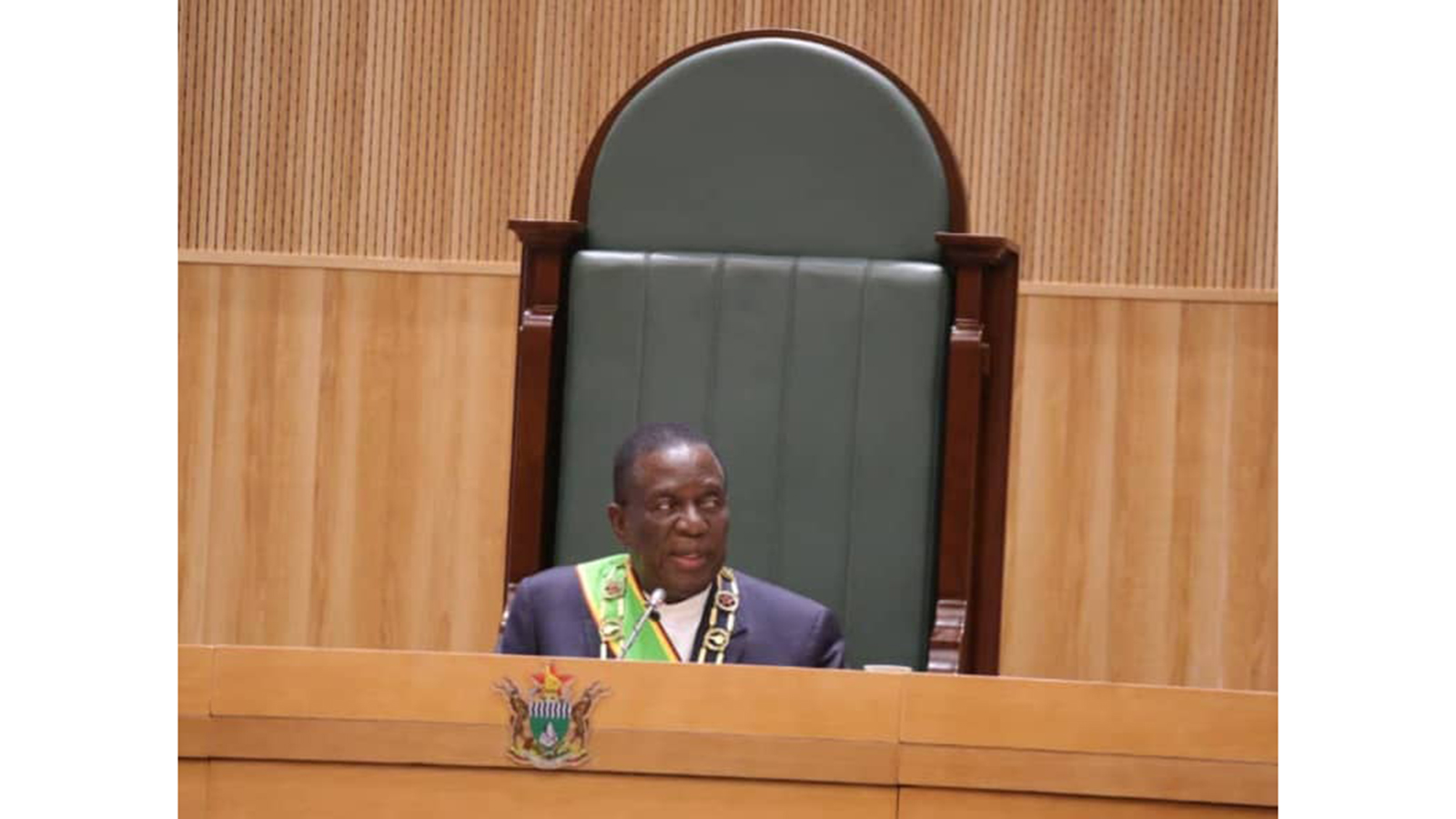
Dr Masimba Mavaza
President Mnangagwa will today deliver the 2026 State of the Nation Address and officially open the Fourth Session of the 10th Parliament at the New Parliament Building in Mt Hampden.
This was announced by Speaker of the National Assembly, Advocate Jacob Mudenda, under General Notice 1866 of 2026 titled “Notice of Official Opening of Parliament and SONA,” published in last Friday’s Government Gazette.
The joint Senate and National Assembly sitting marks the official opening of the Fourth Session, where the President will detail Government’s legislative agenda and policy direction in line with constitutional requirements.
Ruling ZANU PF officials highlight the speech as a key moment to advance national priorities under Vision 2030, with focus on economic measures and development programmes.
Coming soon after his United Nations General Assembly engagements in New York, the address will guide lawmakers on progress made and the session’s calendar at the new Mt Hampden venue.
But what exactly is the State of the Nation Address? Where does this sacred ritual come from?
A HISTORY THAT BEGAN IN 1790
SONA is one of the oldest rituals of constitutional democracies in the world.
Its genesis is in the United States. The American constitution, in Article II, Section 3, Clause 1, commands that the President “shall from time to time give to the Congress Information of the State of the Union, and recommend to their Consideration such Measures as he shall judge necessary and expedient.”
The first address was delivered by President George Washington on 8th January 1790 in New York City, then the provisional capital. It was a short address of only 1 089 words. President John Adams continued the tradition of delivering it in person.
Then came Thomas Jefferson, who considered the in-person delivery too monarchical, too reminiscent of the King’s speech from the throne.
He abandoned the oral delivery and instead sent a written report to Congress. For more than a century, from 1801 to 1913, Presidents fulfilled their constitutional duty by sending written messages. History turned again in 1913. President Woodrow Wilson revived the practice of delivering the Annual Message in person before a joint session of Congress, an act that “stunned official Washington”.
He believed the President must be a national spokesman. From that moment, it became the theatre of democracy we know today.
The tradition evolved with technology: the first radio broadcast was Calvin Coolidge in 1923, the first televised address was Harry Truman in 1947, and the first live webcast was in 2002.
From that American seed, the concept travelled the globe — to the European Union, to France, to Spain which adopted it as “Debate on the State of the Nation” in 1983, to Ghana which first implemented it under president John Kufuor, and to South Africa, where the ANC’s January 8th Statement became a SONA outside Parliament during apartheid.
WHEN DID ZIMBABWE ADOPT IT?
Zimbabwe’s journey to SONA mirrors its journey to constitutionalism.
Under the Lancaster House Constitution of 1979, which came into effect on 18th April 1980, the President opened Parliament, but there was no explicit, entrenched provision for a comprehensive State of the Nation Address as we know it today.
The governance culture was largely parliamentary and executive addresses were ceremonial mirroring the British system where the monarch addresses a joint sitting.
The birth of the modern SONA in Zimbabwe came with the Constitution of Zimbabwe Amendment (No. 20) Act, 2013. That Constitution, approved by 95 percent of voters in a referendum, is the most progressive in our history. It created, for the first time, a clear constitutional obligation for transparency and accountability at the highest level.
Section 140 of the 2013 Constitution is the legal anchor:
Section 140(1) provides that the President must address Parliament at the opening of each session and set out the Government’s legislative agenda.
Section 140(4) provides that the President must at least once a year, address Parliament on the State of the Nation.
SONA is four things at once:
1. It answers the simple question: Where are we as a nation? What have we achieved in agriculture, mining, health, education, roads?
2. A Legislative Compass: Tomorrow’s speech is not just reflection, it is direction. The President will lay out the Bills that will dominate the Fourth Session. In the last session, Parliament tabled 54 reports and passed seven Bills apart from Constitutional Amendment No. 3. Tomorrow he will tell the nation what comes next to achieve Vision 2030 — an upper middle-income society.
3. A Moment of National Unity: In a joint sitting of Senate and National Assembly, with ZANU PF and CCC both present — parties that last week together hailed the passage of Amendment No. 3 with 226 votes for and 41 against in the National Assembly — SONA reminds us that despite our differences, we belong to one State and one nation.
4. A Bridge Between Global and Local:
Coming after his UN General Assembly engagements, President Mnangagwa’s address will domesticate global diplomacy into local policy. What did Zimbabwe promise the world, and what will Zimbabwe do for its own people?