Online Reporter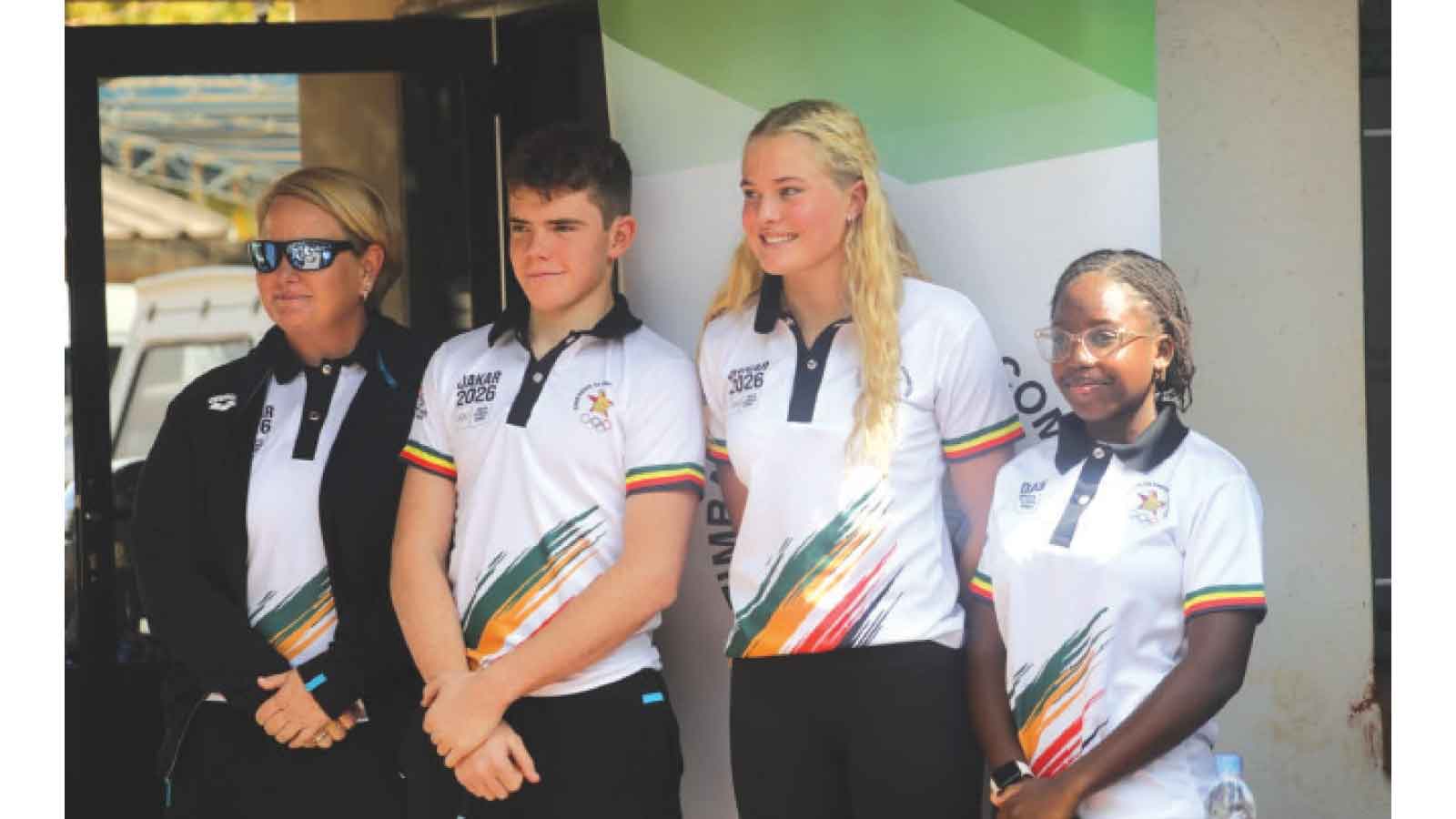
Ellina Mhlanga
Zimpapers Sports Hub
ZIMBABWEAN swimming rarely commands the attention enjoyed by football, cricket and rugby, but whenever the country assembles a team for a major international competition, the sport continues to deliver.
Four of the 11 athletes selected to represent Zimbabwe at the Dakar 2026 Youth Olympic Games are swimmers.
Alexis Johnsen, Daniella Viki, Kwandokuhle Nkomazana and Connor Grist will carry the country’s hopes in the pool when about 2 700 young athletes gather in Senegal from October 31 to November 13. The swimmers make up more than a third of Team Zimbabwe, which has athletes drawn from seven sporting disciplines.
It is the largest swimming contingent Zimbabwe has sent to the Youth Olympic Games.
The country had two swimmers at the 2014 Games in Nanjing, China, before Liam Davis became its sole representative in Buenos Aires, Argentina, four years later. Dakar, the first Youth Olympic Games to be staged on African soil, represents another important moment for a sport that continues to carry a significant share of Zimbabwe’s international ambitions.
Zimbabwe Swimming interim committee coordinator Rumbidzai Mahobele said securing four places had come as a welcome surprise.
“This is a massive milestone and an incredibly positive sign for the future of Zimbabwean aquatics,” said Mahobele.
“Zimbabwe Swimming was absolutely not expecting to secure four slots. This has come as a welcome surprise for the swimming community and the board.
“Having four athletes qualify from a single sport is highly significant, considering that the Zimbabwe Olympic Committee announced an 11-member squad across seven sporting disciplines.
“This opportunity takes the four athletes from regional competition into the elite global arena.” Seasoned coach Lindsy Tudor-Cole, who will lead the swimming team in Dakar, shared Mahobele’s excitement.
“Oh look, we are very grateful. I don’t think we expected to have four,” said Tudor-Cole.
“In the history of the Youth Olympic Games, we have had two swimmers and then one in Argentina in 2018. To be given four spots is a real blessing, and we are very privileged.
“It is such big exposure for these athletes, especially at youth level, so we are very excited.”
Tudor-Cole travelled with Davis to the 2018 Games and will now return to the competition with Zimbabwe’s biggest swimming team.
The four swimmers are not strangers to international competition.
They were part of Team Zimbabwe at last year’s African Youth Games in Angola, where swimming provided 14 athletes, one of the largest contingents in the national team.
Johnsen emerged as one of Zimbabwe’s leading performers after winning three individual medals. Her campaign included gold in the women’s 50m freestyle, where she clocked 27.00 seconds to set a national record.
Such performances suggest swimming still has a functioning pathway for identifying and developing young talent.
Mahobele attributes the sport’s consistency to an organised domestic competition programme that begins at school level, feeds swimmers into clubs and provincial structures, and supports their long-term development.
But she believes more must be done to help those athletes move from regional success to elite international competition.
“Swimming must bridge the gap between regional talent development and elite international sport,” said Mahobele.
“Building on the Dakar 2026 milestone requires turning this achievement into a repeatable and sustainable system.”
Any promising generation of Zimbabwean swimmers will inevitably be measured against the country’s Olympic past.
Apart from the women’s hockey team that won gold at the 1980 Moscow Olympic Games, swimming is the only discipline to have delivered Olympic medals for Zimbabwe.
Through former Sport, Recreation, Arts and Culture Minister and current International Olympic Committee president Kirsty Coventry, the country won seven medals across the Athens 2004 and Beijing 2008 Olympic Games. Coventry won three medals in Athens, including gold in the women’s 200m backstroke, before successfully defending that title in Beijing, where she collected another four medals.
No Zimbabwean swimmer has added to that Olympic tally, but the sport has continued to provide athletes for major competitions such as the African Games and the Olympics.
It also remains one of Zimbabwe’s leading medal contributors at the African Union Sports Council Region Five Youth Games.
A new generation is beginning to emerge.
Swimmers such as Anje van As and Paige van der Westhuizen, who are targeting the Los Angeles 2028 Olympic Games, have been joined by youngsters, including Mikayla Makwabarara and Johnsen, in breaking longstanding national records.
Makwabarara underlined her progress at the Africa Aquatics Senior Championships in Algeria in May, winning five individual medals on her debut.
Her haul included gold medals in the women’s 100m and 200m butterfly events.
She had won the 200m butterfly title at the Africa Aquatics Junior Championships in Cairo, Egypt, in 2025, and repeating that success at senior level showed her steady growth.
The results offer hope, but they also bring the country’s familiar challenges back into focus.
Zimbabwe still needs better swimming facilities, more international exposure and regular high-level competition if its promising juniors are to develop into elite senior athletes.
The four places secured for Dakar show that the pathway continues to produce talent.
Dakar has shown that Zimbabwe can still produce promising swimmers. The real test is whether the country can keep them in the pool long enough to reach the elite stage.