Sundaymail Editor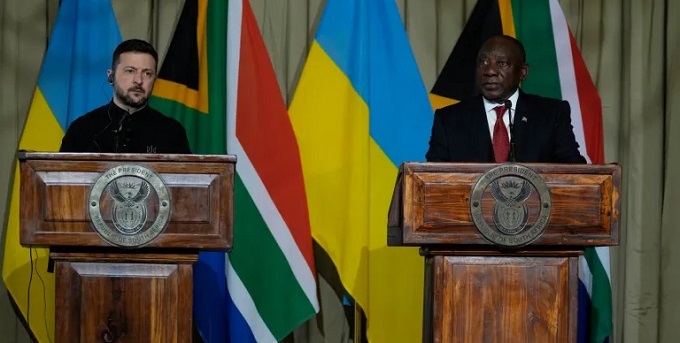
Moussa Ibrahim
When Ukraine’s leader Volodymyr Zelenskyy landed on African soil last week, he was not just making another stop in a diplomatic tour.
He was bringing with him the full weight of the Euro-American agenda, crafted in Washington, Brussels and London, with the aim of drawing Africa into a war it did not start and does not benefit from.
This was not about Ukraine seeking understanding or empathy — it was about maintaining a global hierarchy, in which Africa is expected to follow, not to lead.
To understand the gravity of this moment, we must move beyond the spectacle and sound bites and revisit the deeper currents shaping the world today. The war in Ukraine is not a self-contained event.
It is the product of decades of NATO expansion, Western military-industrial escalation and the relentless refusal of the West to accept a multipolar world. Ukraine, tragically, is not a sovereign protagonist in this story — it is a pawn. Since the 2014 Western-backed coup and subsequent civil war in the Donbass, Ukraine has been absorbed into the orbit of NATO’s militarism and the West’s ideological war against Russia.
It has become a client state of Washington, surviving on International Monetary Fund (IMF) loans, European Union (EU) aid packages and American military hardware.
Its economic decisions are dictated by external creditors. Its war effort is sustained by Western arms.
Its diplomacy is choreographed by the same apparatus that once orchestrated regime change and military interventions across the Global South. And now, this same apparatus is seeking to globalise the conflict by dragging Africa into its fold.
Zelenskyy’s visit to South Africa is thus not a bilateral courtesy — it is part of a greater project to fracture the Global South’s solidarity with Russia, China, India and the BRICS alliance. Africa must resist this.
Ukraine’s historical disregard for Africa
Let us not be seduced by the sudden charm offensive. Ukraine’s voting record at the United Nations has consistently been aligned with the West — even when it meant opposing African interests.
Ukraine has supported anti-Palestinian resolutions, abstained on decolonisation issues and followed the European bloc in rejecting anti-racism initiatives.
Its sudden discovery of Africa is opportunistic, not principled.
Even more disturbing was the treatment of African students and migrants during the early stages of the 2022 war.
As Ukrainians fled to neighbouring countries, black students were denied transport, harassed and pushed to the margins of safety corridors. This racial hierarchy is not incidental — it is embedded in the very white European supremacist frameworks that Africa has struggled against for centuries.
So, we must ask: What kind of partnership is this? What solidarity do we owe to a nation that, in its moment of crisis, showed Africa its back?
Cultural imperialism and the weaponisation of sympathy
Ukraine’s diplomatic messaging is powered not by traditional diplomacy, but by Western public relations firms, Hollywood scripts and media manipulation. Zelenskyy himself is a product of entertainment politics, styled to mimic Churchill one day and a Netflix hero next. This soft power offensive is designed to induce guilt, moral pressure and emotional submission. Africa must not confuse media saturation with moral legitimacy.
Our memory is long.
We know that NATO has never cared for peace — only for hegemony.
We know that selective outrage is a weapon. And we must see Zelenskyy’s appeal for what it is: a geopolitical script to preserve Western dominance by appealing to the sympathies of the formerly colonised.
Africa’s peace philosophy vs NATO’s militarism
Africa’s philosophical traditions — such as Ubuntu — emphasise reconciliation, communal healing and justice.
These values are incompatible with the logic of military escalation, sanctions and permanent war that defines the NATO worldview. Africa must call for peace — but not the hypocritical, self-serving peace that only ends when NATO says so.
We must demand peace rooted in justice, mutual respect and non-alignment, peace that recognises the security concerns of all parties, including Russia, peace that ends the militarisation of diplomacy.
The hypocrisy of sovereignty rhetoric
Zelenskyy speaks often of “sovereignty”. But this rhetoric rings hollow when his government does not respect the sovereignty of African nations to make independent foreign policy choices. His message is not: “stand with peace”. It is: “stand with us, or be morally condemned”.
This is not diplomacy.
It is coercion. It is the colonial logic of moral superiority, updated for the 21st century. Zelenskyy’s outreach targets African political elites, not African peoples.
It follows the old colonial playbook: seduce the chiefs, bypass the masses.
But African liberation was never won by elites alone. It was built by grassroots mobilisation, mass consciousness and continental unity. If we are to engage in international diplomacy, it must be people-centred, not elite-centred. We must resist being used as pawns in another man’s war.
We are not new to these games.
We remember that it was the Soviet Union, Cuba and China — not the United States or the United Kingdom — who supported our freedom struggles. Gamal Abdel Nasser nationalised the Suez Canal and defied imperialism. Patrice Lumumba was assassinated for rejecting Belgian neo-colonialism.
Kwame Nkrumah warned us that neo-colonialism would be the final stage of imperialism. Julius Nyerere taught us that development without dignity is slavery.
Muammar Gaddafi envisioned a United States of Africa and sought economic independence from the West.
These leaders understood that Africa cannot be free unless it speaks with one voice. Zelenskyy’s visit, if not checked, could divide Africa and weaken that collective voice.
Ukraine’s role in arms trafficking and global militarism
Ukraine has for decades been a source of illicit arms, many of which have found their way into African conflict zones.
It has fed the very violence it now claims to abhor. Its military-industrial complex is now aligned with NATO’s, and its survival depends on the continuous flow of weapons. How can such a state offer us lessons on peace?
Ukraine is not economically sovereign. Its national budget is underwritten by Western lenders. Its economy is moulded by IMF conditionalities. Its development model is designed to serve Western European capital — not its own people.
Africa must not emulate this model.
We must resist being pulled into a network of economic dependencies that serve only to preserve the dominance of the dollar and the euro.
BRICS and strategic coherence
South Africa is a member of BRICS, a group committed to multipolarity and alternative development models. Welcoming Zelenskyy without a Pan-African mandate undermines the strategic coherence of this alliance.
It sends the wrong signal to Russia, China, Brazil and India. Diplomacy must be collective, not individualistic. South Africa cannot and should not define Africa’s position unilaterally. This is a continental issue, not a national one. Rather than becoming a battleground for foreign influence, Africa must lead a new peace movement. We can propose an Afrocentric peace framework — grounded in non-alignment, historical justice and multipolar negotiation. This would place Africa at the moral centre of global politics. It would revive our legacy as peacebuilders, not proxies. We can revive the spirit of the Non-Aligned Movement, not as nostalgia, but as a living strategy for independence in global affairs. This framework should include:
A continental summit on African neutrality and peace diplomacy.
A new African Peace and Justice Commission to investigate foreign interference.
Direct people-to-people peace forums between African and Eurasian societies, bypassing elite mediation.
Africa faces urgent crises: climate change, debt slavery, extractive neo-colonialism and social inequality. Zelenskyy’s visit risks distracting from these existential threats and diverting attention, resources and discourse away from the real work of liberation.
Let us not trade our future for a cameo in a European drama.
Africa aligns with itself
Zelensky’s visit is not neutral.
It is a test.
Will we remember who we are? Will we honour the legacy of our martyrs?
Will we reject the seduction of Western agendas and assert a sovereign, Pan-African voice? Africa must rise — not as a tool for others, but as a sovereign force for peace, justice and dignity.
We do not need permission to define our destiny. We need only the courage to stand together. We are not the audience to Europe’s tragedy. We are the authors of our own liberation. — rt.com
Moussa Ibrahim is the executive secretary of the African Legacy Foundation in Johannesburg, South Africa.


 Online Reporter