Online Reporter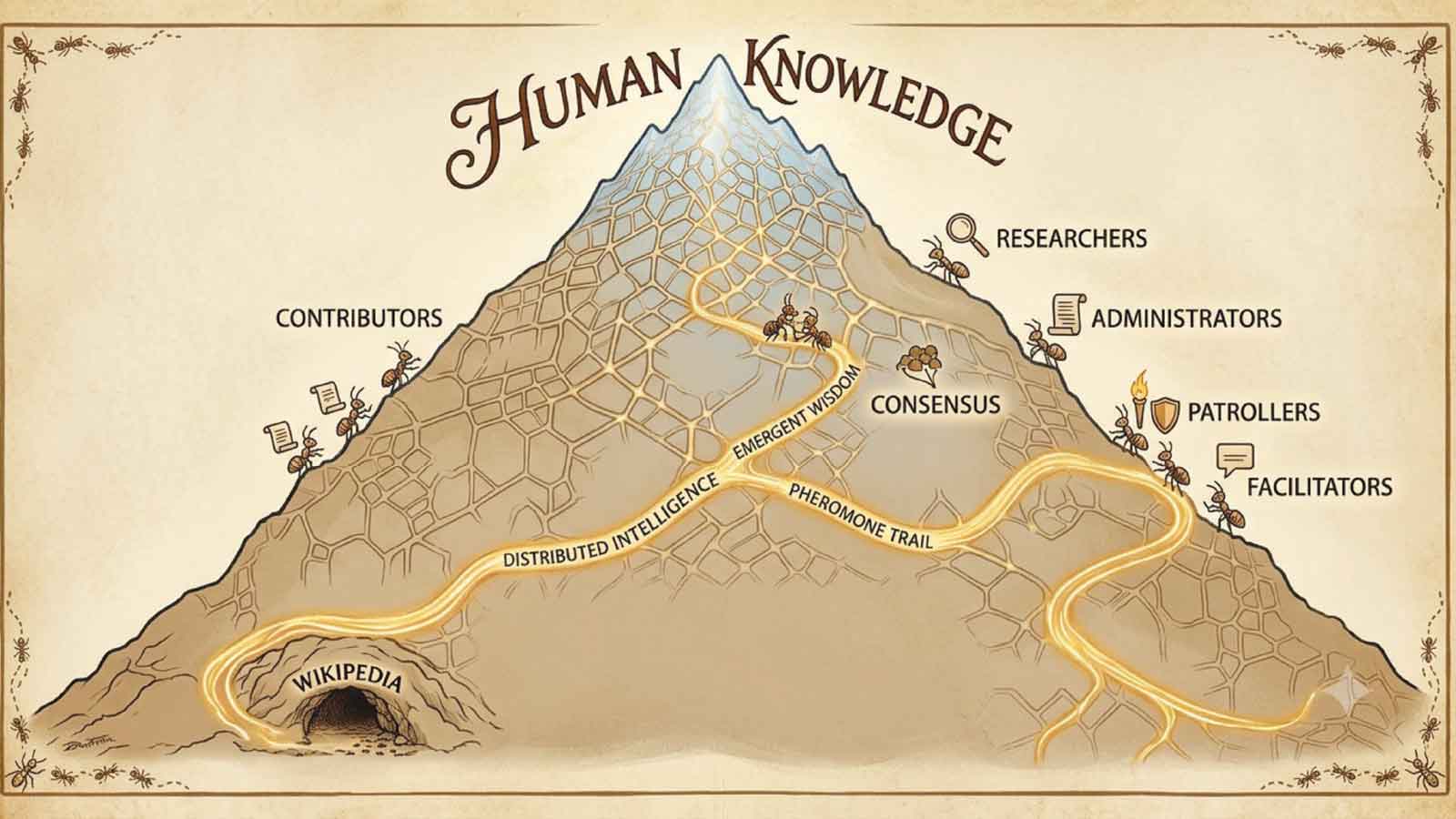
Arthur Marara
Point Blank
In 2001, a bold and seemingly absurd experiment began. Two entrepreneurs, Jimmy Wales and Larry Sanger, proposed to build a free encyclopedia on the internet.
Not a small one, not a modest one, but an encyclopedia that would rival Britannica—the gold standard of human knowledge for over two centuries.
The idea was audacious enough. The method was downright insane. They would let anyone write it. Any person, anywhere, with any level of expertise, could create or edit articles. No editorial board would vet contributors. No central authority would approve content. The project, many declared, would be a disaster. Within months, it would descend into chaos, vandalism, and irrelevance.
Twenty-four years later, Wikipedia has over six million articles in English alone, is available in nearly 300 languages, and serves billions of readers monthly. It has become the largest repository of human knowledge ever assembled, not despite its radical structure, but because of it. Wikipedia is the encyclopedia built by ants—a living testament to the power of distributed intelligence, specialised collaboration, and emergent problem-solving. It offers a masterclass in how to harness the collective wisdom of a community to accomplish what no central authority could even attempt.
- Complex Problem Breakdown: Making the Impossible Possible
The task of creating a comprehensive encyclopedia was historically the domain of massive institutions with deep resources. Britannica required hundreds of full-time editors, thousands of contributors, and decades of accumulated expertise. The sheer scale of knowledge—the millions of topics, the endless revisions, the constant need for updating—seemed to demand centralised control.
Wikipedia solved this problem by doing what ant colonies do: breaking the impossible into the simple. No one needed to write the entire encyclopedia. A user in Brazil could add a sentence about local history. A student in India could correct a typo. A researcher in London could add a citation. A retired teacher in Iowa could reorganise a confusing section.
Each contribution was small, often trivial in isolation. But together, across millions of individuals and billions of edits, they built a mountain from grains of sand.
This is the ant’s first principle in action: distribute the problem. Wikipedia’s genius was not in having a better plan for writing an encyclopedia; it was in recognising that no single plan was necessary. By lowering the barrier to participation to zero—anyone could edit—the project transformed an overwhelming challenge into countless manageable tasks. The architecture of the platform, with its simple edit buttons and transparent version history, made contribution frictionless. The result was not chaos but the most comprehensive knowledge base humanity has ever created.
- Role Specialisation with System Awareness: The Emergence of Order
Critics predicted that Wikipedia would be overrun by vandals, dominated by cranks, and buried in trivia. What emerged instead was something remarkable: a self-organising community with sophisticated role specialisation. Without central direction, contributors naturally gravitated toward functions that served the whole.
Some became “gnomes,” quietly fixing formatting errors and standardizing citations. Others became “patrollers,” monitoring recent changes and reverting vandalism with remarkable speed. Some became subject-matter experts, writing deeply researched articles on niche topics.
Others became “facilitators,” mediating disputes and guiding consensus on controversial subjects. Still others became “administrators,” trusted community members with additional tools to protect the project from abuse.
Yet these roles were not rigid. A patroller one day might become a content creator the next. An expert in physics might, when a biographical article was being disputed, shift into a mediator role.
The community developed shared norms, documented in extensive “policies and guidelines,” that served as the pheromone trails guiding activity. Talk pages attached to every article became the forums where contributors coordinated, debated, and refined. Edit histories provided transparency and accountability.
This is the ant’s second principle: flexible specialisation within a system of shared awareness. Wikipedia demonstrated that order does not require command. It emerges when individuals, pursuing their own interests and following simple guidelines, coordinate through transparent communication and shared norms. The community developed the sophistication of a superorganism, with each member contributing according to their skills and passions, and the whole achieving what no planner could have designed.
III. Emergent Intelligence: The Wisdom of the Collective
Perhaps Wikipedia’s most radical feature is that no one runs it. The Wikimedia Foundation provides infrastructure, legal protection, and technical support, but it does not direct content. The content emerges from countless autonomous decisions, made by individuals who never meet, often from different cultures, speaking different languages, holding different perspectives.
When a controversial topic arises—a political figure, a historical event, a scientific debate—the process is messy. Editors argue on talk pages. Edits are made and reverted. Accusations fly. But gradually, through what seems like chaos, consensus emerges. The article stabilises. Competing perspectives are weighed. Citations are added. A version emerges that, while perhaps satisfying no one completely, represents the community’s collective judgment.
This process is not always pretty. It can be slow. It can be contentious. But it is remarkably resilient. When false information appears, the collective corrects it—often within minutes.
When vandals attack, patrollers revert their edits faster than they can be made. When new events occur—a natural disaster, a political assassination, a scientific breakthrough—the community swarms the topic, building comprehensive articles in hours that traditional encyclopedias would take months to produce.
This is the ant’s third principle: trusting emergence over control. Wikipedia does not succeed despite its messiness; it succeeds because of it. The system is designed to let intelligence flow from the edges, to let thousands of small decisions accumulate into something no central authority could have conceived. It is not efficient in the way a factory is efficient. It is adaptive, resilient, and scalable in ways no factory can match.
The Primal Leadership Takeaway
Wikipedia demonstrates that distributed intelligence, properly cultivated, can accomplish what no central authority could even attempt. With a fraction of the budget of a traditional encyclopedia, with no paid workforce, with no centralised editorial control, it has produced a resource that is deeper, broader, and more current than anything its predecessors ever achieved.
For leaders, the lesson is profound. The old model of organisational intelligence—brilliant strategists at the top, obedient execution at the bottom—is not the only model. It may not even be the best model for the challenges we face. The ant colony, and its digital incarnation in Wikipedia, suggests an alternative: an organisation designed for emergence.
One where problems are broken into distributed action, where roles are specialised yet fluid, where intelligence is trusted to arise from the collective.
The question for every leader is whether you are building a Britannica or a Wikipedia. Are you centralising wisdom in the few, or cultivating it across the many? Are you designing for control or for emergence? Are you trusting your people to build the mountain, grain by grain, or insisting that you must place every stone yourself?
The ants have shown us the path. Wikipedia has walked it. The future belongs to those with the courage to follow.
Arthur Marara is a corporate law attorney, keynote speaker, peak performance and corporate strategy speaker. With his delightful humour, raw energy, and wealth of life experiences, he captivates audiences and inspires them to unlock their full potential. He is also a leadership expert with extensive experience in leadership development and coaching. Arthur is the author of “Toys for Adults” a thought-provoking book on entrepreneurship, and “No One is Coming” a book that seeks to equip leaders to take charge. Send your feedback to bookings@arthurmararaattorneys.
com visit his website www.arthurmarara.
com or contact him at +263772467255.