


 Online Reporter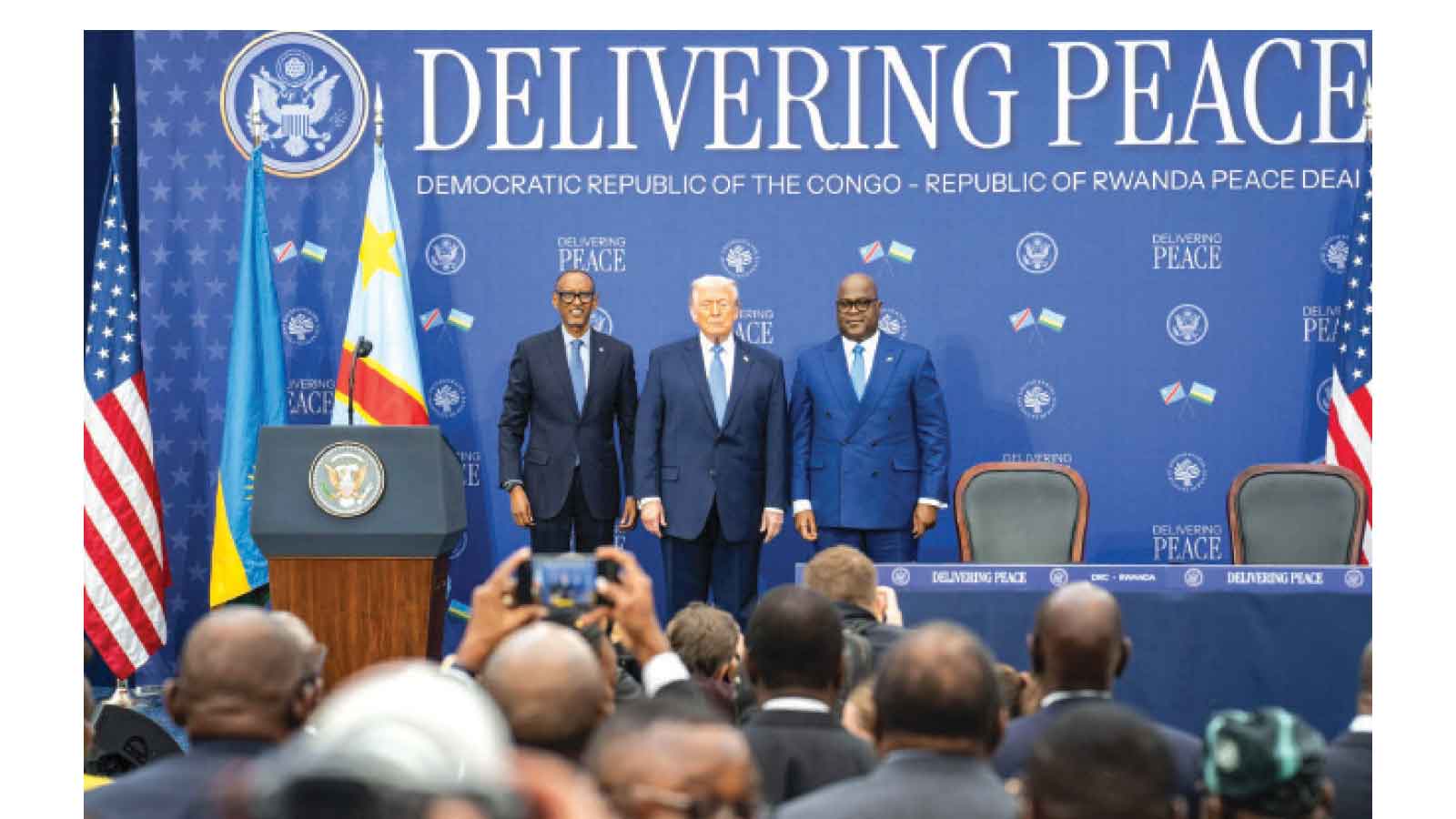
Lenin Ndebele
Presidents Paul Kagame of Rwanda and Felix Tshisekedi of the Democratic Republic of Congo (DRC) signed the historic Washington Accords on Thursday.
It is anticipated that both nations will collaborate to establish robust infrastructure for continued cooperation in both the security and economic domains.
At the centre of the agreements is the United States.
At the signing ceremony, US Secretary of State Marco Rubio said: “Like every deal that’s signed, the implementation is going to be critical, but we hope it shows, in conjunction with what was signed earlier today, the US commitment to be a partner to both the Democratic Republic of Congo and Rwanda for many years to come in both the security and economic realms in a way that’s mutually beneficial.”
Peace between the DRC and Rwanda is important for the US because of the Great Lakes region’s vast mineral resources. Already, America is working with allies to revive the Lobito Corridor, which will link the DRC’s mineral-rich regions to the seaport in Lobito, Angola.
On the eve of the Washington Accords, the US and the European union issued a joint statement of intent to “create the conditions necessary for increased US and EU (European Union) investment across the region (Great Lakes), recognising that economic development is a cornerstone of long-term stability”.
Peace between the DRC and Rwanda is beneficial for the US and its allies, enabling them to tap into the vast resources of the Great Lakes region ahead of their geopolitical rivals, China and Russia.
The Washington Accords — four of them — fall under what has been referred to as the Regional Economic Integration Framework (REIF).
They explore energy, mainly to expand electricity access to power homes and industries. There is also the mineral supply chain to curb illicit trade by building a system of cross-border cooperation and value sharing, free of illicit flows or conflict financing.
Other areas are public health safety, national park management and infrastructure. All these areas have been affected by decades of conflict across the DRC and, most recently, in South and North Kivu, which share a border with Rwanda.
Between Goma in the DRC and Gisenyi in Rwanda lies the oil-rich Lake Kivu.
In 2017, both countries signed an agreement for the exploration of oil in the lake.
Rwanda conducted the surveys but did not share data with the DRC, and a dispute arose.
With a legacy of problems that go back to the root causes of the Rwandan genocide of 1994 and the fall of Zaire’s Mobutu Sese Seko to Rwandan-funded rebels in 1997, leading to the first Congo War, relations between Rwanda and the DRC are strained, even as the ink of the Washington Accords is yet to dry.
The Washington Accords also touched on this age-old beef.
According to the accords, Rwanda is expected to commit to withdrawing its support for the M23 rebels that are running the show in the eastern DRC, and the DRC should also stop its support for the Democratic Forces for the Liberation of Rwanda (FDLR).
The FDLR are remnants of Hutu extremists who fled Rwanda at the end of the 1994 genocide and sought refuge in the DRC.
They continued launching guerrilla attacks in Rwanda.
Currently, they are fighting alongside the Congolese national army and the Burundian forces, along with Wazalendo militias, against the Rwandan-backed M23 rebels.
Thus, for the Washington accords to fully come into effect, both parties should stop supporting rebels, and Rwanda should also retreat from Congolese territory.
Lasting peace?
Unfortunately, the accords are between Rwanda and the DRC, and not the DRC and the M23 rebels. The grievances of the rebels were not considered, and the rebels were not invited into these talks — it was a government-to-government affair.
Thus, there are doubts on whether the pacts will lead to sustained peace.
Instead, the Doha process, which includes the direct involvement of the rebels, is the platform that could find a solution — if any.
But that is a hard ask.
The DRC frustrated the Qatari and now wants a process mediated by Togo.
While Kagame, Tshisekedi and US President Donald Trump posed for pictures for the world to see, there was intense fighting that, even at the time of going to press, is ongoing in the eastern DRC.
The M23 rebels downed a drone used to bomb a school and hospital in North Kivu.
The Burundian army retreated home, where they are shooting blindly and indiscriminately at the town of Kamanyola in the DRC.
Hundreds have taken refuge in Rwanda.
The Burundian border was closed on Thursday due to a large number of people trying to cross with weapons.
Hence, as long as there is conflict in the eastern DRC, there is no way Rwanda will withdraw its defensive measures because the shelling crosses into its territory, where tourism is the mainstay of the economy.
I must mention some missed opportunities for an Africa-led peace process, particularly the Luanda one, backed by the African union to resolve the conflict in the eastern DRC, and tensions between the DRC and Rwanda, focusing on neutralising armed groups like the FDLR and M23, normalising relations and promoting regional stability through agreements on ceasefire, troop disengagement and security cooperation, though implementation faced challenges like deep mistrust and complex local dynamics.
Then there was the Nairobi process, an East African Community (EAC) initiative to bring together the DRC and rebel outfits operating in Congo.
Again, mistrust led to the collapse of the talks. President Tshisekedi favoured war against the M23 rebels, which is why the EAC standby force, which came in as peacekeepers, was replaced by the combative Southern African Development Community Mission in the DRC (SAMIDRC) in December 2023.
The SAMIDRC early this year withdrew from the eastern DRC as the regional bloc favoured talks amid cries of casualties at the hands of the M23 rebels.
Lenin Ndebele is an international journalist covering African affairs.



