Chronicle Editor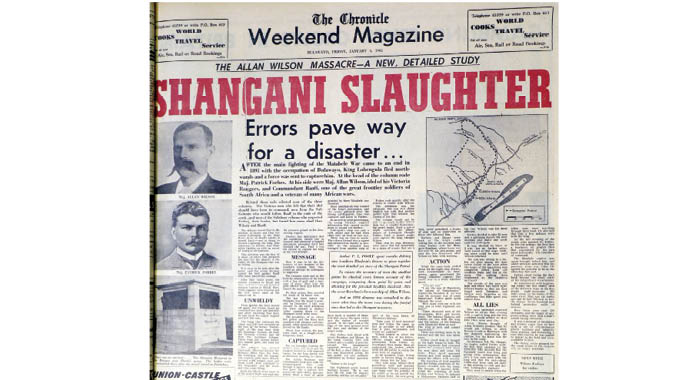
Nduduzo Tshuma, Political Editor
ON December 4, 1893, King Lobengula’s army led by strategist Mtshana Khumalo, killed Major Allan Wilson and his men at the Battle of Pupu in Lupane, blocking the attempted capture of the King by the colonialists.
The place, about 175 kilometres from where the country will host the main programme of the Independence Day celebrations at Barbourfields Stadium in Bulawayo on April 18, was made a monument by the whites who listed the names of the vanquished white soldiers who died at the hands of the crack regiment – Imbizo – commanded by Mtshana Khumalo. He was supported by other regiment commanders like Maqhekeni Sithole, Fusi Khanye and Magibidwane Hlabangana.
In 1962, in a series of articles published in The Chronicle, the whites grudgingly acknowledged Chief Mtshana as an astute military strategist who engineered the death of Allan Wilson and his patrol squad.
All the dead soldiers were immortalised after streets in Bulawayo were named after them in Bulawayo’s North End suburb, until recently when the Government renamed various institutions.
The likes of Colenbrander, named after a scout in the Wilson Patrol, Johan Colenbrander, were renamed Lookout Masuku after the last Zipra commander during the liberation war, the late Lookout Khalisabantu Vumindaba Masuku.
Bulawayo City Council has also sought approval from the Government to rename some streets and replace them with names of luminaries who contributed to the liberation of Zimbabwe.
However, BCC has in some instances proposed name changes and included those that the Government had proposed.
Veteran playwright and founding director of Amakhosi Cultural Centre Mr Cont Mhlanga said there should be a narrative behind the sites.
“They (Allan Wilson and his soldiers) were taken firstly from there (Pupu) to Great Zimbabwe because it was said that they should be buried at a place designed for heroes. Then Rhodes later decided that he will be buried in Matobo. When his will was read, he instructed that their bodies be collected and be buried next to him and we visit them there, our children visit them there but our children are never told that these are the same soldiers that were killed in Pupu; that memory is not connected,” said Mr Mhlanga.
“They are never told that those same people are the reason behind the liberation struggle. It’s like when you visit there, it’s just a tourist site that has no narrative.”
He commended the Government for sprucing up Pupu but called on an accompanying narrative that details how Allan Wilson was killed by King Lobengula’s army in their futile attempt to capture him.

In November last year, the Government renamed some streets and institutions to honour the country’s national heroes, as well as nationalists from the region.
At the time, the acting of Information Publicity and Broadcasting Services Minister Nqobizitha Mangaliso Ndlovu said Cabinet approved new names of roads, places and Government buildings in Harare, Bulawayo and other towns across the country, as a deliberate effort to foster unity, while reflecting on the country’s history and identity.
“Cabinet noted that through the process of naming, every community or society defines its identity and culture, tells its history, and espouses its values, beliefs, norms and world-view,” he said.
“Naming is also a social engagement tool that fosters understanding, peace and unity in diversity.”
Political analyst Mr Teddy Ncube said while the renaming of some institutions was commendable, some institutions still remain glorifying colonialism and need to be looked at.
“The project of decolonisation is not complete if certain spaces still retain the memory of colonialism in its superiority. Whilst the post-Independence government should be commended for its unwavering commitment to the project of decolonisation, it should be pointed that the onus of decolonisation does not solely rest in the jaws of the government as an administrative actor,” said Mr Ncube.
“Metaphysical nuances of spatial planning should also be used as an instrument to retrieve the lost memory of the liberation struggle. It is in that context that we can use the liberation struggle as a discourse to defeat and undo the remnants of colonialism. It is also in this context that the post independent society can permanently lay to rest the disempowering colonial history which transpires at the expense of the liberation struggle’s legitimate premises.”
The National Museums and Monuments of Zimbabwe director Dr Godfrey Mahachi said they embarked on a programme to spruce up the Pupu monument and add the narrative that captures how King Lobengula’s army vanquished the Wilson Patrol as part of a national programme of either setting up new heritage sites or fixing the narrative of existing ones to detail the country’s liberation history.
He said in Pupu they have added a narrative accompanied by pictures showing how the Allan Wilson Patrol was vanquished by the Imbizo regiment in a programme that is still ongoing although much of the work has been done.
He said besides the Pupu monument, they, two years ago, erected a monument in Chinhoyi, the place of the 1966 Chinhoyi battle and a similar monument was also built in Gutu where liberation fighters overwhelmed the colonial forces with gun fire during the war of liberation among other areas.
Dr Mahachi said after the Government named a number of institutions, they have embarked on a massive programme to provide information on the people that the institutions have been named after.
“We are in the process of researching and colleting information around all those individuals that were named after various institutions so that we provide and preserve their history in relation to the liberation of the country. It is a massive project that we are engaged in and we are likely to see the results towards the end of the year,” said Dr Mahachi.
Bulawayo Town Clerk Mr Christopher Dube said the local authority was in the process of implementing names proposed by the Government as part of preserving the liberation history.
He said the local authority serves different people and there was a group of residents that would love to see some streets or institutions named after colonialists preserved.
“However, we listen to the people and if they approach us to change those remaining colonial names, we will note their wishes and relay to the Government,” he said.


 Online Reporter