

 Online Reporter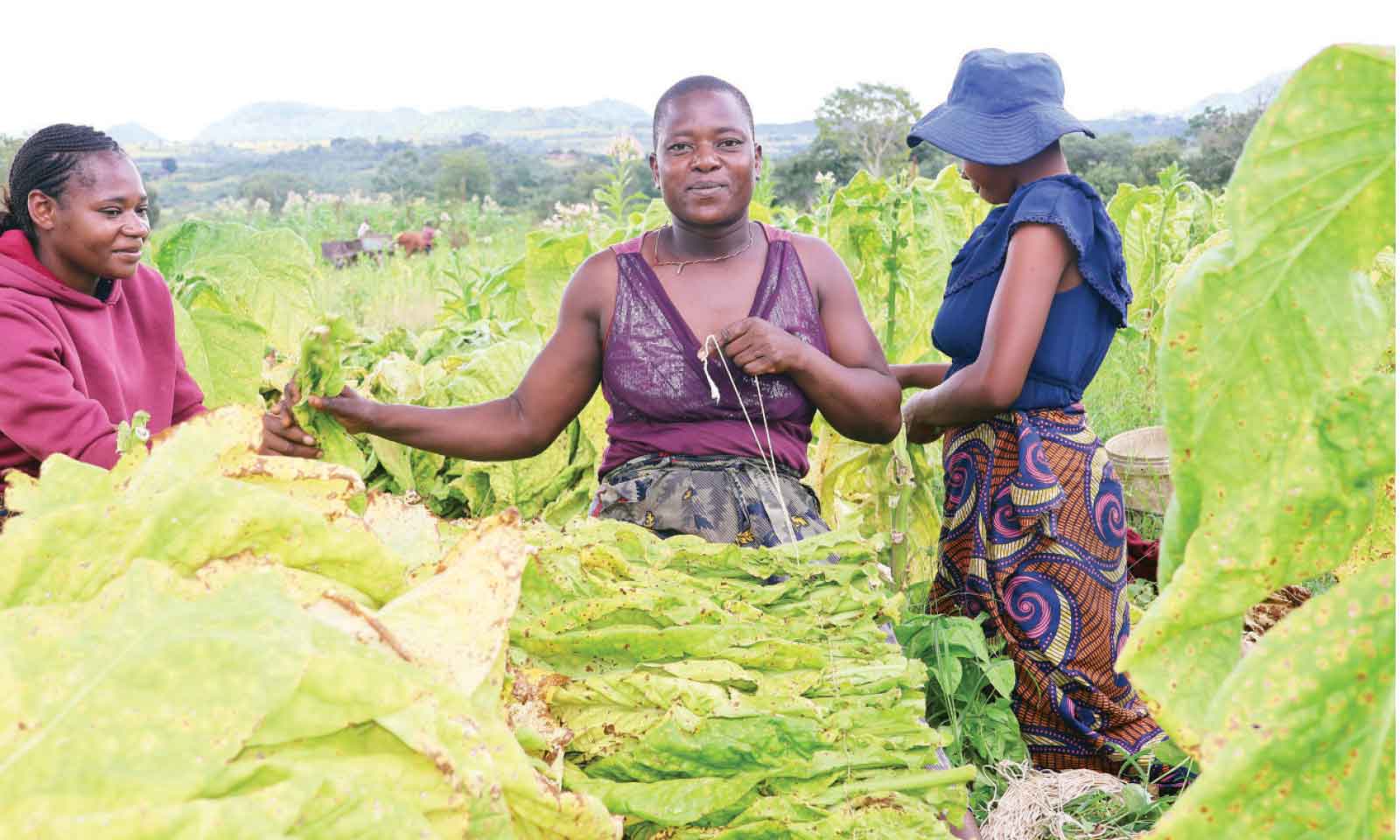
Theseus Shambare
Features Writer
AT sunrise in the Kelston farming area in Guruve, Mashonaland Central Province, about 30 kilometres west of Mvurwi, Charity Munaki moves steadily through rows of towering tobacco plants, her hands expertly selecting mature leaves from the crop she has carefully nurtured for months.
On her two-hectare field, planted separately from the three hectares managed by her husband Ashton, Munaki works with the quiet confidence of a farmer who has mastered the demanding craft of producing Zimbabwe’s famed golden leaf.
Her movements are deliberate as she harvests, ties and inspects the leaves that will soon begin the long journey from rural fields to the auction floors in Harare.
But beyond the rows of tobacco plants lies a deeper story of transformation and empowerment unfolding in Zimbabwe’s rural farming communities.
Munaki holds her own grower number, a powerful symbol of independence that allows her to market her tobacco and directly control the income generated from her crop.
For many years, women like her worked the land but rarely controlled the financial rewards that came from the harvest.
Today, Munaki is part of a growing shift where female farmers are stepping forward as decision-makers within Zimbabwe’s agricultural economy.
Therefore, her tobacco field is more than a plot; it is a statement of determination and possibility.
For Munaki, however, the journey to owning and marketing her own crop did not come easily.
For years, she worked alongside her husband in the fields, contributing labour from planting to curing, but she often hesitated to venture out on her own.
“I used to fear taking control of my own crop,” she admitted.
The turning point came in 2024 when she joined a contract farming scheme that provided her with inputs worth about US$600 for a half-hectare plot.
“It was a small beginning, but one that changed everything in my view of agriculture,” she said
After the first harvest, Munaki combined her earnings with money she received for assisting on her husband Ashton’s three-hectare field and reinvested the funds to expand her own tobacco crop to one hectare.
The results were enormous.
Encouraged by her success, she pushed even further this season, expanding her crop to two hectares.
She is now in the third reaping stage and expects to produce no less than 6 000 kilogrammes of tobacco — no small feat for a smallholder farmer.
For Munaki, the income represents more than numbers on an auction floor receipt.
It means she can assist pay school fees without anxiety. It means she can buy decent clothing and shoes for her children.
“You know, as women, we sometimes have preferences that differ from men’s. Now it is easier, because my husband sees how important these things are after I have already done them, though it was not easy before,” she said.
It means she can improve her homestead and acquire small comforts, like furniture, kitchen appliances and livestock.
It means she can invest in farming equipment to make her work more efficient.
“It gives me pride to know that I can contribute meaningfully to my family,” she said.
Working alongside her husband Ashton, Munaki said tobacco farming has become the foundation upon which they are building a better future for their family.
The couple carefully plans every season together, sharing labour, knowledge and responsibilities in pursuit of a common goal.
“Our dream is to transform our lives through farming,” she said quietly as she inspected the crop.
That dream is rooted in a powerful ambition, ensuring that their children reach the highest possible levels of education despite growing up in a rural setting.
Munaki believes that the income generated from tobacco will allow her children to access opportunities that were once far beyond the reach of many rural families.
“Education is the greatest investment we can make for them,” she said.
Her determination reflects the aspirations of countless rural women who see agriculture as the gateway to generational change.
Zimbabwe’s tobacco industry provides a powerful backdrop to Munaki’s journey.
Data from the Tobacco Industry and Marketing Board shows that the country produced more than 355 million kilogrammes of tobacco during the 2024–2025 season, surpassing the national target of 300 million kilogrammes.
The crop generated over US$1,2 billion in export earnings, reaffirming tobacco’s status as one of Zimbabwe’s most valuable agricultural commodities.
The sector has also seen a dramatic increase in the number of smallholder farmers entering production.
Statistics from the tobacco regulator show that more than 147 162 growers are now registered to produce tobacco in Zimbabwe.
Many of these farmers operate in communal and resettlement areas similar to Kelston, where smallholder agriculture drives local economies.
Within this expanding community of growers, women are becoming increasingly visible.
For decades, women formed the backbone of agricultural labour but remained largely invisible when it came to marketing crops or controlling earnings.
Women planted seedlings, weeded fields, harvested crops and cured tobacco leaves while men frequently handled sales and finances.
That imbalance is now slowly changing as more women obtain their own grower numbers and participate directly in agricultural markets.
Munaki represents this new generation of female farmers who are claiming their space within the sector.
Her vision for the future extends beyond tobacco production alone.
After the tobacco sales, she hopes to invest part of her earnings into starting broiler and layer poultry projects.
The plan is designed to create continuous income streams throughout the year.
Such diversification would strengthen the family’s financial stability and reduce dependence on a single crop.
Munaki’s ambition mirrors a broader movement among Zimbabwe’s smallholder farmers who are increasingly combining different agricultural enterprises.
The shift reflects the growing recognition that resilient livelihoods often depend on multiple sources of income.
Yet Munaki’s story also reflects a much larger global reality about women and agriculture.
According to the Food and Agriculture Organisation, women make up about 43 percent of the global agricultural workforce.
The same organisation estimates that women produce more than half of the world’s food.
In many developing countries, women contribute between 60 and 80 percent of total food production.
Despite this enormous contribution, female farmers often face structural barriers that limit their full participation in agricultural markets. Research shows that women frequently have less access to land ownership, credit facilities, agricultural inputs and extension services compared to men.
These inequalities have long restricted women’s economic potential in rural communities.
Zimbabwe’s agricultural leadership acknowledges the central role women already play in farming.
Ministry of Lands, Agriculture, Fisheries, Water and Rural Development Permanent Secretary Professor Obert Jiri Obert Jiri said women remain the backbone of the sector.
“Women constitute the largest portion of the agricultural labour force in Zimbabwe,” Prof Jiri said. “They are involved in nearly every stage of production, from land preparation to harvesting.”
However, he noted that women have historically taken a back seat when it comes to marketing agricultural produce and making financial decisions. Empowering female farmers, he said, is therefore essential for strengthening agricultural productivity and rural development.
“When women participate fully in agricultural markets and decision-making processes, the benefits extend beyond households to entire communities and the national economy,” he said.
International human rights frameworks also recognise the importance of women’s economic participation. The Universal Declaration of Human Rights affirms the right of every person to work and participate in economic life without discrimination.
Article 23 states that everyone has the right to work, to free choice of employment and to just and favourable conditions of work.
For gender equality advocates, recognising women’s role in agriculture is central to achieving these rights in practice.
Back in the tobacco fields of Kelston, Munaki may not speak in the language of global reports or policy frameworks. Yet her everyday work reflects the very transformation that researchers and policymakers have long advocated for.
Each tobacco leaf she harvests represents resilience and determination. Each bale she prepares carries the promise of school fees, household stability and opportunity.
Each plan she makes to expand into poultry production signals a farmer who is thinking strategically about the future.
In the quiet fields of Kelston, 30 kilometres west of Mvurwi, Munaki is doing more than growing tobacco. She is cultivating a future where rural women stand not at the margins of agriculture but at its centre.



