Chronicle Editor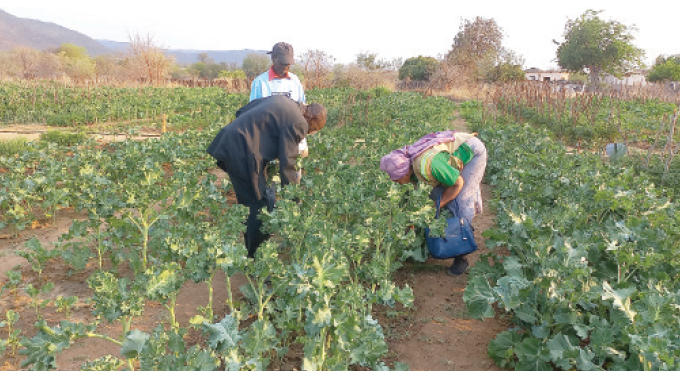
Obey Sibanda, [email protected]
THE Agricultural Advisory and Rural Development Service (AARDS) in partnership with other development partners has established farmer field schools at ward level to equip rural farmers with organic fertiliser manufacturing skills and sustainable farming in response to the effects of climate change.
The programme is part of efforts by Government to promote smart agricultural practices among farmers and boost food security and nutrition at household level.
The field schools are targeting vulnerable households and the majority of active participants are women.
A farmer field school is a group-based learning process whereby farmers carry out experimental learning activities that help them understand the ecology of their farming practice.
These activities involve simple experiments, regular field observations and group analysis.
The knowledge gained from these activities enables participants to make their own locally specific decisions about farming management practices.
This approach represents a radical departure from earlier agricultural extension programmes, in which farmers were expected to adopt generalised recommendations that have been formulated by specialists from outside the community.
Each farmer field school has between 10 to 30 members. Farmers are being taught conservative, sustainable, and profitable organic farming which is less costly in terms of implementation while also reviving the soil.
Adapting to the unpredictable weather patterns that help protect and boost agriculture in the country is not just a solution, but a necessity for the future of farming and being able to alleviate hunger.
AARDS extension officer, Mr Donovan Marata said they are teaching farmers how to make use of organic fertilisers thereby improving the moisture and water-holding capacity of the soil.
“This is the process of actually reviving our soils. We need to incorporate a lot of organic materials since we are removing a lot of organic material through harvesting. There is a need to incorporate these back to the soil so that the soil remains alive,” he said.
Sustainable Agricultural Technology (SAT) scientist Mr Tendekai Mudimu said there are three types of technologies they are promoting namely biochar, thermal compost and vermicompost.
Thermal compost is prepared using organic matter such as grass, leaves, and stalks. It matures using heat that generally destroys the weed seeds. It takes about four to eight weeks to full maturity of the compost.
Biochar is a semi-burnt organic matter. The burnt organic matter creates channels within the organic matter which stores water. When it is applied to the soil and it happens that there is no moisture or no rainfall, that moisture is released into the soil.
It acts as a moisture conservation technique. Vermicomposting is the scientific process of making compost by using earthworms. They are mostly found living in soil, feeding on biomass and excreting it in a digested form.
“We have to promote soil conservation methods in our plots so that as the crops grow they would be able to use the moisture that will be released in the soil. This year there is lower rainfall, particularly in Matabeleland South and that is why we are incorporating these technologies as they retain moisture back in the soil,” said Mr Mudimu.
Matabeleland South Province nutritionist Mr Innocent Mazarura said different stakeholders came together with the collective intention of ensuring better national health using nutrition-smart agricultural solutions.
“Basically the aim is to improve resilience for vulnerable households. The basic thing that we are doing is disseminating nutritional information to farmers to ensure that they are well-nourished. Someone without proper nutrition cannot fend for themselves,” he said.
One of the participants at field schools, Mrs Chambika Nyamunganga, of Nyezi village in Insiza District in Matabeleland South, said before enrolling at the school she had spent years cultivating the small piece of land behind her home producing less yields.
Mrs Nyamunganga said she is now able to cultivate a larger area. She said in the last farming season, she recorded a good harvest.
“I recorded a good harvest and sold some of the produce and managed to develop my homestead and we are now able to have a decent meal,” she said.
Another farmer, Ms Lunia Siziba said they are now able to make their own fertilisers and guaranteed of a better harvest.
“We thank the Government for introducing the school. We no longer rely on our husbands for money as we are able to generate our own income,” she said.
President Mnangagwa has said despite the negative effects of climate change that are worsening and intensifying water-related disasters, creating complex challenges and threatening lives and livelihoods, particularly for the vulnerable globally, Zimbabwe has developed various strategies to ensure water availability and build resilient agricultural systems.
Zimbabwe is emerging from food insecurity to food security and is now shifting focus to improving the quality of food for its citizenry as a way of conforming to nutritional requirements for the betterment of people’s lives.


 Online Reporter