Online Reporter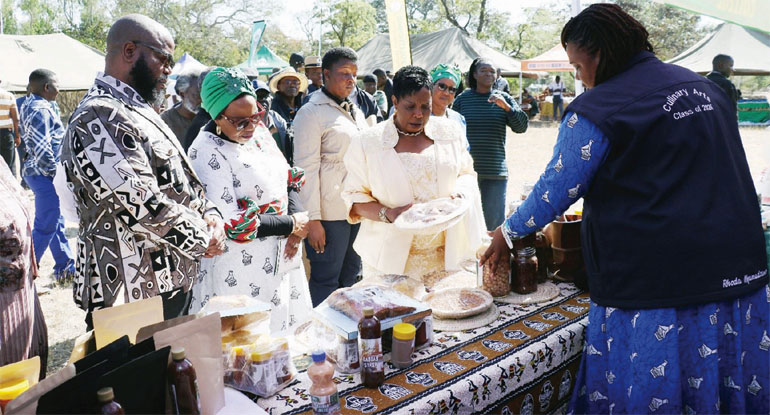
Lloyd Makonya
Correspondent
WHAT was once an ordinary rural homestead in Mukoto Village, Ward 31, Buhera, has become a living classroom where agriculture, tourism, culture and women entrepreneurship converge to transform livelihoods.
Recently, the homestead of Dr Daud and Mrs Christina Taranhike affectionately known throughout Buhera as “Mai Chimuti’s Place” was a hive of activity as hundreds of community members, academics, students, tourism practitioners and development partners gathered for the second edition of the 2026 Agrotourism4SHE Research Conference.
The conference, officially opened by the First Lady, Dr Auxillia Mnangagwa, showcased how rural women are leveraging agriculture, indigenous knowledge and tourism to create sustainable livelihoods while preserving their cultural heritage.
More importantly, the event demonstrated how the First Lady’s women empowerment programmes continue to inspire rural women to become entrepreneurs, employers and custodians of Zimbabwe’s rich cultural heritage.
For many visitors, Mai Chimuti’s homestead was more than a conference venue. It stood as living proof that with determination, innovation and the effective use of local resources, rural communities can build thriving tourism enterprises that benefit entire communities.
The model has already begun creating ripple effects across Mukoto Village, where women have ventured into accommodation services, poultry production, peanut butter processing, traditional crafts, indigenous food processing and other income-generating activities linked to community-based tourism.
Speaking during the conference, Mrs Christina Taranhike, paid tribute to the First Lady for championing women’s economic empowerment through initiatives such as Agric4She.
“The First Lady has shown women that empowerment does not necessarily begin with large amounts of capital. It begins with recognising the value of the knowledge we already possess, the land we have and the resources within our own communities,” she said.
She said her vision extends beyond developing her own enterprise to ensure that women across her community also benefit from opportunities created through agrotourism.
“Our greatest success is seeing other women succeed.
“Today, women in this community are providing accommodation to visitors, running poultry projects, processing peanut butter, producing traditional crafts and value-adding indigenous foods. That is the kind of inclusive development we want to continue building.”
Mrs Taranhike said community-based tourism becomes sustainable when local people are active participants and direct beneficiaries rather than spectators.
The conference also highlighted the importance of value addition as a pathway towards increasing incomes for rural women.
Experienced and award-winning Nyazura-based commercial farmer, Mrs Mavis Mupingo, challenged women to move beyond selling raw agricultural produce and instead invest in processing and packaging to maximise profits.
“We must stop exporting value together with our produce. When we process what we produce, we create more income, more employment and more opportunities for our communities. Value addition is what will make agriculture attractive and profitable, especially for young women,” she said.
Mrs Mupingo applauded Government initiatives promoting women’s empowerment, saying programmes spearheaded by First Lady, Dr Mnangagwa, are equipping women with practical skills and confidence to become successful entrepreneurs.
She, however, challenged universities to deepen their engagement with farming communities by producing research that responds directly to farmers’ needs.
“Our universities should become active partners in rural development. Students should spend more time working alongside farmers through internships and attachments, allowing knowledge to flow in both directions. Farmers have practical experience while students bring scientific knowledge. Together they can produce remarkable innovations.”
Mrs Mavis Mupingo shares her experiences during the conference
She also called for stronger participation by financial institutions during future conferences.
“If banks and financial institutions understand the realities facing small-scale farmers, they can develop financing models that are simpler and more accessible. Affordable finance will encourage more young people to see agriculture as a viable business.”
University of Zimbabwe Dean of the Faculty of Business Management Sciences and Economics, Dr Onai Muvingi, challenged academics to move beyond theoretical research and produce knowledge that directly improves people’s lives.
“We have listened carefully to women entrepreneurs and farmers. Their message is clear, they are asking for scientific expertise that will help them improve quality, increase value addition and access better markets. That is where universities must respond.”
Dr Muvingi said institutions of higher learning should embrace applied research that produces measurable impact in communities.
“As academics, we must constantly ask ourselves what value our research is creating for society. Heritage-Based Education 5.0 calls upon universities, not only to generate knowledge, but to use that knowledge to solve real community challenges, create enterprises and transform livelihoods.”
She further encouraged stronger collaboration between universities and the private sector.
“While development partners remain important, sustainable transformation will come when academia, industry and communities work together. The private sector has the capacity to commercialise innovations emerging from universities and community enterprises, creating long-term economic opportunities.”
The conference reinforced the growing importance of partnerships involving academia, industry, local communities and students in driving rural development. Researchers gained valuable insights from indigenous knowledge systems preserved by local communities, while students were exposed to practical models of entrepreneurship beyond the classroom. Community members, in turn, benefited from scientific expertise and research-based innovations capable of improving production, value addition and business management.
As delegates departed Mukoto Village, one message resonated strongly: empowering women is not simply about providing financial assistance.
It is about creating platforms where knowledge, culture, research, entrepreneurship and innovation intersect to unlock the vast potential already existing within Zimbabwe’s rural communities.