

 admin
admin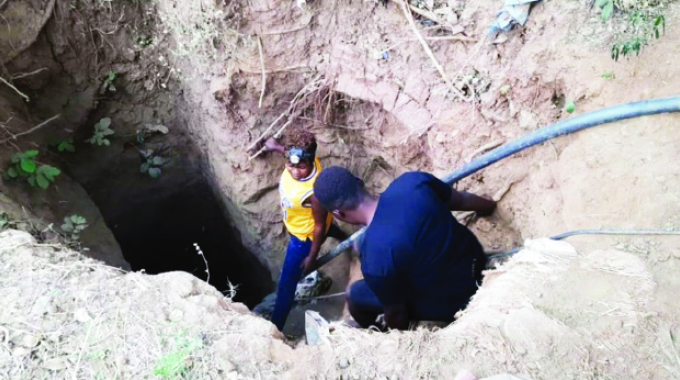
Fungai Lupande-Mashonaland Central Bureau
Farming in some areas of Mashonaland Central has been affected by climate change, which has been bringing either little rains that caused droughts or plentiful of rains that resulted in floods and destruction of property.
And in this, it is the women at the forefront of suffering the consequences of climate change as they have to fend for their families, ensuring there is adequate food and other home provisions.
It is a result of the disruption of farming in some areas in the province that some women are now turning to gold mining in an effort to make ends meet.
But all is not rosy as the women struggle to fit in this male dominated sector, where the operating rules are often breached at will and in most cases without recourse.
What these women think as an alternative to make ends meet in the face of climate change and its effects, often turns out to be a struggle within a struggle.
Narrating their ordeals, the women urged Government to intervene to ensure they have space in the mining sector to help bring food on the table for their children in light of limited farming activities in the dry areas of Mashonaland Central province.
Take Brenda Bunga (27), for example.
She adjusts a torch on her head while clad in a pair of jeans and a t/shirt, gracefully placing one foot after the other at both ends of a mine shaft, while supporting herself with her hands as she makes her way underground.
Albeit the danger of working underground, Brenda and her two sisters take turns to work in their 40-metre deep mine-shaft with no protective clothing.
Brave, tenacious, patient, risk takers – are the words to describe these few women who are challenging the physical and social norms just to prove that they are capable of mining.
More women who are venturing in small scale artisanal mining at various sites in Mashonaland Central province as an escape route from the effects of climate change are faced with various challenges, including lack of support, poor safety and discrimination.
Pushed by persistent droughts due to climate change, Brenda and her two sisters Liznet and Rutendo joined Mukaradzi mining site in Mt Darwin in search of a better life.
When they are undergoing, the trio chisel at gold belts together with their male counterparts.
“We are physically able,” said Brenda. “I am now used to working underground. We take turns to go underground with my sisters, but we do this without helmets and other protective clothing.
“We want help with a lot of mining equipment like compressors so that we can do proper mining. We are persevering although we lack a lot of tools.”
Due to the culture of undermining women as capable miners “sponsors” at Mukaradzi prefer to financially assist men in the mining business.
Brenda said mining can transform lives of several women who are interested in joining the industry, but some end up giving up due to insurmountable barriers.
The sisters started mining in 2008, taking over from their mother.
Rutendo said they had been going underground for 14 years now and she enjoyed it.
Women are often accused of bringing bad luck when they enter or come near a mine shaft.
This cultural norm seems to be fading away as women are becoming heavily involved in mining to become economically empowered.
As the manager, Rutendo said she dictated where to blast or the direction to mine.
“We have a lot of women willing to join mining, but these challenges make them quit and opt to start cooking or vending businesses at the mining site,” said Rutendo.
Elizabeth Chiwaka joined Mukaradzi in 2005 after realising that farming alone was no longer sustaining her family due to erratic rains.
“We are appealing for support as women,” she said. “A few of us who are lucky to get mining claims end up losing them due to lack of resources.”
Mrs Tendai Mwando, who joined Mukaradzi to venture into mining, opted for vending due to the arduous nature of mining.
Now, she sells clothes, groceries and beer, but the money she is getting is little compared to prospects in mining.
“Given the opportunity, I want to join mining,” said Mrs Mwando. “Mining can transform my life. I can buy a house or car compared to vending. We have witnessed women doing great things through mining. Others have bought cars and houses.”
Life is not easy for these women who are juggling motherhood, family and working extra hard at the mine just to prove that they are capable.
United by their shared pain, these women have started small scale savings and revolving loan schemes to buy protective clothing.
A miner in the area, Mr Clever Kapikwa, said these women earned a nickname, “gwejeline” due to their bravery and perseverance in mining.
“They don’t have any support and sometime they are displaced by rowdy men when their mines start producing gold,” he said.
“We are proud of these women who are working hard to care for their families. We emulate their bravery and with more support, they can contribute to national development.”
A visit to Mazowe, in the Jumbo area painted a gloomy picture of how unfair agreements and contracts have fleeced women of their hard-earned investments into mining.
Small-scale mining in Mazowe has been turned into capitalistic enterprises and this has led women to resort to manual jobs, including sluicing, vending, cooking and prostitution at the mining areas.
Women are choosing small downstream manual jobs as small-scale mining in Mazowe is providing a livelihood for thousands of families.
Gold claim owners in Mazowe take 50 percent gross revenue or share per every transaction and forfeit all the gold below five grams despite expenses.
The role of women in mining has become veiled due to unequal relations between men and women.
At SOS mining site, women have their shafts closed and subjected to arrest following sour relations with claim owners.
Mrs Cathrine Mangwende from Glendale, who works at SOS, said failure to produce the required grams of gold can cause one’s shaft to be closed.
“I opened seven shafts, investing over US$8 000 trying to find a high yielding place so that I can meet the target,” she said. “I just woke up one day and the shaft was closed. I then looked for assistance at the Zimbabwe Artisanal Miners Association (ZAMA) and we won the court case.”
She returned, opened another shaft and was immediately arrested for breach of contract.
“I slept in a police cell for my desire to venture into mining,” said Mrs Mangwende. “I am now ill due to these frustrations.”
The Herald caught up with a group of women tucked along a river in Mazowe panning for gold away from the centre of activities at Mukaradzi.
Melody Dzikamunhenga had a baby strapped on her back, knee deep in the mud and sluicing rubbles ferried four kilometres away.
“As women, we are looked down upon,” she said. “Men don’t want to see us near mine shafts due to cultural beliefs that menstruating brings back luck for miners. We decided to move away from the centre of activities. We carry the rubble four kilometres away and bring it here for this process.”
In Mt Darwin, Pfura Rural District Council has encouraged women to come together and form mining syndicates.
This will help them to get recognition, access financial assistance and engage in proper mining.
The council’s Engineer Emson Chitsungo said other women in the district were making great strides with a mining site in Dotito, wholly owned by women.
“We are aware of the challenges that female artisanal miners are facing at Mukaradzi,” he said. “In incident, a pregnant woman went underground and later had a miscarriage.
“Women are going underground without protective clothing and are at risk of inhaling toxic gases. We are engaging mine owners to enforce safety.”
Mashonaland Central provincial mining director Mr John Makandwa said the Ministry of Mines and Mining Development had a mining industry loan fund which women and youth can access.
This fund assists registered small scale artisanal miners who meet the requirements and merit of the project.
Due to lack of resources, some women opted to operate without being registered.
“We encourage women to work under the law, with a certificate of registration and following environmental regulations,” he said.
“Female miners without capacity can form syndicates or register a company. This will help them in accessing financial resources, skills and knowledge.”
Mr Makandwa said Fidelity Printers had a fund to support such gold miners.
“The Ministry (of Mines and Mining Development) is available to provide technical advice,” he said. “Due to lack of resources, we cannot reach out to everyone, but they can make an effort to come to our offices.
“We are dealing with a number of disputes, but they are not segregated by gender. They are arising due to management systems and titles, but once we are computerised, we will eliminate this challenge.”
The trend and challenges facing women in mining in Southern Africa are similar, from surface mining, slicing, petty trading business and lack of machinery, expertise and support to being intimidated and swindled.
According to mining expert Rachel Perks, in the Democratic Republic of Congo young girls and women endure arduous labour from pounding quartz to extract gold for as low as US$2 per day.
She said women in the DRC move to South Kivu in pursuit of economic opportunities.
However, they are vulnerable to coercion, intimidation and sexual violence due to lack of social safety nets and protective laws.
In Tanzania and Ghana, only a few women dare to venture into mining, according to a special report on mining in these countries.
*This story was funded by the Women in News SIRI Real Grant Project


 Online Reporter