admin
admin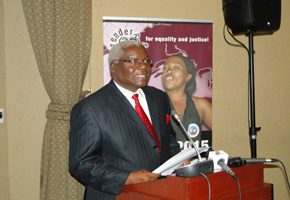
the Minister of Local Government, Rural and Urban Development, Dr Ignatious Chombo, said yesterday.
Officially opening the third Local Government and Gender Justice Summit in Johannesburg, South Africa, yesterday, Dr Chombo said gender was a very emotive and often misunderstood subject.
He said events such as the summit played a critical role in removing misconceptions and fears surrounding gender issues.
“I view this summit as a joining together in celebration of the strides made by ordinary men and women in improving the lives of the people they serve and to measure ourselves against the milestone set out in the Sadc Protocol Gender and Development,” said Dr Chombo.
He said “perceived” roles assigned to women should not be restrictive or limiting as women also had a lot to offer towards national development.
“Where on earth can you have development and progress when half the population is trapped in the kitchen or maternity ward?” asked Dr Chombo.
“In Zimbabwe, our own Vice-President Cde Joice Mujuru and Deputy Prime Minister Ms Thokozani Khupe are women who have been to the maternity ward and who still spend time in the kitchen without in any way impinging on their ability to handle their senior positions in national and international matters of governance and development.”
He applauded leaders in the region for crafting the protocol, saying it linked the creation of an even playing field for women, men, boys and girls with the important subject of development.
Dr Chombo said women deserved to be elected into leadership positions because they were generally less corrupt than men.
“I have never had to intervene with disciplinary action for a woman councillor,” he said to applause from delegates.
Dr Chombo encouraged participants to learn from each other at the summit.
He re-affirmed Zimbabwe’s commitment to achieving the 28 targets set for 2015 by the protocol.
Dr Chombo said the country could achieve the seemingly insurmountable task, or make significant progress towards its achievement if stakeholders and development partners worked together.
He expressed hope that the harmonised elections, scheduled for this year in Zimbabwe, would see the number of women increasing in local Government and other leadership positions.
“At the moment, 18 percent of urban councillors and 19 percent of rural district councillors are women.
I sincerely hope that this number will increase in the next general elections as these will be the last to be held before the 2015 deadline,” said Dr Chombo.
He said his ministry was working at achieving equality through deliberately crafting policies designed to eliminate gender bias.
A total of 280 participants from 10 Sadc countries have converged on South Africa for the three-day summit, which has been convened by Gender Links, under the rallying call “365 days of local action to end violence and empower women.”
Gender Links is a Sadc non-governmental organisation mandated to implement the protocol.
The Sadc Protocol on Gender and Development calls for a 50-50 representation of both sexes by 2015 in governments in the region.
It has set 28 targets to be achieved within the same period to ensure gender equality.
The protocol has been described as a road map to achieving Millennium Development Goal three — gender equality.
Broadly, the protocol advances gender equality by ensuring accountability by all Sadc member States, as well as providing a platform for the sharing of best practices, peer support and review.
Its aims include a reform constitutional and legal rights to enshrine gender equality, governance, gender representation and participation, equal access to education and training for both sexes and take measures to promote the equal representation of women in ownership and decision making structures in the media.
Zimbabwe falls far short of the Sadc target of equal representation of women and men in politics and decision making, with only 18 percent women in local Government and a mere 15 percent in Parliament.
The country is also way behind on regional statistics, where Seychelles’ parliament is made up of 45 percent women, in neighbouring South Africa women have 44 percent representation in parliament, 44 percent in cabinet and 40 percent in local government.
In Angola 38 percent of members of parliament are women, in Mozambique the figure is 36percent while in Lesotho, the representation of women in local government has dropped from 58 to 46 percent.
Member states submit comprehensive reports to the Sadc secretariat every two years indicating the progress made on the implementation of the provisions.
The protocol was adopted by the region on 17 August 2008 and Zimbabwe became a signatory in 2009.


 Online Reporter