admin
admin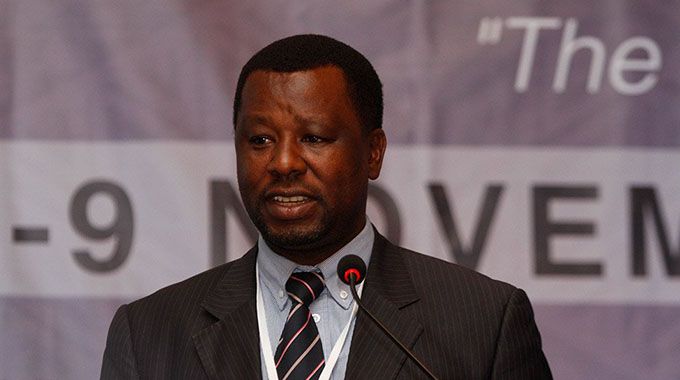
Herald Reporter
A collaborative approach has been called for in the development and implementation of community level climate change adaptation projects to help in the attainment of national development priorities and the global Sustainable Development Goals.
Permanent Secretary in the Ministry of Environment, Climate, Tourism and Hospitality Industry, Mr Munesushe Munodawafa, said there was need for climate action with everyone’s participation and involvement as working together would enable the country to overcome the global challenge.
He was speaking on Tuesday at the inception workshop for the Green Climate Fund (GCF) integrated climate risk management for food security and livelihoods in Zimbabwe project, which will focus on Masvingo and Rushinga districts.
The initiative aims at directly supporting long-term adaptation to the impacts of climate change and variability of 10 000 vulnerable and food insecure households — 50 000 people of which 66 percent are women — in Masvingo and Rushinga districts. In total, the initiative targets to benefit 102 000 people. Zimbabwe’s Vision 2030 of becoming an upper middle income economy is anchored on the gains from agriculture, with Government reiterating the importance of building resilience to climate shocks by smallholder communities.
“As we all know, the economy of Zimbabwe and the livelihoods of its rural communities are highly vulnerable to climate change due to their over reliance on rain-fed agriculture, Rushinga and Masvingo districts have not been spared,” said Mr Munodawafa.
“The districts normally experience poor and uneven rainfall distribution with frequent and prolonged mid-season dry spells and very high temperatures coupled with extreme weather events such as floods and tropical cyclones.
“This has caused a decline in agricultural production thus threatening livelihoods of the rural communities. As a country, we are therefore faced with the task of enhancing preparedness and ensuring that our socio-economic sectors are climate-proofed in order to withstand and cope with the impacts of climate change. Strengthening the early warning system for agriculture is very imperative.”
Mr Munodawafa said Government had been instrumental in strengthening and facilitating the enabling environment for climate action through enactment of a robust policy framework guided by a National Climate Policy and a National Climate Change Response Strategy (NCCRS) and the on-going National Adaptation Planning process.
The project is expected to jumpstart the implementation of one of the first concrete adaptation projects being financed by the Green Climate Fund (GCF) in Zimbabwe and co-financed by the Swiss Agency for Development and Cooperation (SDC) and implemented by the United Nations’ World Food Programme (WFP), in collaboration with the Ministry.
“This project comes at an opportune time as we move from adaptation planning into real action as guided by the National Development Strategy 1 (NDS1).
“NDS1 has mainstreamed climate change across all its thematic areas recognising the cross-cutting nature of climate change and the need to consider climate change in all developmental aspects,” said Mr Munodawafa.
Zimbabwe has standing commitments on greenhouse gas emissions reduction to the United Nations Framework Convention on Climate Change (UNFCCC) and its Paris Agreement through the Nationally Determined Contributions (NDCs).
In September 2021, Cabinet approved Zimbabwe’s revised NDC to the UNFCCC, which commits to a 40 percent per capita emissions reduction target by 2030.
“As we move into the implementation of these commitments, it is the Government’s wish to bring on board as many partners to work on the various aspects of these commitments.
“This project, as I see it, will very much contribute to the adaptation component of the revised NDC with some potential mitigation co-benefits. As we begin the year 2022 and scale up implementation of NDS1, I would like to call upon all of you, to collaborate with my Ministry in the development and implementation of community level climate change adaptation projects towards enhancing adaptive capacity. This will contribute towards attainment of Zimbabwe’s own national development priorities and the global Sustainable Development Goals,” he said.
The Environment ministry is ready to play a part in supporting implementation of the project through its cycle.
Government has adopted the Pfumvudza/Intwasa concept, which is a climate smart agriculture initiative aimed at improving food security in drought prone areas.



 Online Reporter